

Pre-requisite to understand this
Basic Networking Knowledge: Understanding of IP routing and data forwarding.
OSI Model: Familiarity with the OSI layers, particularly Layer 2 (Data Link) and Layer 3 (Network).
Packet Switching: Familiarity with how packets are forwarded in a traditional IP network.
Introduction
MPLS (Multiprotocol Label Switching) is an advanced networking technology used to speed traffic across complex networks, especially in large-scale environments such as Internet Service Providers (ISPs) and enterprise-level infrastructures. MPLS works by attaching a small, fixed-length label to data packets, allowing network devices to forward them more efficiently and bypassing the need for complex lookups of destination IP addresses. It is often used for applications that require reliable, low-latency communication, such as voice and video, and allows for traffic engineering, VPN services, and improved quality of service (quality of service).
What problem can we solve with this?
MPLS solves several challenges in large-scale networks, including inefficiencies in traditional IP routing, the need for traffic management, and scalability issues. MPLS enables faster packet forwarding, greater control over traffic routing, and the ability to handle complex network configurations. It also improves network performance by prioritizing critical traffic and providing a flexible framework for different protocols.
Problems MPLS Solves
Slow Packet Forwarding: In traditional IP networks, routers perform a time-consuming lookup of the destination IP address in routing tables. MPLS improves this process by using labels, which are more efficient.
Lack of Traffic Engineering: Without MPLS, traffic management is typically less precise, leading to congestion and inefficiencies. MPLS enables precise control over traffic paths and bandwidth allocation.
Quality of Service (quality of service): MPLS enables better traffic prioritization, which is crucial for real-time applications such as VoIP, video conferencing, and critical business applications.
Scalability Issues: Large networks can become difficult to manage without proper traffic control. MPLS offers a scalable method of routing and traffic management.
Lack of VPN Support: MPLS allows for the creation of virtual private networks, which are essential for securely connecting remote locations.
Complexity in Routing: MPLS allows networks to handle complex routing decisions, often resulting in more optimal paths and lower latency.
How to implement/use this?
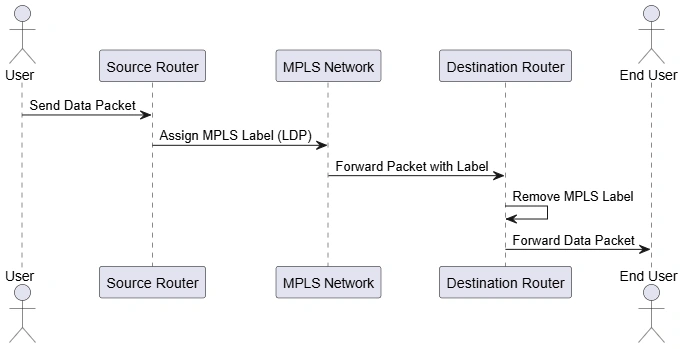
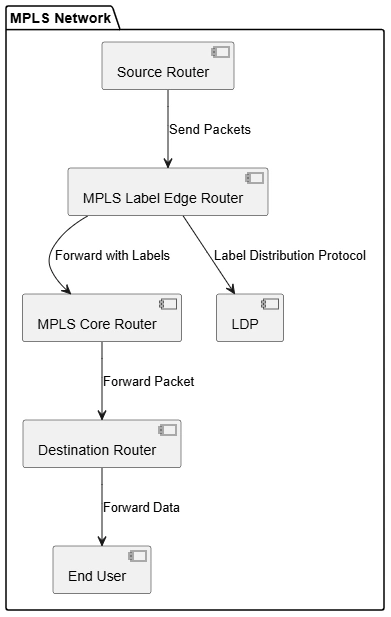
Implementing MPLS in a network involves several key steps, including setting up MPLS on the routers, configuring Label Distribution Protocol (LDP) for label assignment, and creating Label-Switched Paths (LSPs) for data transmission. Once MPLS is set up, network administrators can define traffic policies to control the flow of data, ensuring that critical applications get priority and that network resources are used optimally. MPLS can be integrated into existing IP networks without major changes, but it does require specialized hardware and software that supports MPLS.
Steps for Implementing MPLS
Router Configuration: Enable MPLS on routers in the network and configure necessary interfaces.
Label Distribution Protocol (LDP): Set up LDP for label assignment and distribution between routers.

Join the conversation! Your thoughts help the community grow.