Multithreading in Java

This article explains how to perform a single and multiple tasks using multiple threads.

Performing single task

If we need to perform a single task using multiple threads then we need to use only one/single run() method.
Example
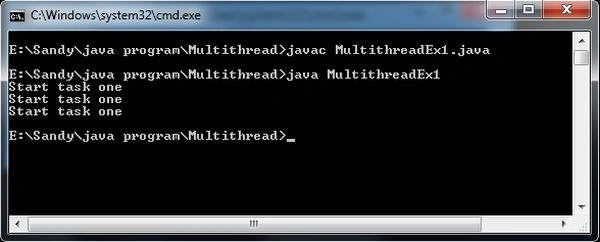
In this example, we simply extend the thread and perform a single task using multiple threads.
  1. class MultithreadEx1 extends Thread
  2. {
  3. public void run()
  4. {
  5. System.out.println("Start task one");
  6. }
  7. public static void main(String args[])
  8. {
  9. MultithreadEx1 th1 = new MultithreadEx1();
  10. MultithreadEx1 th2 = new MultithreadEx1();
  11. MultithreadEx1 th3 = new MultithreadEx1();
  12. th1.start();
  13. th2.start();
  14. th3.start();
  15. }
  16. }
Output
Fig-1.jpg
Example 2
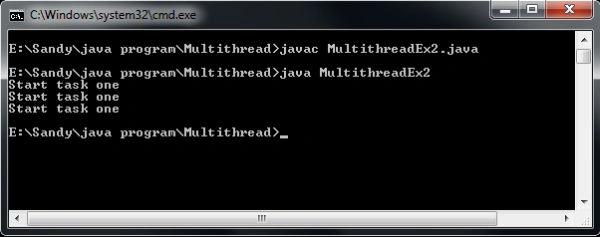
In this example we use the Runnable interface instead of extending threads.
  1. class MultithreadEx2 implements Runnable
  2. {
  3. public void run()
  4. {
  5. System.out.println("Start task one");
  6. }
  7. public static void main(String args[])
  8. {
  9. Thread th1 = new Thread(new MultithreadEx2());
  10. Thread th2 = new Thread(new MultithreadEx2());
  11. Thread th3 = new Thread(new MultithreadEx2());
  12. th1.start();
  13. th2.start();
  14. th3.start();
  15. }
  16. }
Output
Fig-2.jpg

Performing multiple tasks

To perform multiple tasks by multiple threads, we need to use multiple run() methods.
Example 1
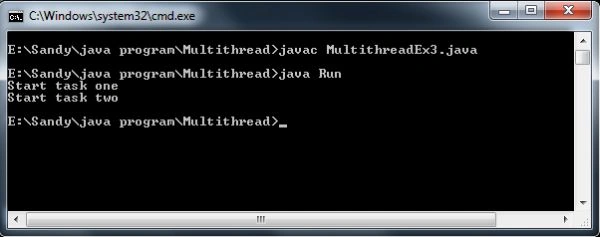
In this example; we need to extend the thread to perform multiple tasks.
  1. class MultithreadEx3 extends Thread
  2. {
  3. public void run()
  4. {
  5. System.out.println("Start task one");
  6. }
  7. }
  8. class MultithreadEx4 extends Thread
  9. {
  10. public void run()
  11. {
  12. System.out.println("Start task two");
  13. }
  14. }
  15. class Run
  16. {
  17. public static void main(String args[])
  18. {
  19. MultithreadEx3 th1 = new MultithreadEx3();
  20. MultithreadEx4 th2 = new MultithreadEx4();
  21. th1.start();
  22. th2.start();
  23. }
  24. }
Output
fig-3.jpg
Example 2
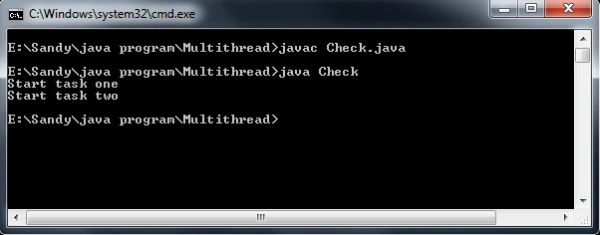
In this example, we use an anonymous class that extends the Thread class.
  1. class Check
  2. {
  3. public static void main(String[] args)
  4. {
  5. Thread th1 = new Thread()
  6. {
  7. public void run()
  8. {
  9. System.out.println("Start task one");
  10. }
  11. };
  12. Thread th2 = new Thread()
  13. {
  14. public void run()
  15. {
  16. System.out.println("Start task two");
  17. }
  18. };
  19. th1.start();
  20. th2.start();
  21. }
  22. }
Output
Fig-4.jpg
Example 3
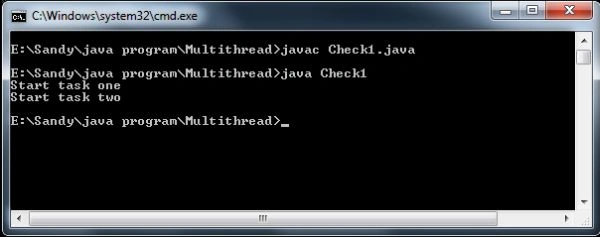
In this example, we use an anonymous class that implements the Runnable interface.
  1. class Check1
  2. {
  3. public static void main(String[] args)
  4. {
  5. Runnable run1 = new Runnable()
  6. {
  7. public void run()
  8. {
  9. System.out.println("Start task one");
  10. }
  11. };
  12. Runnable run2 = new Runnable()
  13. {
  14. public void run()
  15. {
  16. System.out.println("Start task two");
  17. }
  18. };
  19. Thread th1 = new Thread(run1);
  20. Thread th2 = new Thread(run2);
  21. th1.start();
  22. th2.start();
  23. }
  24. }
Output
fig-5.jpg