Reducing Google Cloud Platform costs has become a critical priority for CTOs, architects, founders, and engineering leaders. Many organizations move to Google Cloud for its data, AI, and Kubernetes strengths, expecting flexible pricing and efficient scaling. What often follows is a monthly bill that grows faster than anticipated, even when workload demand remains stable.
The issue is not Google Cloud pricing itself. The root cause is that most GCP environments are designed without a cost first architecture, without governance, and without continuous optimization. Once inefficient configurations are deployed, unnecessary spend compounds quietly over time.
Industry studies consistently show that organizations waste nearly 30 percent of their cloud budgets due to over provisioned compute, idle resources, inefficient storage tiers, and lack of cost accountability. This article explains how to reduce Google Cloud costs using proven, production tested strategies rather than theoretical best practices.
Why Google Cloud Costs Increase Unexpectedly
Google Cloud follows a usage based pricing model, but many teams treat it like traditional infrastructure. Compute Engine instances are sized for peak load instead of real usage. Kubernetes clusters are over allocated. Persistent disks are oversized. Data egress and inter region traffic are overlooked. Discounts and committed use opportunities are underutilized.
Google Cloud charges exactly for what is provisioned and consumed. Inefficient design results in predictable overspending.
Real World Google Cloud Cost Reduction Examples
Google Cloud cost optimization delivers tangible results when approached systematically.
In one production analytics platform, annual GCP costs were reduced by more than 55 percent after rightsizing Compute Engine instances, moving batch workloads to preemptible VMs, optimizing BigQuery queries, and committing to sustained and committed use discounts.
In another SaaS environment running heavily on GKE, costs dropped by nearly 45 percent by optimizing pod requests and limits, reducing node pool sizes, implementing cluster autoscaling, and moving non critical workloads to lower cost regions.
At enterprise scale, idle persistent disks, oversized Kubernetes clusters, inefficient BigQuery usage, and uncontrolled data egress are often the biggest contributors to wasted spend. Addressing these systematically results in consistent cost reductions of 30 to 50 percent.
Google Cloud savings are architectural, not accidental.
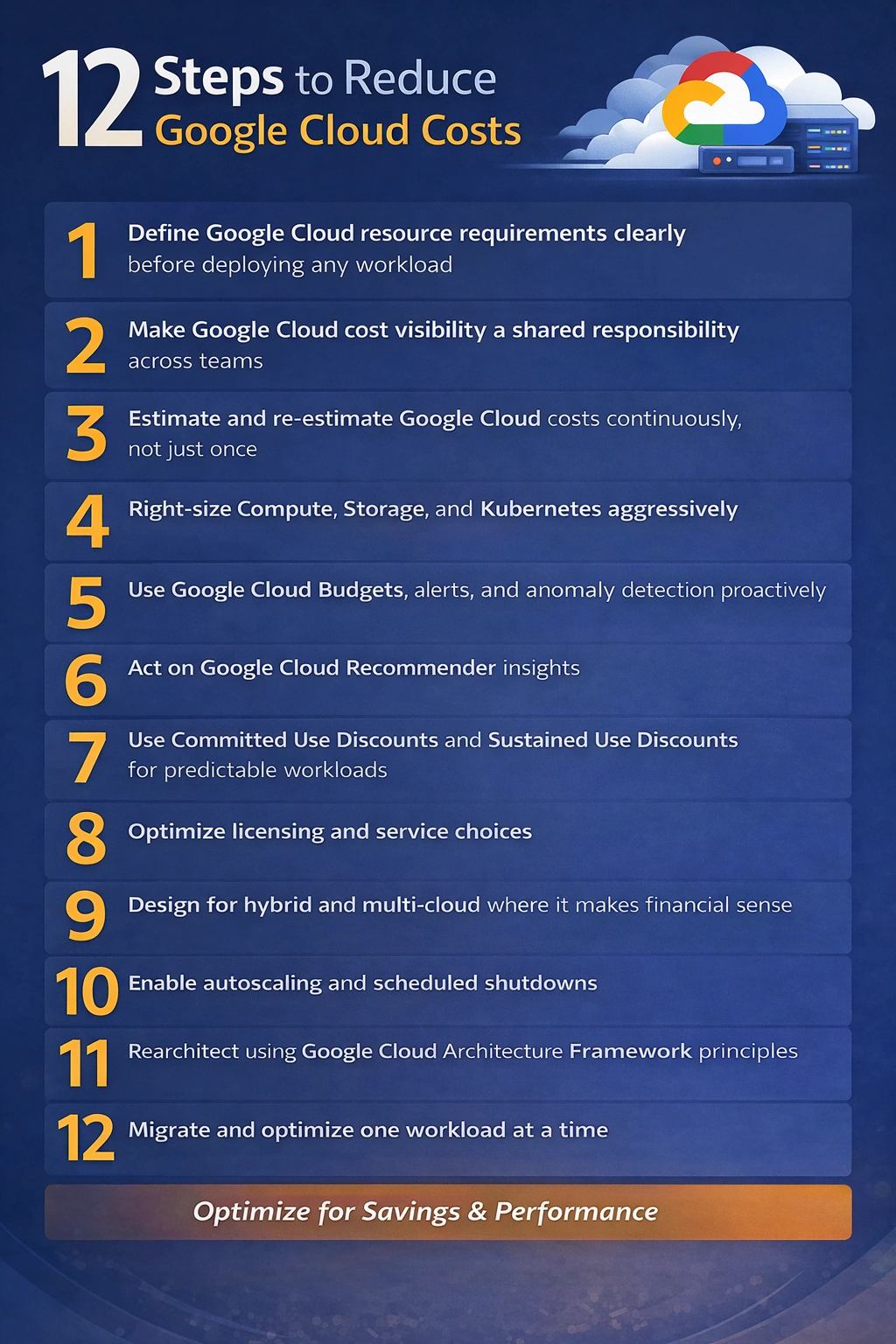
Step 1 Define Google Cloud Resource Requirements Clearly Before Deployment
Most GCP cost issues begin before deployment. Teams often migrate workloads from on premises or other clouds without revisiting architecture assumptions.
Each workload should define expected traffic patterns, scaling behavior, availability requirements, data locality, compliance constraints, and performance expectations. Business owners, architects, DevOps teams, and finance must align on these assumptions early. When requirements are unclear, over provisioning becomes inevitable.
Step 2 Make Google Cloud Cost Visibility a Shared Responsibility
Google Cloud cost optimization fails when only finance teams monitor spend. Engineering teams must understand how their decisions impact costs.
Effective organizations use labels consistently, allocate costs by project and service, restrict access to expensive resources through IAM policies, and conduct regular cost reviews with engineering leadership. When teams see cost data alongside performance metrics, behavior changes quickly.
This is where Mindcracker Inc adds immediate value. Independent Google Cloud cost audits often uncover idle resources, inefficient architecture, and missed discount opportunities that internal teams overlook.
https://www.mindcracker.com/contact-us
Step 3 Estimate and Re Estimate Google Cloud Costs Continuously
Many teams estimate Google Cloud costs once during planning and never revisit assumptions. This guarantees drift.
Google Cloud Pricing Calculator and Billing Reports should be reviewed continuously. Usage patterns change, workloads grow, and pricing models evolve. Organizations that re estimate costs quarterly consistently spend less than those that do not.
Step 4 Right Size Compute Storage and Kubernetes Aggressively
Right sizing is the fastest way to reduce GCP costs.
Compute Engine instances, GKE node pools, Cloud SQL databases, and persistent disks are often oversized. Start with conservative allocations, monitor metrics through Cloud Monitoring, and scale only when justified by real usage.
Preemptible VMs are underutilized and can reduce compute costs significantly for batch processing, analytics jobs, CI pipelines, and non critical workloads.
Step 5 Use Google Cloud Budgets Alerts and Anomaly Detection Proactively
Google Cloud Billing should be treated as an operational tool, not just a finance report.
Budgets, alerts, and spend anomaly detection help teams catch cost spikes early. Monitoring costs daily exposes inefficient usage patterns before they become expensive habits. Discovering overspend at month end means optimization is already late.
Step 6 Act on Google Cloud Recommender Insights
Google Cloud Recommender provides recommendations based on actual usage data, including rightsizing compute resources, optimizing idle workloads, and reducing unnecessary spend.
Teams that review Recommender insights regularly reduce waste without major architectural changes.
Step 7 Use Committed Use Discounts and Sustained Use Discounts
For predictable workloads, Committed Use Discounts offer substantial savings on compute and database services. Sustained Use Discounts apply automatically for long running workloads.
Production systems, databases, and core services benefit the most. The key is committing only to workloads with stable demand.
Step 8 Optimize Licensing and Service Choices
Many organizations overspend by choosing premium services where standard options would suffice. Selecting the right machine types, storage classes, and managed services has a direct impact on long term cost.
Service selection matters as much as scaling strategy.
Step 9 Design for Hybrid and Multi Cloud Where It Makes Financial Sense
Google Cloud does not need to host every workload. Some services may be cheaper or better suited outside GCP, such as CDN providers, messaging services, or specialized analytics platforms.
Google Cloud excels in data analytics, AI, and Kubernetes. Strategic workload placement delivers better cost efficiency than forced consolidation.
Step 10 Enable Autoscaling and Scheduled Shutdowns
Non production environments are one of the largest sources of wasted spend in Google Cloud. Development, testing, and staging systems rarely need to run continuously.
Autoscaling, scheduled shutdowns, and infrastructure as code policies often reduce non production costs by 30 to 60 percent without impacting productivity.
Step 11 Rearchitect Using Google Cloud Architecture Framework Principles
Cost optimization is not only about tuning resources. It is about design.
The Google Cloud Architecture Framework encourages selecting the right compute model for each workload. Serverless, event driven, and container optimized architectures often outperform traditional VM heavy designs in both scalability and cost efficiency.
Step 12 Migrate and Optimize One Workload at a Time
Large scale migrations executed all at once increase risk and cost.
Successful Google Cloud transformations migrate incrementally, validate assumptions early, optimize continuously, and apply lessons learned to subsequent workloads. This approach minimizes risk and prevents architectural debt from spreading.
How Mindcracker Inc Helps Organizations Reduce Google Cloud Costs Long Term
Google Cloud cost optimization is not a one time cleanup exercise. It is an ongoing operating model.
Mindcracker Inc helps organizations assess Google Cloud environments, audit billing and usage, redesign architectures using Google Cloud best practices, implement governance, and continuously optimize workloads as usage evolves.
If your Google Cloud bill feels higher than it should be, it probably is.
https://www.mindcracker.com/contact-us
Final Thoughts
Google Cloud can significantly reduce infrastructure costs when used intentionally. Organizations that treat cloud platforms as strategic systems rather than rented infrastructure consistently outperform peers on cost, scalability, and reliability.
Cost optimization is not a one time task. It is a discipline. The earlier it becomes part of your Google Cloud operating model, the faster the savings compound.


Join the conversation! Your thoughts help the community grow.