

Pre-requisite to understand this
Basic understanding of REST APIs
HTTP methods (GET, PUT, POST, DELETE)
Object storage concepts (bucket, object, metadata)
Cloud storage services (AWS S3, MinIO, Ceph, etc.)
Understanding of authentication & authorization (Access Key / Secret Key)
Awareness of client-server architecture
Introduction
An S3-compatible API is an object storage interface that follows the same API conventions and behavior as Amazon Simple Storage Service (Amazon S3). It allows applications written for AWS S3 to interact seamlessly with other storage systems that implement the same API standard. These storage systems can be cloud-based, on-premises, or hybrid, enabling portability and interoperability without changing application code.
What problem we can solve with this?
The S3-compatible API solves the problem of vendor lock-in and storage interoperability by providing a standardized object storage interface.
Problems addressed:
Dependency on a single cloud provider
Difficulty in migrating storage between vendors
Inconsistent APIs across storage platforms
Complex application rewrites when changing storage backend
Problems solved:
Write once, run anywhere storage access
Easy migration between AWS S3 and alternatives
Unified access pattern for multiple storage systems
Cost optimization by switching providers
How to implement/use this?
To implement or use an S3-compatible API, applications interact with an object storage service using standard S3 operations such as PutObject , GetObject , and DeleteObject . The storage backend could be AWS S3 or any S3-compatible system like MinIO, Ceph, Wasabi, DigitalOcean Spaces, or OpenStack Swift (S3 layer).
Steps to implement:
Choose an S3-compatible storage provider
Create buckets to store objects
Generate Access Key & Secret Key
Configure SDKs or CLI with credentials
Perform object operations using S3 API calls
Common tools:
AWS SDKs (Java, Python, Go, Node.js)
AWS CLI
Sequence Diagram (S3 API Flow)
This sequence diagram shows how a client uploads an object using an S3-compatible API.
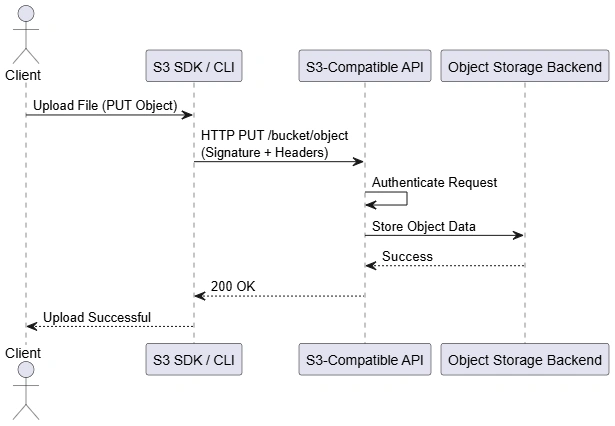
Step-by-step flow:
Client initiates an upload request
SDK signs the request using AWS Signature v4
S3-compatible API validates credentials
Object is stored in the backend
Success response is returned
In an S3-compatible architecture, the client never interacts with the underlying storage directly; all requests are routed through the S3-compatible API layer, which abstracts the storage implementation. Every request must be authenticated using secure credentials, ensuring that only authorized users or applications can access or modify data. The API strictly follows AWS S3 request and response semantics, including signing mechanisms and error handling. This consistency allows existing S3-based tools and applications to work seamlessly. Together, these principles provide security, portability, and predictable behavior across different storage systems.
Component Diagram (Architecture)
This component diagram shows the logical architecture of an S3-compatible storage system.
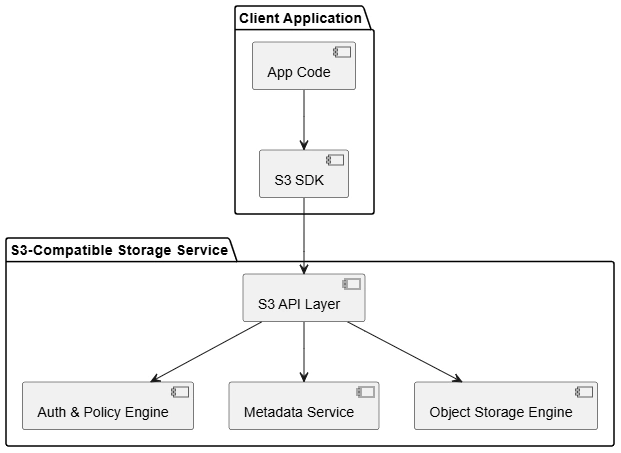
Component roles:
App Code: Business logic using storage
S3 SDK: Handles API requests and signing
S3 API Layer: Exposes S3-compatible endpoints
Auth & Policy Engine: Validates access rights
Metadata Service: Tracks buckets and objects
Object Storage Engine: Stores actual data
An S3-compatible system follows a decoupled architecture where the API layer, authentication, metadata management, and storage engine operate independently. This separation allows each component to scale or evolve without impacting others, resulting in a scalable and extensible design. The backend storage implementation is flexible and can be based on a local filesystem, block storage, or a fully distributed storage system. Such flexibility enables deployments across on-premises, cloud, or hybrid environments while maintaining the same S3 API interface.
Abstract Base Class in C# (S3-Compatible Contract)
using System.IO;
using System.Threading.Tasks;

public abstract class S3CompatibleStorage
{
    protected string AccessKey;
    protected string SecretKey;
    protected string Endpoint;

    protected S3CompatibleStorage(string accessKey, string secretKey, string endpoint)
    {
        AccessKey = accessKey;
        SecretKey = secretKey;
        Endpoint = endpoint;
    }

    // Bucket operations
    public abstract Task CreateBucketAsync(string bucketName);
    public abstract Task DeleteBucketAsync(string bucketName);

    // Object operations
    public abstract Task UploadObjectAsync(string bucketName, string objectKey, Stream data);
    public abstract Task<Stream> GetObjectAsync(string bucketName, string objectKey);
    public abstract Task DeleteObjectAsync(string bucketName, string objectKey);
}
The Abstract Base Class (S3CompatibleStorage) defines a common contract for any storage system that claims to be S3-compatible. It specifies what operations must be supported (such as bucket and object operations) without dictating how those operations are implemented. This design enforces consistency across different storage providers while keeping the implementation flexible.
At the core, the class stores shared configuration such as AccessKey, SecretKey, and Endpoint, which are required by all S3-compatible services for authentication and communication. By placing these in the base class, duplication is avoided across concrete implementations like AWS S3 or MinIO.
The abstract methods (e.g., CreateBucketAsync, UploadObjectAsync, GetObjectAsync) act as a formal API contract. Any class inheriting from this base class must provide concrete implementations for these methods, ensuring that all providers expose the same behavior and capabilities.
Overall, this abstract base class enables decoupled architecture, provider independence, and easy extensibility. Application code can depend on this abstraction instead of a specific vendor SDK, making it simple to switch or add new S3-compatible storage backends without changing business logic.
Advantages
Seamless migration from AWS S3
Compatible with existing tools and SDKs
Supports hybrid and multi-cloud strategies
Scalable and cost-effective
Industry-standard API's
Summary
The S3-compatible API is a powerful abstraction that standardizes object storage access across multiple platforms. By mimicking Amazon S3’s API behavior, it allows applications to remain storage-agnostic, reduces vendor lock-in, and simplifies migration and scaling strategies. With well-defined REST operations, strong authentication mechanisms, and widespread tooling support, S3-compatible storage has become the de facto standard for modern object storage systems.
Join the conversation! Your thoughts help the community grow.