

Be a Thinker First, Then a Doer
Coverage Topic
- Underscore(_) or not underscore with the private member variable
- Golden Hammer - Anti-Pattern
- Personal Preference vs. Best Practice
- Best Practice Guidance
- Shouldn't use var everywhere
- When to use 'var'
- When 'var' can't be used
Let's Drill Down the Basic Concept
The Problem
Adam Rusch is my colleague and he is working as "Dot-Net C# developer" in a team. Code-review is the part of his job responsibility. So, during code review, he was confused about the coding standard for the private member variables. He means, some people use underscore with private variables and some peoples use camel case with private variables. Another issue he knows about is why var was introduced; but now people are using “var” everywhere as a data-type. He is considering C# as a programing languages and .NET as a development platform.
Naming Convention for Private Member Variables
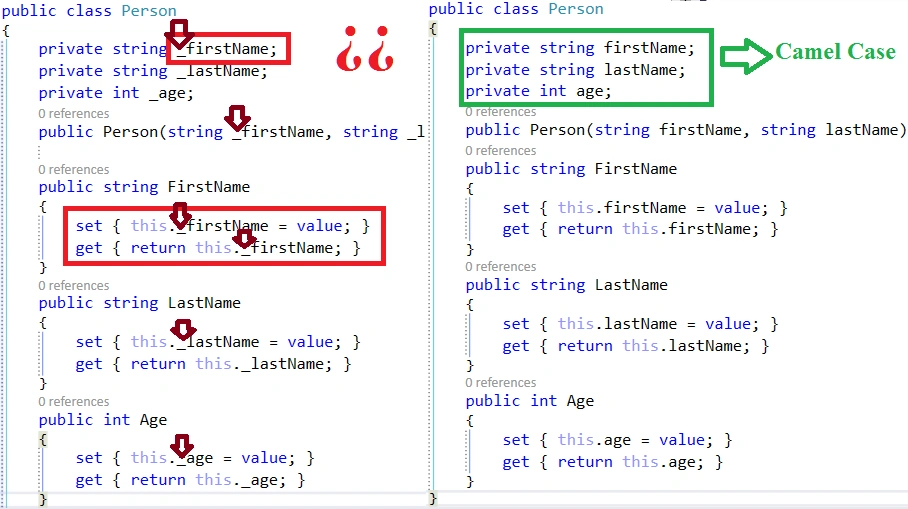
Question
Adam asked me, which convention is standard with underscore or without underscore according to the best practice guidance?
Answer
I said, it depends on the personal preference of the developer; because some people don't follow the standard guidelines, they have their own preference.
But Adam was not satisfied with the answer. Because, if everybody follows his/her own preference then it's difficult to review and maintain for another person.
Investigation to Underscore or not to Underscore
Few programing languages are case-insensitive, for example, say, Visual Basic (old version). In the VB, there is no difference between pascal case (i.e., VariableName) and camel case (i.e., variableName). Therefore, they have to use underscore with the private member variable (i.e, _variableName).
C# is a case sensitive programing language and it knows the difference between pascal-case (VariableName) and camel-case (variableName).
Therefore,
- If C# is a case sensitive programing language, then why am I using underscore (_) prefix before private member variable?
- What is the extra benefit to use the underscore(_) prefix before private member variable?
- Am I a doer only? Few people are following an exceptional convention and so why am I using the same convention?
- Is it the beauty of readability?
- In the best practice guidelines, it is clearly suggested that using camel-case for the private variable, so then what is the problem to follow the general guidelines?
- If people use the underscore with the private variables, then this is an exceptional case. Exception is not an example for the best practice, then why aren't they thinking out of the box?
Solution
Be a THINKER first, then a DOER.
Real-life Investigation
- In C++, underscore was used for private variables. Hungarian notation(i.e, 'm_') was used as a prefix with member variables for MFC. But current practice states "Don't use underscores at-all".
- If I have the same name for the private variables and parameters, then I'm using underscore to avoid the problem. This is not a good reason to use underscore in C#. What happen if people start to use underscore with the parameters?
- Only use underscore, if you are writing unit testing methods. In BDD naming convention, underscore is used with test methods to make it more readable.
For example

- If I use any intelligence tool and if it doesn't have best practices as a default (say default is underscore with private variable), then there is an option to change the default settings.
- I know programing very well to solve any problem quickly. I have implemented hundreds of applications. But if I used to write code according to my personal preference, then it doesn't mean that I know all of the best practices.
Remember, tomorrow doesn't come; but tomorrow NEVER dies.
Underscore vs. this
- If I use same name for the private variables and parameters, then I have to use '
this' with private variable. - This is good practice, if you use 'this' for all references of the private variables.
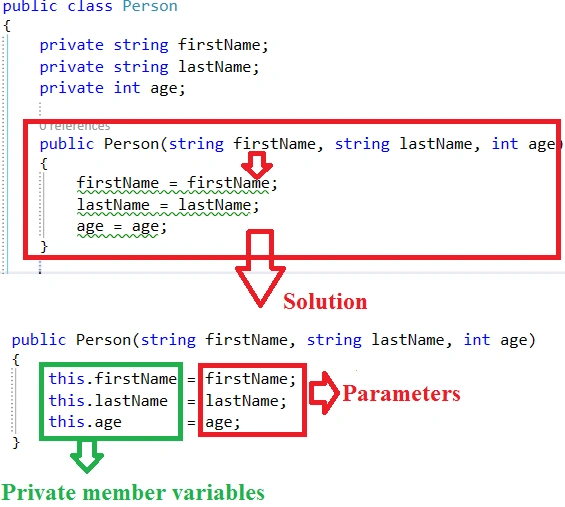
Underscore is a Thorn for Private Variable
- Doctor sometimes uses drugs as a treatment to the patient; but now if general people start to use the same drug for their pleasure, then this is illegal; because it is harmful for the human body.
- If I'm in the Amazon rainforest as a survivor game changer, then it's okay to eat some raw food because, there is no alternative option. It doesn't mean that - in my real life, every time I will eat that raw food.
Similarly, I'm writing code using VB (old) or C++. So, in VB, there is no difference between Pascal case (i.e, VariableName) and camel case (i.e., variableName). Therefore, I am using underscore with the private member variable (i.e., _variableName). It doesn't mean that this is the standard for all of the languages.
Therefore the most worst excuse,
- I'm used to use underscore with the private variable
- I personally believe that it is the best.
- I have self-explanation that it is easy to find out the private member variables or easy to read
- I don't need to write 'this' with private variables.
- I don't need to use 'this' when both private variables and parameters have the same name or bla- bla reasons.
Moral Points
I know, some programing languages use underscore. Because, they have some explanation for that.
- Now I want to fit the underscore everywhere. Even I know that C# doesn't have any limitation that it needs to use underscore with private variables. But I want to fit it by hook or by crook.
- This is my personal preference and I'm writing it only for me; in future, nobody needs to maintain it.
- I don't need to worry about the other team members or the best practice guidance.
- Even I am leading a team and I am advising the team members to do the worst practice like me.
These kind of immature thoughts are one kind of anti-pattern such as GOLDEN HAMMER.
I am not writing the code only for the machine or myself. If so, then it doesn't need modern languages, in general, it just knows only 0 and 1.
Remember, I am writing code for humans; so that different people can maintain it. If I write code for me only, then I don't need to follow any best practices. In these case, my personal preference is enough.
Golden Hammer - Anti-Pattern
"If all you have is a hammer, everything looks like a nail."
I'm using particular technology, tools, methodology or architecture to solve all kinds of problems; although I know that there are alternative and better solutions to solve that problem, only because, I'm familiar and used to it.
Personal Preference vs. Best Practice
Definition of best practices:
"A procedure or set of procedures that is preferred or considered standard within an organization, industry, etc."
Think, why do you need international language? Why aren't you communicating using your local or personal preferred languages to the world? We all know the answer, I'm avoiding it to make it short.
If you follow the best practice guidelines, then there is no question at-all. Although, there are some exceptions and they are used to it. They don't care about the best practice. But exception is not the best example to follow. If you follow that, then sometimes be ready to face "okay, but ...".
Best Practice
- Don't use Hungarian notation
- Don't use an Underscore prefix for private member variables.
- Do use camel casing for private member variables
- Do use 'this' for all references of the private variables.(For VB, use 'me')
Keep personal preferences aside, pick the best technique to solve the problem.
General naming convention from Microsoft - "Don't use underscore and Hungarian notation".
References


Improper Use of 'VAR' Everywhere

Have Questions
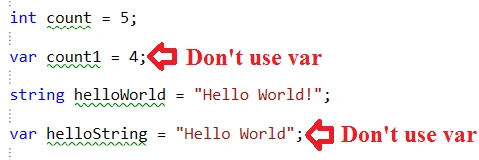
- In the above example, is there the beauty of readability?
- Why am I using var for a simple declaration?
- Why can't I say that, these kinds of improper use, are an anti-pattern?
Investigation to var or not to var
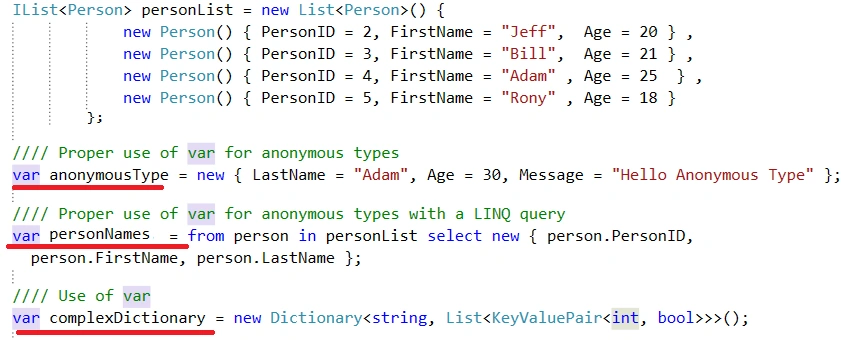
'var' should not be used in simple declarations, as shown below:
When Must 'var' be Used
- Should be used in LINQ
- Should be used with anonymous types.
When Can't It Be Used
There is a restriction, declaring local variables within the method or property, including iteration variable in 'for' or 'foreach' statements.
- As a type of field
- As a type of parameter
- As a return type of method or property
- As a type parameter in generic type or method
Solution
First, be a thinker, then a doer.
Anti-Pattern using VAR Everywhere
Why was var introduced? It was introduced for LINQ, anonymous types, etc.
Now if I use it everywhere, then it is one kind of anti-pattern such as Golden Hammer. So, avoid the anti-pattern. Because, it is like a thorn for the software development. It is better to avoid type guessing.
Please note:
I apologize, if I hurt your feelings. This is mainly a focus on the best practices in C# language. Few people who are used to their personal preference, this article is not pointing at them. This is general guidance for new developers.
Aydar SPosted Dec 22, 2025, 9:43 PM
It seems like best practice you're referring to is somewhat 15-20 years old. Current C# documentation suggest using _ for private members: https://learn.microsoft.com/en-us/dotnet/csharp/fundamentals/coding-style/identifier-names. "Best Practice" do change over time as industry/language evolves. Also, you suggest to think first and then do, so blindly following "best practice" suggested by someone is not necessarily right thing to do.
Your EnemyPosted Jan 2, 2024, 10:01 AM
Im butt hurt now. The reason i use and recommend using the three different cases of: _case, case and Case, is because there are three types of variables i want to differentiate between at a glance. Private class scoped variables, locally scoped variables and public variables. ClassScope: case, locallyscoped: _case, public:Case. Especially when you're deep in a function this not only saves time but also adds to the readibility.
Wasiqul IslamPosted Jul 17, 2023, 11:33 AM
You can find that Microsoft recommended convention is to use _ for private member variables. Reference: https://learn.microsoft.com/en-us/dotnet/csharp/fundamentals/coding-style/coding-conventions
ThiPosted Feb 5, 2021, 6:03 AM
No! Use VAR everywhere.
Jeff ScorowPosted Jul 21, 2020, 6:25 PM
No! Use VAR everywhere. After five years, I have yet to run into a single case where it's caused me trouble. This article claims an *extremely* unlikely case is going to happen to you. It's not. Enjoy more readable code.
Qubie1 Qubie1Posted May 16, 2019, 6:39 AM
I have always typed private members without underscore. Lately I'm mostly writing wpf applications which means I have a lot of properties with private backing fields. It happened a couple times that I accidently typed the backing field instead of the property in my code. It's sometimes hard to spot these bugs so I'm actually considering using underscores for private members.
Antonio OrtizPosted Feb 1, 2019, 3:04 PM
The core FX standar states: We use _camelCase for internal and private fields and use readonly where possible. Prefix internal and private instance fields with _, static fields with s_ and thread static fields with t_. When used on static fields, readonly should come after static (e.g. static readonly not readonly static). Public fields should be used sparingly and should use PascalCasing with no prefix when used.
Antonio OrtizPosted Feb 1, 2019, 3:03 PM
But what about the corefx standard? https://github.com/dotnet/corefx/blob/master/Documentation/coding-guidelines/coding-style.md
Eduard De JongPosted Jan 19, 2019, 8:30 AM
To me, in the beginning the entire introduction of the var-keyword in a language like C# felt like making it a kind of JavaScript, a language in which explicit type declarations don't even exist (with all the disadvantages that it has), and in which every variable is declared using that "var" word. But I got used to it after some years (for years I have never used it because I actually hated it). I still think that explicit type declaration is a thing of quality. I have never considered it a "boiler plate" that should be removed. Furthermore, I have always learned that the underscore usage is a bad practice and I have heard people saying that you should be using "this." indeed. But now I am very surprised that Visual Studio 2017 (I have been using a much older version of VS before, where "full" property generation was not available in that way yet) now defaults to auto generating property back fields with underscores (when choosing to generate a "full" property)! Is Microsoft itself changing standards?
Marcus JPosted Oct 31, 2018, 9:04 AM
I'm sorry sir, but I must disagree on your stance var. I think var myString = "some String" is a perfect usecase of var, as per the documentation. It saves you from frivolous *over specification*. As you can obviously tell that "my String" is a string. Why write string? It's pointless in my opinion. I will agree that it is overused, and in the case of var someVal = getSomeVal(), I will concede that this is a BAD use case of var as I have no clue what someVal actually is. I would not call using var to simplify self documenting code as a *bad practice*! ~my humble opinion.
Zam EbPosted Jun 27, 2018, 3:51 PM
The approach to encourage to use "this" vs "underscore" is interesting, but in many points it feels like you're fighting against yourself. You call "excuses" to points that you're not discussing at all: being a private variable is a very atractive reason to use "underscore" for some reason that you already mention: clear distinction between private vs parameters. You encourage that "this" is better for that purpose, despite its verbosity. There is also a difference on intellisense, both of them have pros and cons. I dont see a clear unbiassed analysis on it. For example what about code density? And as a bonus, you mention the "var disadvantages". Why to use var? Because you dont need to know the type, only the context: var a = 2 + 2; means 4, doesn't matter if it is a real, double, int or byte. var name = "Pepe"; more of the same. A name is a name, you dont need to know it is a string or not. var person = GetPersonById(); better yet: a person is a person and we should use good variable naming to focus on the business context.
Saravanan VPosted Jun 14, 2017, 3:20 PM
Hi, I just found the article which says when the type of a variable is clear from the context, use var in the declaration. eg. var var1 = "This is clearly a string."; Reference: https://docs.microsoft.com/en-us/dotnet/csharp/programming-guide/inside-a-program/coding-conventions It also says use implicit typing to determine the type of the loop variable in for and foreach loops. What's your view on this?
matthew sheeranPosted Jun 8, 2017, 3:22 AM
It's more than camelCase which is for Parameters it is CamelCase unless a Property requires a private backing Field. Think about it.
Vipin TyagiPosted Jun 7, 2017, 6:00 AM
An amazing read by the way.I enjoyed it seriously.