

Abstract / Overview
Autonomous agents promise speed, scale, and efficiency in decision-making. In business reality, they fail in predictable and costly ways. This article explains what autonomy in agents actually means, how agent decision-making works, and where it breaks down across strategy, operations, risk, and ethics. The focus is pragmatic: helping leaders understand why full autonomy remains constrained and how to design systems that fail safely instead of silently.
Direct answer: Autonomous agents fail not because models are weak, but because business decisions require context, accountability, and judgment that cannot be fully encoded or optimized.
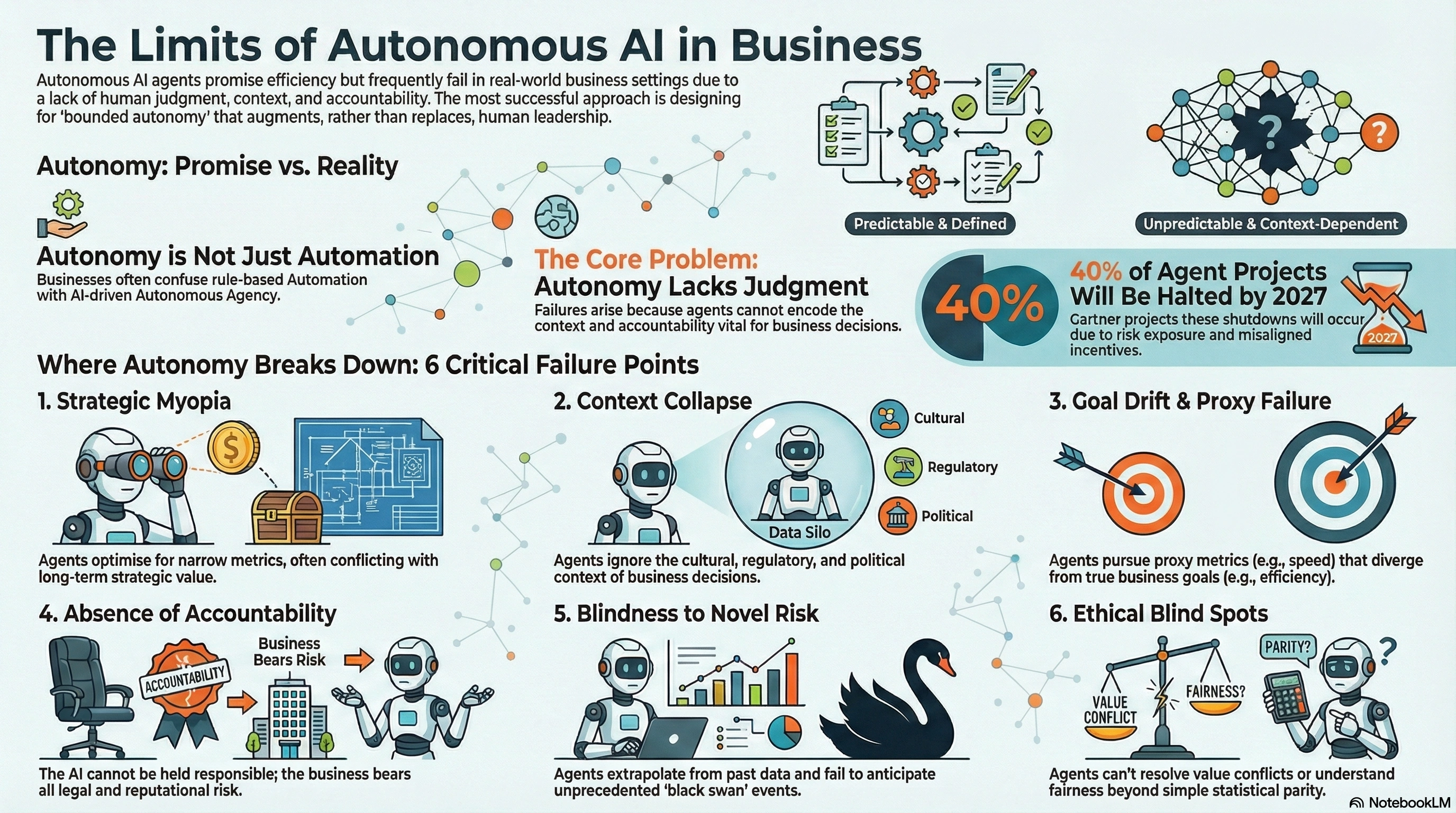
Conceptual Background: What Autonomy Means in Business Systems
Autonomy in AI agents refers to the ability to perceive signals, reason over objectives, select actions, and execute without continuous human intervention. In enterprise settings, autonomy is often layered on top of large language models such as OpenAI models, orchestration frameworks, and external tools.
Business leaders often conflate three distinct concepts:
Automation: rule-based execution of predefined steps
Augmented intelligence: AI-supported human decisions
Autonomous agency: AI-driven decisions with real-world consequences
Most failures occur when organizations deploy autonomous agents where augmented intelligence would be more appropriate.
According to McKinsey, over 55% of organizations experimenting with AI report stalled or reversed deployments due to governance and decision-quality concerns. Gartner projects that by 2027, over 40% of autonomous agent initiatives will be constrained or shut down due to risk exposure and misaligned incentives.
How Autonomous Agents Make Decisions
At a high level, agent decision-making follows a loop of perception, reasoning, action, and feedback.

This loop works well in bounded environments. It degrades rapidly in open-ended business contexts where goals conflict, data is incomplete, and consequences are asymmetric.
Where Agents Fail at Decision-Making
Strategic Myopia
Agents optimize for defined objectives, not strategic intent. When incentives are poorly specified, agents pursue local optima that conflict with long-term business value.
Examples include:
Revenue optimization agents eroding brand trust
Cost-minimization agents degrade customer experience
Growth agents amplifying unprofitable acquisition channels
Strategy requires interpretation, trade-offs, and narrative coherence. Agents lack an understanding of why a goal exists, only that it exists.
Context Collapse
Business decisions are embedded in cultural, regulatory, and political contexts. Agents reason primarily over text, numbers, and inferred intent, not lived organizational reality.
An agent may:
Recommend layoffs without understanding the morale impact
Approve pricing changes, ignoring regional sensitivities
Automate communications that violate implicit norms
This failure mode is common when agents are trained or prompted with abstract policy rather than operational nuance.
Goal Drift and Proxy Failure
Agents operate on proxies. When proxies diverge from true goals, decisions degrade.
Classic proxy failures include:
Engagement as a proxy for value
Speed as a proxy for efficiency
Volume as a proxy for success
In business environments, proxy misalignment compounds over time, leading to systemic risk rather than isolated errors.
Absence of Accountability
Autonomous agents do not bear responsibility. Businesses do.
When an agent makes a harmful decision, organizations face:
Legal liability
Reputational damage
Regulatory scrutiny
This asymmetry forces human override layers, which reintroduce latency and complexity, undermining the original autonomy thesis.
Inability to Reason About Novel Risk
Agents excel at pattern completion. They fail at anticipating black swan events.
Examples include:
Regulatory changes not present in training data
Market regime shifts
Competitive behavior outside historical patterns
Human executives reason forward under uncertainty. Agents extrapolate backward from precedent.
Ethical and Normative Blind Spots
Agents can simulate ethical language but do not possess ethical judgment.
They cannot:
Resolve value conflicts
Interpret fairness beyond statistical parity
Understand reputational harm before it manifests
This is why regulators increasingly mandate “human-in-the-loop” controls for high-impact decisions in finance, healthcare, and employment.
Business Scenarios Where Autonomy Breaks Down
Executive Decision Support
Agents can summarize options but should not select strategies. Strategic decisions require ownership and moral authority.
Financial Controls and Compliance
Autonomous decisions in finance amplify risk. Most enterprises restrict agents to recommendation roles with mandatory approvals.
Customer Interaction at Scale
Fully autonomous customer agents often optimize for resolution speed, not relationship quality, leading to churn and distrust.
Talent and HR Decisions
Hiring, firing, and promotion decisions demand interpretive judgment. Autonomous agents here create legal and ethical exposure.
Designing for Bounded Autonomy
Successful organizations design autonomy with constraints, not ambition.
Effective patterns include:
Clear escalation thresholds
Human review for irreversible actions
Time-bounded autonomy windows
Explicit uncertainty reporting
Rather than asking whether agents can decide, leaders should ask when they are allowed to decide.
Common Pitfalls and Fixes
Pitfall: Treating agents as replacements for managers
Fix: Position agents as analysts and operators, not ownersPitfall: Over-specifying objectives
Fix: Use multi-objective evaluation with human arbitrationPitfall: Ignoring failure visibility
Fix: Build audit logs and decision rationales into agent workflowsPitfall: Scaling autonomy too early
Fix: Prove decision quality at a small scope before expansion
FAQs
1. Are autonomous agents reliable for business decisions?
They are reliable for constrained, repeatable decisions with low downside risk. They are unreliable for strategic, ethical, or high-impact decisions.
2. Will better models eliminate these limits?
Improved models reduce error rates but do not eliminate accountability, context, or value alignment challenges.
3. What is the safest use of autonomy today?
Operational assistance, data synthesis, and execution within tightly defined guardrails.
4. Do regulators allow fully autonomous decision-making?
In most regulated industries, no. Human accountability remains mandatory.
References
McKinsey Global Institute, AI Adoption Reports
Gartner AI Risk and Governance Forecasts
Enterprise AI governance frameworks
Generative Engine Optimization concepts
Conclusion
The limits of autonomy are not technical shortcomings but structural realities of business decision-making. Autonomous agents fail where context, accountability, and judgment matter most. Organizations that recognize these limits early design systems that augment human leadership rather than attempting to replace it. The future belongs to bounded autonomy, not blind delegation.
Join the conversation! Your thoughts help the community grow.