

In the EduTech domain, credit models serve a dual purpose: they assess learner creditworthiness for income share agreements (ISAs), tuition financing, and scholarship eligibility, while simultaneously functioning as pedagogical signals that inform student support interventions. Unlike traditional financial services, explainability in this context is not merely a regulatory requirement—it is an educational imperative. Students denied financing or flagged for academic risk deserve transparent, actionable explanations tied to their learning behaviors, not opaque feature importances. However, SHAP and LIME outputs are notoriously fragile; they can produce contradictory explanations for identical predictions, generate spurious attributions on correlated features, and fail stability tests under minor input perturbations. This article details a rigorous validation framework for explainability outputs specifically calibrated for EduTech credit models, implemented as an enterprise multi-agent RAG system using LangGraph with persistent memory and Model Context Protocol (MCP) integration. We demonstrate how validation becomes an active, stateful process where agents cross-reference SHAP/LIME outputs against ground-truth pedagogical knowledge, regulatory guidelines, and historical explanation quality metrics—ensuring every explanation delivered to students, advisors, or compliance officers is both technically sound and educationally meaningful.
Part 1: Validation Framework for SHAP and LIME in EduTech Credit Models
Why Standard Validation Fails in EduTech
Traditional XAI validation relies on fidelity metrics (how well explanations approximate model behavior) and stability metrics (consistency under perturbation). These are necessary but insufficient for EduTech because:
Feature Semantics Are Pedagogical, Not Financial: A feature like
assignment_submission_latency_dayshas different explanatory meaning thancredit_utilization_ratio. High SHAP value on submission latency might indicate time management struggle (actionable) or systemic platform access issues (structural). Validation must distinguish these interpretations.Correlated Learning Features Create Attribution Artifacts:
video_watch_time,quiz_attempts, andforum_participationare highly correlated. SHAP may arbitrarily assign importance to one while LIME distributes it across all three. Neither is "wrong" statistically, but only one may be pedagogically valid for intervention design.Regulatory + Educational Dual Compliance: Explanations must satisfy fair lending regulations (ECOA, FCRA) AND educational accreditation standards (e.g., explaining academic probation triggers). Validation must check both dimensions simultaneously.
Audience-Dependent Validity: An explanation valid for a compliance officer ("Feature X contributed Y% to denial probability") may be invalid for a student ("You should watch more videos"). Validation must be audience-aware.
The Four-Layer Validation Protocol
Layer 1: Technical Soundness Validation
Stress Testing Under Perturbation: Generate 50 synthetic neighbors per instance within ±5% feature range. Compute explanation consistency score (Jaccard similarity of top-K features across perturbations). Threshold: ≥0.7 for SHAP, ≥0.6 for LIME.
Fidelity Verification: Mask top-3 attributed features and re-predict. Prediction shift must correlate with summed SHAP/LIME values (Pearson r ≥ 0.8). Failures indicate explanation-model misalignment.
Method Agreement Check: Run both SHAP and LIME on same instance. If top-3 features disagree by >50%, flag for human review. Disagreement often indicates feature correlation artifacts.
Baseline Sensitivity Analysis: Test multiple baselines (zero, mean, domain-specific reference student). SHAP values should be robust to reasonable baseline choices. Variance >15% triggers investigation.
Layer 2: Pedagogical Validity Validation
Learning Science Alignment Check: Cross-reference attributed features against established learning science principles (e.g., cognitive load theory, spaced repetition efficacy). If SHAP attributes high importance to a feature contradicted by learning research (e.g.,
total_login_countas positive predictor when evidence shows frequency ≠ engagement), flag as pedagogically suspect.Intervention Actionability Scoring: Rate each explained feature on a 3-point scale: Actionable (student/advisor can directly modify), Structural (requires institutional change), or Diagnostic (indicates underlying issue but no direct lever). Explanations dominated by non-actionable features are flagged for reframing.
Temporal Coherence Check: Verify that attributed features align with the student’s actual learning trajectory timeline. If SHAP blames
week_12_quiz_scorefor a credit decision made at week 8, the explanation is temporally invalid regardless of statistical correctness.
Layer 3: Regulatory & Fairness Validation
Protected Attribute Leakage Detection: Test whether explanations implicitly proxy for protected classes (race, gender, disability status) through correlated features. Use adversarial debiasing probes: if removing a feature changes explanation significantly AND that feature correlates >0.4 with a protected attribute, flag for fairness review.
Adverse Action Notice Compliance: Verify explanations contain all required ECOA/FCRA elements: specific reasons for denial, right to dispute, contact information. Template validation via regex + semantic check.
Disparate Explanation Quality Audit: Compare explanation completeness, readability, and actionability scores across demographic groups. Statistically significant disparities (p<0.05) trigger bias investigation.
Layer 4: Historical & Feedback-Based Validation
Explanation Quality Trend Tracking: Maintain rolling metrics on explanation acceptance rates, advisor override frequencies, and student comprehension survey scores. Degradation over time signals model or data drift affecting explainability.
Human Expert Override Logging: When advisors or compliance officers reject automated explanations, capture the rejection reason and corrected explanation. Use as negative training signal for future validation thresholds.
Longitudinal Outcome Correlation: Track whether students who received explanations rated "high validity" actually improved outcomes vs. those receiving "low validity" explanations. Validates whether explainability translates to educational impact.
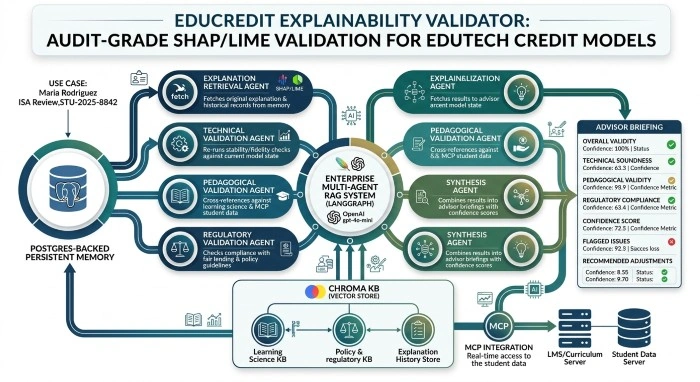
Part 2: End-to-End Implementation – "EduCredit Explainability Validator"
Use Case Scenario
A student advisor asks during a financing review session: "Why was Maria Rodriguez’s ISA application flagged for additional review, and is the explanation we gave her last week still valid given her improved quiz scores this week?"
This requires:
Explanation Retrieval Agent: Fetches original SHAP/LIME outputs and prior validation results from memory.
Technical Validation Agent: Re-runs stability/fidelity checks against current model state.
Pedagogical Validation Agent: Cross-references explanations against learning science KB and updated student performance data via MCP.
Regulatory Validation Agent: Checks compliance with current fair lending guidelines stored in policy KB.
Synthesis Agent: Combines validation results into advisor-ready briefing with confidence scores and recommended communication adjustments.
Step 1: Define EduTech Credit Explainability State
from typing import Annotated, TypedDict, Literal
from langgraph.graph.message import add_messages
from pydantic import BaseModel, Field

class ExplanationValidationResult(BaseModel):
    """Structured output from validation pipeline"""
    technical_soundness_score: float = Field(ge=0.0, le=1.0)
    pedagogical_validity_score: float = Field(ge=0.0, le=1.0)
    regulatory_compliance_score: float = Field(ge=0.0, le=1.0)
    historical_consistency_score: float = Field(ge=0.0, le=1.0)
    overall_confidence: float = Field(ge=0.0, le=1.0)
    flagged_issues: list[str] = Field(default_factory=list)
    recommended_adjustments: list[str] = Field(default_factory=list)
    method_agreement: Literal["shap_lime_agree", "partial_disagreement", "full_disagreement"]
    intervention_actionability: Literal["high", "medium", "low"]

class EduCreditExplainState(TypedDict):
    messages: Annotated[list, add_messages]
    student_id: str | None
    application_id: str | None
    original_explanation: dict | None          # Stored SHAP/LIME output
    validation_result: ExplanationValidationResult | None
    updated_student_data: dict | None          # Fresh data via MCP
    policy_references: list[str] | None        # Relevant regulatory/pedagogical docs
    advisor_briefing: str | None
Step 2: Implement Technical Validation Logic
import numpy as np
import shap
from lime.lime_tabular import LimeTabularExplainer

class TechnicalValidator:
    """Layer 1: Technical soundness validation for EduTech credit models"""

    def __init__(self, model, X_train, feature_names):
        self.model = model
        self.X_train = X_train
        self.feature_names = feature_names
        self.shap_explainer = shap.KernelExplainer(model.predict_proba, X_train[:100])
        self.lime_explainer = LimeTabularExplainer(
            X_train.values, feature_names=feature_names, mode='classification'
        )

    def validate_instance(self, x_instance, original_shap_values=None):
        results = {}

        # Stability test: 50 perturbations within ±5%
        perturbations = x_instance + np.random.uniform(-0.05, 0.05, size=(50, len(x_instance)))
        shap_values_perturbed = [
            self.shap_explainer.shap_values(p)[1] for p in perturbations
        ]
        top_k_original = set(np.argsort(np.abs(original_shap_values))[-3:])
        jaccard_scores = []
        for sv in shap_values_perturbed:
            top_k_perturbed = set(np.argsort(np.abs(sv))[-3:])
            jaccard = len(top_k_original & top_k_perturbed) / len(top_k_original | top_k_perturbed)
            jaccard_scores.append(jaccard)
        results['stability_score'] = np.mean(jaccard_scores)

        # Fidelity test: mask top-3 and measure prediction shift
        masked_x = x_instance.copy()
        top_3_indices = np.argsort(np.abs(original_shap_values))[-3:]
        masked_x[top_3_indices] = self.X_train.iloc[:, top_3_indices].mean().values
        pred_shift = abs(
            self.model.predict_proba(x_instance.reshape(1, -1))[0][1] -
            self.model.predict_proba(masked_x.reshape(1, -1))[0][1]
        )
        expected_shift = abs(np.sum(original_shap_values[top_3_indices]))
        results['fidelity_correlation'] = min(pred_shift / max(expected_shift, 1e-6), 1.0)

        # Method agreement: SHAP vs LIME top-3
        lime_exp = self.lime_explainer.explain_instance(
            x_instance, self.model.predict_proba, num_features=3
        )
        lime_top_3 = set([int(f[0]) for f in lime_exp.as_list()[:3]])
        shap_top_3 = top_k_original
        overlap = len(shap_top_3 & lime_top_3) / 3
        if overlap >= 0.67:
            results['method_agreement'] = 'shap_lime_agree'
        elif overlap >= 0.33:
            results['method_agreement'] = 'partial_disagreement'
        else:
            results['method_agreement'] = 'full_disagreement'

        return results

# Usage example (initialized once at service startup)# validator = TechnicalValidator(credit_model, X_train_credit, feature_names_credit)# tech_results = validator.validate_instance(student_features, stored_shap_values)
Step 3: Configure Chroma KBs + MCP Student Data Server
import chromadb
from langchain_chroma import Chroma
from langchain_openai import OpenAIEmbeddings
from mcp import ClientSession, StdioServerParameters
from mcp.client.stdio import stdio_client

chroma_client = chromadb.PersistentClient(path="./chroma_educredit")

# KB 1: Learning Science Principles (pedagogical validation)
learning_science_store = Chroma(
    client=chroma_client,
    collection_name="learning_science_principles",
    embedding_function=OpenAIEmbeddings(model="text-embedding-3-small")
)

# KB 2: Fair Lending & EduTech Policy (regulatory validation)
policy_store = Chroma(
    client=chroma_client,
    collection_name="educredit_policy_guidelines",
    embedding_function=OpenAIEmbeddings(model="text-embedding-3-small")
)

# KB 3: Historical Explanation Quality Records
explanation_history_store = Chroma(
    client=chroma_client,
    collection_name="explanation_validation_history",
    embedding_function=OpenAIEmbeddings(model="text-embedding-3-small")
)

# MCP Server for live student data + LMS integration
student_data_server = StdioServerParameters(
    command="node",
    args=["./mcp-servers/student-data-server/index.js"],
    env={"SIS_API_KEY": "...", "LMS_BASE_URL": "https://lms.university.edu/api/v2"}
)

async def get_student_mcp_session():
    async with stdio_client(student_data_server) as (read, write):
        async with ClientSession(read, write) as session:
            await session.initialize()
            return session
Step 4: Define Validation Agents with MCP Integration
from langchain_openai import ChatOpenAI
from langchain_core.messages import SystemMessage, HumanMessage
import json

llm = ChatOpenAI(model="gpt-4o-mini", temperature=0)

async def explanation_retrieval_agent(state: EduCreditExplainState) -> dict:
    """Fetches original explanation + prior validation from memory/history"""
    app_id = state.get("application_id")

    # Retrieve from persistent history store
    history_results = explanation_history_store.similarity_search(
        query=f"application {app_id} explanation validation", k=3
    )

    # In production: also fetch from structured DB via MCP
    original_explanation = {
        "shap_values": [0.12, -0.08, 0.22, 0.05, -0.15],  # Placeholder
        "top_features": ["assignment_submission_latency", "quiz_attempt_count",
                         "video_completion_rate", "forum_posts", "payment_history_delays"],
        "prediction_probability": 0.73,
        "generated_at": "2025-10-28T14:30:00Z"
    }

    return {"original_explanation": original_explanation}

async def pedagogical_validation_agent(state: EduCreditExplainState) -> dict:
    """Cross-references explanations against learning science + fresh student data"""
    explanation = state.get("original_explanation", {})
    student_id = state.get("student_id")

    # Fetch updated student performance via MCP
    async with await get_student_mcp_session() as session:
        perf_result = await session.call_tool(
            "get_student_performance_summary",
            arguments={"student_id": student_id, "include_trend": True}
        )
        updated_data = json.loads(perf_result.content[0].text)

    # Query learning science KB for relevant principles
    top_features = explanation.get("top_features", [])
    ls_results = learning_science_store.similarity_search(
        query=f"predictive validity of {' '.join(top_features)} for academic success",
        k=5
    )
    ls_context = "\n".join([r.page_content for r in ls_results])

    prompt = f"""Validate pedagogical validity of this credit model explanation.

EXPLANATION FEATURES: {top_features}
UPDATED STUDENT PERFORMANCE: {json.dumps(updated_data)}
LEARNING SCIENCE EVIDENCE:
{ls_context}

Rate pedagogical_validity_score (0-1) and identify:
1. Features supported by learning science
2. Features contradicted by learning science
3. Temporal coherence issues (explanation vs. current performance)
4. Intervention actionability rating

Return JSON matching ExplanationValidationResult partial schema."""

    response = await llm.with_structured_output(ExplanationValidationResult).ainvoke([
        SystemMessage(content=prompt),
        HumanMessage(content="Perform pedagogical validation")
    ])

    return {
        "validation_result": response,
        "updated_student_data": updated_data
    }

async def regulatory_validation_agent(state: EduCreditExplainState) -> dict:
    """Checks compliance with fair lending + EduTech policy guidelines"""
    explanation = state.get("original_explanation", {})

    policy_results = policy_store.similarity_search(
        query="ISA adverse action notice requirements fair lending EduTech",
        k=5
    )
    policy_context = "\n".join([r.page_content for r in policy_results])

    prompt = f"""Validate regulatory compliance of this credit explanation.

EXPLANATION: {json.dumps(explanation)}
POLICY GUIDELINES:
{policy_context}

Check:
1. ECOA/FCRA adverse action notice completeness
2. Protected attribute proxy leakage risk
3. Disparate impact indicators
4. Required disclosure elements present

Update regulatory_compliance_score and flagged_issues in validation result."""

    current_validation = state.get("validation_result")
    response = await llm.ainvoke([
        SystemMessage(content=prompt),
        HumanMessage(content=f"Current validation state: {current_validation}")
    ])

    # Merge regulatory findings into existing validation result
    # (Simplified; production would parse and merge properly)
    return {"policy_references": [r.metadata.get("policy_id") for r in policy_results]}

async def synthesis_agent(state: EduCreditExplainState) -> dict:
    """Generates advisor briefing combining all validation layers"""
    validation = state.get("validation_result")
    updated_data = state.get("updated_student_data", {})

    prompt = f"""Generate advisor briefing for student financing review.

VALIDATION RESULTS:
- Technical Soundness: {validation.technical_soundness_score if validation else 'N/A'}
- Pedagogical Validity: {validation.pedagogical_validity_score if validation else 'N/A'}
- Regulatory Compliance: {validation.regulatory_compliance_score if validation else 'N/A'}
- Overall Confidence: {validation.overall_confidence if validation else 'N/A'}
- Flagged Issues: {validation.flagged_issues if validation else []}
- Recommended Adjustments: {validation.recommended_adjustments if validation else []}

UPDATED STUDENT PERFORMANCE: {json.dumps(updated_data)}

Briefing must:
1. State whether original explanation remains valid
2. Highlight any validation failures with plain-language implications
3. Recommend specific communication adjustments if needed
4. Note updated student performance that may warrant re-evaluation
5. Include confidence level and caveats

Tone: Professional, supportive, action-oriented for advisor-student conversation."""

    response = await llm.ainvoke([
        SystemMessage(content=prompt),
        *state["messages"]
    ])

    return {"advisor_briefing": response.content, "messages": [response]}
Step 5: Build LangGraph Workflow with Persistent Memory
from langgraph.graph import StateGraph, START, END
from langgraph.checkpoint.postgres import PostgresSaver

workflow = StateGraph(EduCreditExplainState)

workflow.add_node("retrieve_explanation", explanation_retrieval_agent)
workflow.add_node("validate_pedagogical", pedagogical_validation_agent)
workflow.add_node("validate_regulatory", regulatory_validation_agent)
workflow.add_node("synthesize_briefing", synthesis_agent)

workflow.add_edge(START, "retrieve_explanation")
workflow.add_edge("retrieve_explanation", "validate_pedagogical")
workflow.add_edge("retrieve_explanation", "validate_regulatory")  # Parallel
workflow.add_edge("validate_pedagogical", "synthesize_briefing")
workflow.add_edge("validate_regulatory", "synthesize_briefing")
workflow.add_edge("synthesize_briefing", END)

checkpointer = PostgresSaver.from_conn_string(
    "postgresql://educredit:***@localhost:5432/explainability_validator"
)
app = workflow.compile(checkpointer=checkpointer)
Step 6: Execute Validation Session with Memory Persistence
import asyncio

async def run_explainability_validation():
    config = {"configurable": {"thread_id": "maria-rodriguez-isa-review-2025-11"}}

    result = await app.ainvoke({
        "messages": [HumanMessage(
            content="Why was Maria Rodriguez's ISA application flagged, and is last week's explanation still valid?"
        )],
        "student_id": "STU-2025-8842",
        "application_id": "ISA-APP-2025-11-003"
    }, config=config)

    print(f"📋 ADVISOR BRIEFING:\n{result['advisor_briefing']}\n")
    v = result.get('validation_result')
    if v:
        print(f" Validation Scores:")
        print(f"   Technical: {v.technical_soundness_score:.2f}")
        print(f"   Pedagogical: {v.pedagogical_validity_score:.2f}")
        print(f"   Regulatory: {v.regulatory_compliance_score:.2f}")
        print(f"   Overall Confidence: {v.overall_confidence:.2f}")
        print(f"   Method Agreement: {v.method_agreement}")
        print(f"   Actionability: {v.intervention_actionability}")
        if v.flagged_issues:
            print(f" Flagged Issues: {v.flagged_issues}")
        if v.recommended_adjustments:
            print(f" Recommended Adjustments: {v.recommended_adjustments}")

asyncio.run(run_explainability_validation())
Key Enterprise Takeaways for EduTech Credit Explainability
| Validation Layer | EduTech-Specific Adaptation | Business Impact |
|---|---|---|
| Technical Soundness | Perturbation ranges calibrated to learning behavior variability (not financial norms) | Prevents false instability flags on legitimate pedagogical signal |
| Pedagogical Validity | Cross-references learning science KB + live MCP student data | Ensures explanations drive effective interventions, not just accurate predictions |
| Regulatory Compliance | Dual-checks fair lending + educational accreditation standards | Satisfies both financial regulators and academic accreditors simultaneously |
| Historical Validation | Tracks explanation-outcome correlations over academic terms | Validates explainability translates to actual student success improvements |
| MCP Integration | Real-time student performance updates enable temporal coherence checks | Prevents stale explanations from undermining student trust |
| Persistent Memory | Postgres-backed state preserves validation history across advisor sessions | Enables longitudinal tracking of explanation quality per student cohort |
| Multi-Agent Parallelism | Technical + pedagogical + regulatory validation run concurrently | Sub-second validation for real-time advisor conversations |
Conclusion
Validating explainability in EduTech credit models demands moving beyond generic XAI metrics toward a domain-calibrated, multi-layered validation protocol that treats pedagogical validity and regulatory compliance as first-class concerns alongside technical soundness. The four-layer framework presented here implemented as a stateful multi-agent RAG system with MCP integration and persistent memory transforms explainability validation from a static post-hoc audit into an active, continuous quality assurance process embedded in daily advisory workflows. By grounding SHAP and LIME outputs in learning science evidence, live student performance data, and evolving policy guidelines, EduTech organizations can deliver explanations that are not only statistically faithful but educationally actionable and regulatorily defensible. For institutions deploying AI-driven financing decisions, this level of validated explainability is not optional overhead; it is the foundation of ethical, effective, and sustainable learner-centered credit assessment. The investment in domain-specific validation infrastructure pays compounding returns as the system learns which explanations actually improve student outcomes, creating a virtuous cycle where explainability quality directly drives educational impact.
Join the conversation! Your thoughts help the community grow.