

Pre-requisite to understand this
Containers: Lightweight units to package applications and dependencies
Docker basics: Common tool to build and run containers
Microservices architecture: Splitting apps into smaller independent services
YAML syntax: Configuration language used to define Kubernetes resources
Cloud/VM concepts: Understanding nodes and distributed systems
Introduction
Kubernetes (often called K8s) is an open-source container orchestration system used to automate deployment, scaling, and management of containerized applications. “Vanilla Kubernetes” refers to the pure, upstream version without vendor-specific enhancements (like those from cloud providers such as EKS, AKS, or GKE). It provides a standardized way to run distributed systems reliably across clusters of machines. Kubernetes abstracts infrastructure complexity and ensures that applications run consistently regardless of environment.
What problem we can solve with this?
Modern applications are increasingly built using microservices and containers, but managing them manually becomes extremely complex as scale increases. Kubernetes solves challenges around deployment, scaling, fault tolerance, and service discovery. It ensures that applications are always running in the desired state, automatically recovering from failures and distributing workloads efficiently across nodes. It also simplifies rolling updates and rollbacks without downtime. In distributed systems, networking and communication between services can become difficult Kubernetes provides built-in mechanisms for that. Overall, it reduces operational overhead and improves reliability and scalability of applications.
Key problems solved:
Container orchestration: Automates deployment and lifecycle management
Auto-scaling: Adjusts resources based on load
Self-healing: Restarts failed containers automatically
Service discovery: Enables communication between services
Load balancing: Distributes traffic efficiently
Rolling updates: Deploys updates without downtime
Infrastructure abstraction: Hides underlying hardware complexity
How to implement/use this?
To use vanilla Kubernetes, you typically set up a cluster consisting of a control plane (master) and multiple worker nodes. The control plane manages the cluster, while nodes run containerized workloads. You define applications using YAML manifests describing Pods, Deployments, Services, etc. Once applied, Kubernetes continuously ensures that the actual state matches the desired state. You interact with the cluster using tools like kubectl. Networking, storage, and scaling are handled automatically via built-in controllers. In production, you also configure monitoring, logging, and security policies. The system operates declaratively, meaning you describe what you want, and Kubernetes figures out how to achieve it.
Steps to implement:
Install cluster: Use kubeadm or tools like Minikube/kind
Configure kubectl: CLI to interact with cluster
Create YAML manifests: Define Pods, Deployments, Services
Apply configurations: Use
kubectl applyMonitor workloads: Check status using kubectl commands
Expose services: Use Service or Ingress
Scale applications: Update replicas dynamically
Sequence Diagram
This sequence shows how a deployment request flows through Kubernetes. The user submits a YAML configuration using kubectl, which communicates with the API Server—the central control point. The API server stores the desired state and notifies the Controller Manager, which ensures that the required number of pods are running. The Scheduler selects an appropriate node for the pod based on resource availability. Once assigned, the Kubelet on that node interacts with the container runtime (like Docker or containerd) to start the container. Finally, the node continuously reports status back to the API server. This loop ensures the system remains consistent with the desired state.
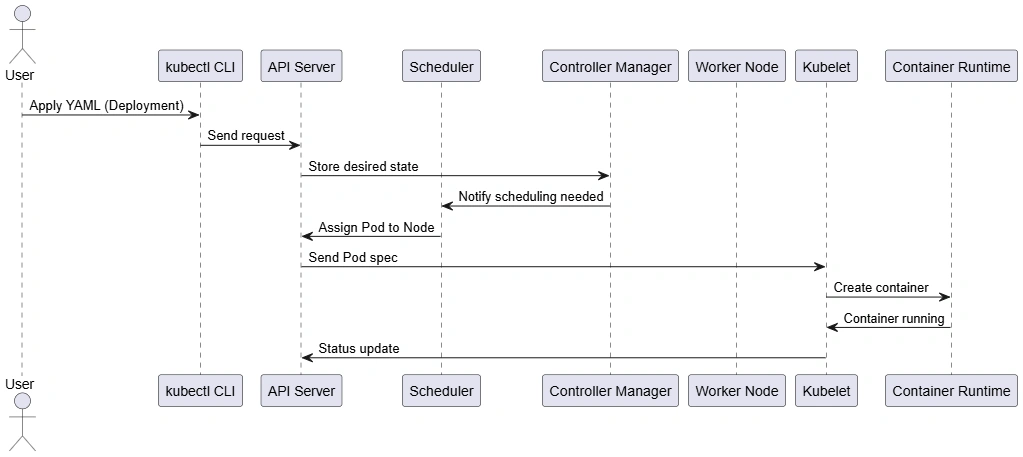
Steps explained:
User submits config: Defines desired application state
API Server receives request: Central entry point
Controller Manager acts: Maintains desired state
Scheduler assigns node: Chooses optimal node
Kubelet executes: Runs workload on node
Container runtime runs app: Starts containers
Status feedback loop: Ensures system health
Component Diagram
This component diagram shows the architecture of a Kubernetes cluster. The Control Plane manages the overall system, with the API Server acting as the gateway, etcd storing cluster state, Scheduler assigning workloads, and Controller Manager enforcing desired states. Worker nodes execute workloads, where Kubelet ensures containers are running and Kube Proxy manages networking. The flow begins with a user request and moves through scheduling, execution, and exposure of services. Each component plays a specific role in maintaining cluster stability and ensuring applications run as intended. This modular architecture allows Kubernetes to scale and remain fault-tolerant.
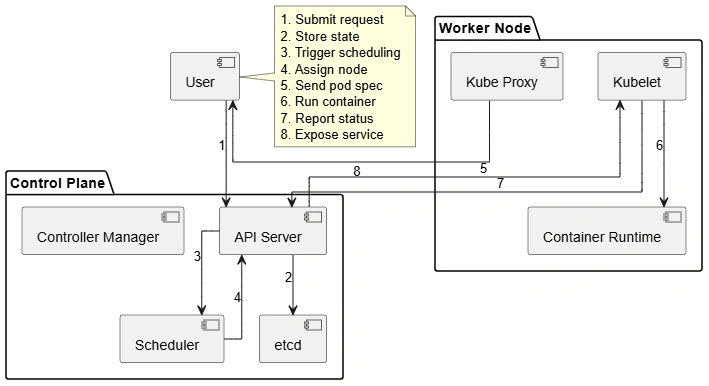
Steps explained:
User request: Initiates deployment
State storage: Persisted in etcd
Scheduling trigger: Need to place pod
Node assignment: Scheduler decision
Pod delivery: Sent to node
Container execution: Runtime starts app
Status reporting: Health feedback
Service exposure: External/internal access
Advantages:
Scalability: Easily scale applications horizontally
High availability: Ensures minimal downtime
Portability: Runs on any infrastructure
Self-healing: Automatically replaces failed components
Declarative management: Define desired state in YAML
Efficient resource usage: Optimizes node utilization
Extensibility: Supports plugins and custom resources
Summary
Vanilla Kubernetes provides a powerful, flexible platform for managing containerized applications at scale. By abstracting infrastructure complexities and offering automation for deployment, scaling, and recovery, it simplifies modern application operations. Its declarative approach ensures consistency, while its modular architecture supports extensibility and resilience. Although it has a learning curve, mastering Kubernetes enables efficient management of distributed systems and is a critical skill in cloud-native development.
Join the conversation! Your thoughts help the community grow.