

Pre-requisite to understand this
Machine Learning basics – Understanding how models learn patterns from data.
Embeddings – Numerical vector representations of text, images, or audio.
Similarity search – Finding items that are “close” based on distance metrics.
Databases – Basic idea of storing and retrieving data.
Natural Language Processing (NLP) – How machines understand human language.
Introduction
Vector storage plays a crucial role in modern AI systems by enabling efficient storage, indexing, and retrieval of high-dimensional vector embeddings. These embeddings are numerical representations generated by AI models to capture semantic meaning from unstructured data such as text, images, audio, or code. Instead of traditional keyword-based search, vector storage allows AI systems to perform semantic and contextual searches. This capability is foundational for applications like chatbots, recommendation engines, document search, and Retrieval-Augmented Generation (RAG). In short, vector databases bridge the gap between raw data and intelligent reasoning.
What problem we can solve with this?
Traditional databases struggle with unstructured data and semantic understanding. Vector storage solves this by allowing similarity based retrieval rather than exact matching. AI applications often need to retrieve relevant context from large datasets quickly and accurately. Vector databases enable this by storing embeddings and using mathematical distance calculations to find related information. This significantly improves response quality in AI systems. It also reduces hallucinations by grounding AI outputs in real data. As data grows, vector storage ensures scalability and performance.
Problems addressed:
Semantic search instead of keyword matching
Context-aware AI responses
Fast retrieval from massive unstructured datasets
Improved accuracy in chatbots and assistants
Personalized recommendations
Reduced AI hallucinations
How to implement / use this?
To use vector storage, data is first converted into embeddings using an embedding model such as OpenAI, HuggingFace, or Sentence Transformers. These embeddings are stored in a vector database like Pinecone, FAISS, Weaviate, or Milvus. When a user submits a query, the query is also converted into an embedding. The vector database then performs a similarity search using distance metrics such as cosine similarity or Euclidean distance. The most relevant results are returned and passed to the AI model. This approach is commonly used in RAG pipelines and semantic search systems.
Implementation steps:
Generate embeddings from raw data
Store embeddings in a vector database
Convert user query into an embedding
Perform similarity search
Retrieve top-k relevant results
Use results for AI inference or response generation
Sequence Diagram (Vector Search Flow)
This sequence diagram illustrates how vector storage is used during a semantic query. When the user asks a question, the AI application converts the query into a vector using an embedding model. This vector is then sent to the vector database, which performs a similarity search against stored embeddings. The most relevant documents are retrieved and provided as context to the large language model. The LLM uses this context to generate a grounded and accurate response. Finally, the answer is delivered to the user.
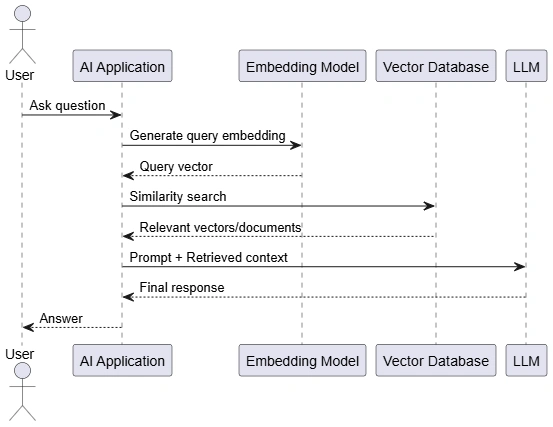
Key steps explained:
User query initiates the flow
Embedding model converts text to vectors
Vector DB performs similarity search
Context is retrieved dynamically
LLM generates an informed response
Component Diagram (System Architecture)
This component diagram shows the architectural view of an AI system using vector storage. The user interface interacts with the AI backend, which acts as the orchestrator. The backend communicates with the embedding service to generate vectors and with the vector database to store or retrieve embeddings. The LLM service is responsible for generating natural language responses. Vector storage acts as a central intelligence layer that enables semantic understanding across the system. This modular architecture improves scalability and maintainability.
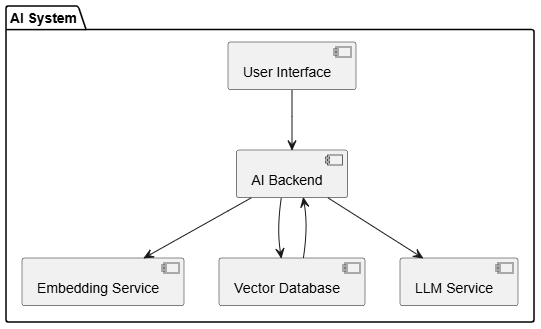
Component roles:
User Interface – Accepts user input and displays output.
AI Backend – Coordinates all operations.
Embedding Service – Converts data into vectors.
Vector Database – Stores and searches embeddings.
LLM Service – Generates AI responses.
Advantages
Enables semantic and contextual search.
Scales efficiently with large datasets.
Improves AI accuracy and relevance.
Reduces hallucinations in LLMs.
Supports real-time retrieval.
Works with unstructured data.
Summary
Vector storage is a foundational technology for modern AI systems, enabling intelligent retrieval and semantic understanding of unstructured data. By converting information into embeddings and using similarity search, AI applications can access relevant context quickly and accurately. This approach enhances chatbots, recommendation engines, and enterprise search systems. With architectures like RAG, vector databases ensure AI outputs are grounded in real data. As AI continues to evolve, vector storage will remain a critical component for building scalable, accurate, and context-aware intelligence.
Join the conversation! Your thoughts help the community grow.