
Artificial intelligence and specifically generative AI (ChatGPT and LLMs) has crossed a threshold and they are part of our daily lives. No matter we are searching Internet, curious about ta topic, check a drug fact, or even asking for an advice, we jump right into ChatGPT or one of the GenAI apps such as Gemini or Perplexity. LLMs are being used to draft legal documents, summarize medical research, and answers architectural questions.
In software development world, today, there is more code written by Copilots and LLMs than ever before. Not only LLMs are writing code but they are helping code quality, check and fix bugs, and add new features. I would not be surprised if more than 80% of the code will be written by AI by next year end. While writing code is not a danger of AI, but using GenAI and LLMs in healthcare advices or discussing some serious topics could be dangerous and GenAI may lead a user into the wrong direction. For example, if you ask ChatGPT about a drug that it may not have enough facts, it may hallucinate and this is where some of the early dangers of AI lies. In a recent news, Open AI, Microsoft sued over ChatGPT's alleged role in fueling man's "paranoid delusions" before murder-suicide in Connecticut - CBS News .
Since the output of these large language models such as GPT-5 is so clean, precise, structured, and persuasive, this fluency is precisely the problem in some cases. And that is where AI hallucinations come in picture. AI hallucinations occur when an LLM produces information that is incorrect, unverifiable, or entirely fabricated while presenting it with confidence and coherence.
This article explains what AI hallucinations really are, why they happen, why they are difficult to eliminate, and what developers, architects, and technology leaders must understand before trusting AI models in real world applications and how they can fix this problem.
What AI Hallucinations Actually Are
An AI hallucination is not a bug or a result of bad data or like AI is trying to trick you. It is how AI models work.
An AI hallucination happens when a language model generates output that appears reasonable and authoritative but has no reliable grounding in reality.
This can include:
Incorrect technical explanations
Invented statistics or metrics
Fabricated research papers or citations
Nonexistent APIs or product features
Confident answers to questions that have no definitive answer
And its not that the AI model is trying to trick you or being smart, its the way model architectures are. They way large language models work are, they predict the next possible letter in the chat based on the data they have been trained on. If model doesn't find a matching letter, it make things up.
Read this to learn more: How Large Language Models (LLMs) Work
How Modern Language Models Generate Responses
To understand hallucinations, you must first discard a common assumption that AI models know anything or they are intelligent. AI models don't know about truth or facts and they don't verify any facts. AI models are nothing but content generators that generates content based on the previous data they already have.
Here is the process how a large language model such as GPT=5 generates a response.
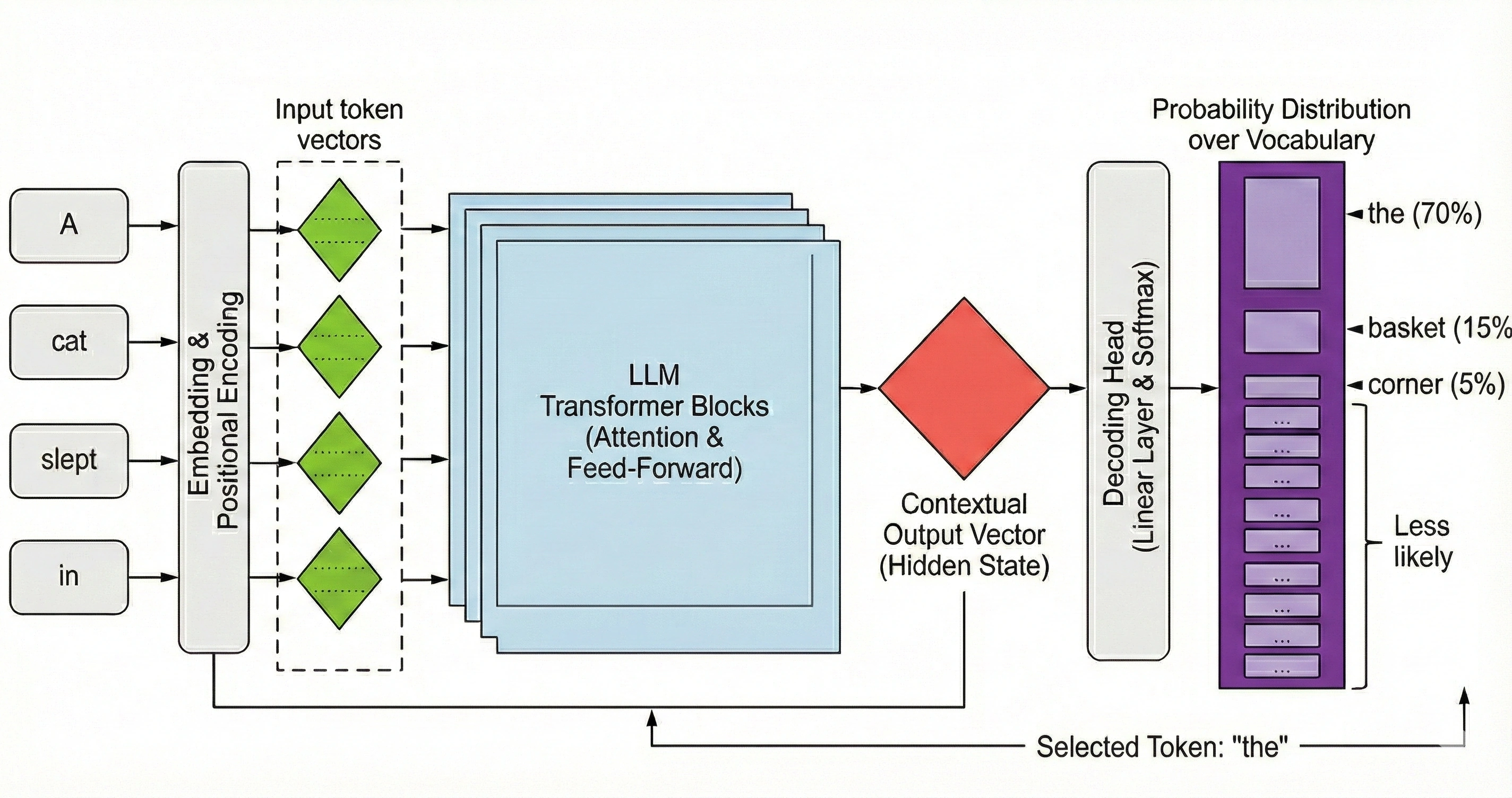
Large language models generate text by predicting the most likely next word based on the words that came before it. That prediction is shaped by patterns learned during training across massive volumes of language.
In practical terms, the model is constantly answering one question:
“Given everything written so far, what usually comes next?”
When a question is common, well defined, and frequently represented in training data, the model’s prediction tends to align with reality. When the question is rare, ambiguous, or poorly specified, the model still responds. It simply does so with lower certainty. And it does not announce that uncertainty. The system continues generating text because continuation is what it is designed to do.
To learn in-depth, read here: How LLMs Generate Responses .
Why Hallucinations Are Not Bad System Design or Software Bugs
In conventional software engineering, incorrect behavior usually points to a logic error, an edge case, or a missing validation rule. Fix the logic and the bug disappears. LLMs do not work that way.
Hallucinations are an emergent property of probabilistic systems trained on human language. Language itself is messy. It contains speculation, opinions, contradictions, outdated knowledge, and incomplete explanations. Models learn all of it without understanding which parts reflect reality. When certainty is high, the model performs well. When certainty is low, coherence becomes the goal. This is why hallucinated answers often sound polished, well reasoned, and convincing even when they are completely wrong.
The Different Types of AI Hallucinations
Hallucinations are not limited to simple factual errors. They appear in multiple forms, many of which are harder to detect than a wrong number or date.
Factual Hallucinations
These occur when the model states something that is plainly false. This might include incorrect technical details, invented specifications, or wrong historical facts. They are the easiest type to catch, especially by experienced practitioners.
Source and Citation Hallucinations
The model fabricates academic papers, authors, documentation pages, or legal cases. The citations look legitimate but do not exist. This is especially dangerous in legal, medical, academic, and enterprise settings where sources carry authority.
Reasoning Hallucinations
Sometimes the final answer is correct, but the explanation is not. The model constructs a logical sounding path that was never actually used to reach the conclusion. This can mislead learners and propagate misunderstanding.
Contextual Hallucinations
The model misunderstands the user’s intent or context and confidently answers the wrong question. This often happens in long or complex conversations.
Narrative and Conversational Hallucinations
Over extended interactions, assumptions compound. The model continues a narrative that feels consistent internally but drifts away from reality over time. This form is subtle and often goes unnoticed until the output causes real damage.
Here is detailed reading on Different Types of AI Hallucinations.
Why We Trust Hallucinations So Easily
Humans are trained to learn from content since childhood to the college, we read from books and learn. We use the internet to learn. We learn from websites, YouTube and all kind of sources. Majority of the sources are usually based on facts. So, when we chat with ChatGPT, we automatically assume the information is correct.
The behavior of models such as GPT-5 and Gemini is so confident and structured, we automatically trust them. If you're talking to person and they say something with confidence, fluency, and well spoken, we tend to trust them. This is where humans fail.
As humans, it is our responsibility to learn, validate, and verify the facts before we trust it.
Hallucinations Versus Misinformation
Hallucinations are often confused with misinformation, but they are fundamentally different. Misinformation is false content introduced by humans, intentionally or unintentionally. Hallucinations are synthetic errors produced by probabilistic systems when they generate text beyond their reliable knowledge boundary.
This distinction matters because hallucinations cannot be solved by simply cleaning datasets or removing harmful content.
The Role of Training Data and Its Limits
Training data shapes how ideas are expressed, not whether they are true. If speculative discussions exist in the data, the model learns how speculation sounds. If authoritative research exists, it learns how authority sounds. It does not understand which one represents reality.
Blaming training data alone oversimplifies the problem. The deeper issue is that language itself contains ambiguity, error, and confidence without proof.
Why Hallucinations Cannot Be Fully Eliminated
In the world of AI models, there is no switch that turns hallucinations off. If a model is forced to answer only when certainty is high, it must refuse frequently and become far less useful. If it is allowed to be flexible and expressive, and uncertainty increases.
How Modern Systems Reduce Hallucinations in Practice
While hallucinations are real and inevitable, they can be reduced if they systems are designed and architected well. Here are some of the things we can do to design better systems:
Retrieval augmented generation grounds responses in verified external data.
Tool based validation allows real time fact checking.
Confidence calibration reduces overconfident language.
Refusal logic prevents answers when uncertainty is too high.
Human review is applied to high risk outputs.
Hallucination mitigation is an architectural challenge, not a model size problem.
What Developers and Architects Must Take Seriously
If you are building or deploying AI based systems that use LLMs, you must start thinking about hallucinations and how to avoid them. If the systems are designed for healthcare, financial, and similar industries, the fix is a must.
There are ways developers are architects can reduce hallucinations. We must start with the mindset that AI models are not an authority but an assistant with ton of knowledge with not much intelligence. We must not treat LLMs as the source of truth and always assume that the response from an LLM may be wrong.
Retrieval Augmented Generation, or RAG, is one of the most effective techniques for reducing hallucinations. Instead of asking the model to answer from memory, the system retrieves relevant documents from a trusted data store and injects them into the prompt.
Validating input, prompts, and context matter and can drastically change the response. Sensitive input must be masked and replaced with synthetic input. Implementing external tools as the final review systems is another way to reduce AI hallucinations.
Why This Matters More Than Ever
AI is now actively being adopted by industries such as healthcare, finance, legal, and education, where mistakes have real consequences. Without fixing AI hallucinations, the systems could pose serious risks to the users. For example, a healthcare AI agent suggest a wrong medicine dose to a patient could lead to serious consequences.
Frequently Asked Questions About AI Hallucinations
What is an AI hallucination
An AI hallucination occurs when an AI system generates information that sounds correct but is actually false, unverifiable, or fabricated.
Why do large language models hallucinate
They hallucinate because they generate language based on probability and patterns, not because they understand facts or reality.
Are AI hallucinations caused by bad training data
Not entirely. Training data influences language patterns, but hallucinations mainly occur when the model lacks certainty and continues generating plausible text anyway.
Can AI hallucinations be completely eliminated
No. Hallucinations are inherent to generative systems. They can be reduced but not fully removed.
Are hallucinations the same as AI lying
No. The system does not know it is wrong. It is not lying. It is generating text without understanding truth.
Why are AI hallucinations dangerous
They are dangerous because fluent and confident answers can mislead users, especially in high stakes domains like healthcare, finance, and law.
How do companies reduce AI hallucinations
They use grounding techniques, external data retrieval, tool based validation, refusal logic, and human oversight.
Do hallucinations increase in long conversations
Yes. Longer interactions allow assumptions to compound, increasing the risk of drift from reality.
Should developers trust AI generated answers
AI output should be treated as a draft or assistant response, not an authoritative source. Verification is always required.
Conclusion
AI hallucinations are not signs of intelligence gone wrong but as a part of the process how AI models are designed and architected. As we know, AI models are not intelligent authorities but just the assistants. We must use them as assistants and the final approval must be by an authority.
As AI models become embedded in software systems, the responsibility shifts to those who design, deploy, and govern these tools.


Join the conversation! Your thoughts help the community grow.