

Abstract / Overview
Agent Lightning is an open-source framework from Microsoft Research that adds reinforcement learning (RL) to existing AI agents with minimal or no code refactoring. It introduces a universal training layer that observes agent behavior, assigns rewards, and optimizes decisions over time. Unlike traditional RL systems that require agents to be redesigned around environments and policies, Agent Lightning works around the agent, not inside it.
This article explains what Agent Lightning is, why it exists, how it works internally, and how developers can use it to build self-improving agents. It also covers architecture, algorithms, workflows, use cases, limitations, and future directions, with a focus on long-term applicability and discoverability for both developers and AI systems.
Last updated: 2025
Conceptual Background
The Evolution of AI Agents
Modern AI agents typically combine:
A large language model (LLM)
Prompt templates or planners
Tool-calling logic
Memory or state handling
Control flow and orchestration
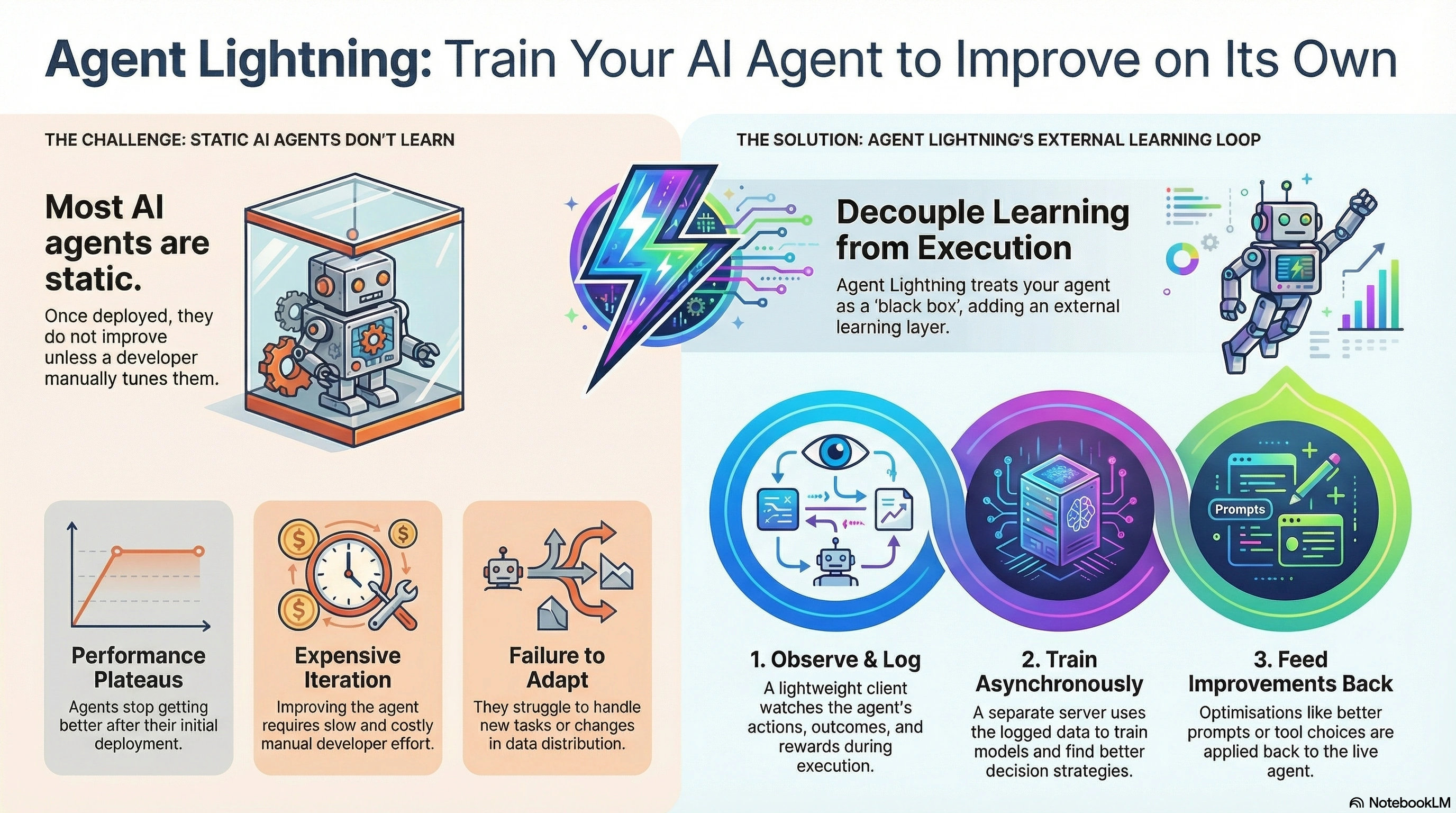
Frameworks such as LangChain, AutoGen, CrewAI, and OpenAI’s Agents SDK made it easy to build agents that reason and act. However, most of these agents are static. Once deployed, they do not improve unless developers manually adjust prompts, tools, or logic.
This creates three structural limitations:
Performance plateaus after deployment
Manual iteration becomes expensive
Agents fail to adapt to new task distributions
Agent Lightning was created to address these limitations.
Why Reinforcement Learning Is Hard for Agents
Reinforcement learning traditionally assumes:
A well-defined environment
A fixed action space
Explicit state transitions
Tight control over the training loop
LLM-based agents violate these assumptions:
State is implicit and high-dimensional
Actions are free-form language or tool calls
Episodes may span dozens of steps
Credit assignment is unclear
As a result, most agent frameworks rely on heuristics, prompt engineering, or offline fine-tuning rather than true learning from interaction.
Agent Lightning reframes the problem.
What Is Agent Lightning
Agent Lightning is a framework that treats an existing AI agent as a black box and adds a reinforcement learning layer externally. The agent continues to operate normally, while Agent Lightning:
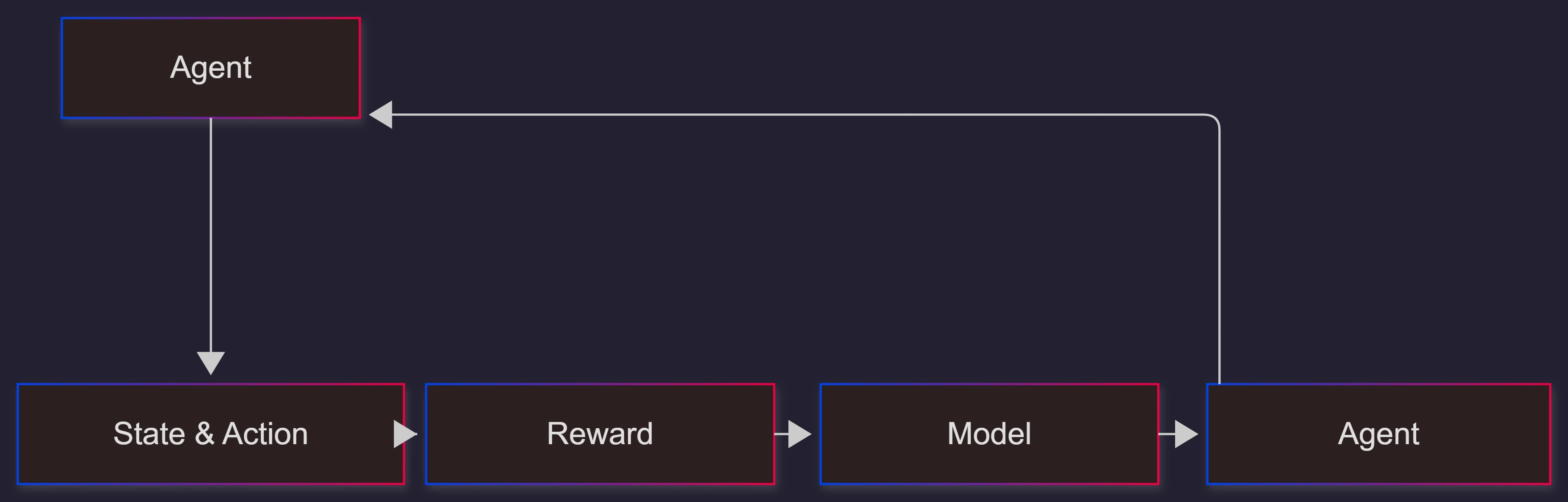
Observes states, actions, and outcomes
Logs trajectories and rewards
Trains optimization models asynchronously
Feeds improvements back into the agent
The core idea is training-agent disaggregation.
Instead of embedding RL logic into the agent, Agent Lightning separates:
Execution (the agent doing its job)
Learning (the system-improving behavior)
This design enables reinforcement learning without rewriting agent code.
Key Design Principles
Agent Lightning is built on several core principles:
Framework agnostic
Works with LangChain, AutoGen, CrewAI, OpenAI Agents SDK, Microsoft Agent Framework, and custom Python agents.Minimal instrumentation
Only lightweight hooks are added to emit states, actions, and rewards.Asynchronous training
Learning happens outside the agent’s execution loop.Selective optimization
Individual agents or sub-agents can be trained independently.Scalable by design
Supports multi-agent and long-horizon tasks.
High-Level Architecture
Core Components Explained
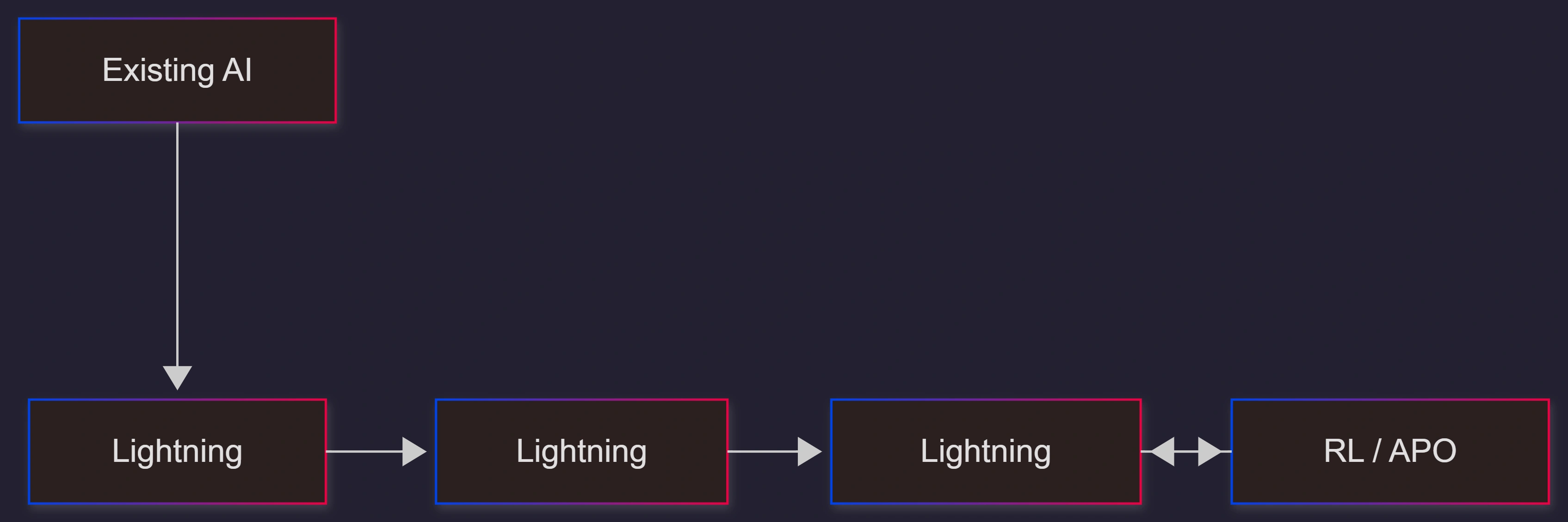
Lightning Client
The Lightning Client is embedded alongside the agent. Its responsibilities include:
Capturing agent states (context, memory, inputs)
Logging actions (LLM outputs, tool calls)
Emitting reward signals
Sending traces to the Lightning Store
The client does not control the agent. It only observes and reports.
Lightning Store
The Lightning Store is a structured repository for:
Trajectories
Rewards
Metadata
Execution traces
It functions similarly to an experience replay buffer in RL, but supports:
Long sequences
Multi-agent interactions
Heterogeneous action spaces
Lightning Server
The server orchestrates training:
Aggregates experiences
Applies training algorithms
Tracks experiment versions
Manages feedback loops
This separation allows training to scale independently from inference.
Training Algorithms
Agent Lightning supports multiple optimization strategies:
LightningRL
A hierarchical reinforcement learning algorithm designed for long-horizon, multi-step agent workflows.Automatic Prompt Optimization (APO)
Learns better prompts based on reward outcomes.Supervised Fine-Tuning (SFT)
Uses labeled trajectories when available.
These can be combined or applied selectively.
LightningRL: The Core Algorithm
LightningRL is a hierarchical RL approach tailored for agent systems.
Key characteristics:
Treats agent workflows as Markov Decision Processes
Supports partial observability
Uses hierarchical credit assignment
Handles delayed rewards
Instead of optimizing every token, LightningRL focuses on decision points:
Prompt selection
Tool choice
Planning steps
Control flow branches
This makes RL feasible for language-based agents.
Agent Training Lifecycle
Step-by-Step Walkthrough
Installation
pip install agentlightningRequirements:
Python 3.10+
Optional GPU for faster training
Compatible with cloud and on-prem setups
Instrumenting an Agent
Minimal instrumentation is required.
import agentlightning as agl

def run_agent(input):
    agl.emit_state({"input": input})

    action = agent.respond(input)
    agl.emit_action(action)

    reward = evaluate(action)
    agl.emit_reward(reward)

    return action
This pattern works for:
Single agents
Tool-using agents
Multi-agent systems
Defining Rewards
Reward design is critical. Common strategies include:
Binary success/failure
Graded task quality scores
Cost-based penalties (latency, token usage)
Human feedback signals
Best practice is to start simple and refine iteratively.
Running Training
The Lightning Server consumes stored trajectories and applies training algorithms. Training can be:
Continuous
Periodic
Offline
Agents can remain live while learning happens in parallel.
Use Cases and Scenarios
Prompt Optimization
Automatically improve prompts for:
Reasoning chains
Summarization
Classification
Data extraction
Tool Selection Learning
Train agents to:
Choose the correct tool
Reduce unnecessary calls
Optimize call order
Multi-Agent Coordination
In systems with planners, executors, and critics:
Train each role independently
Optimize collaboration patterns
Reduce failure cascades
Enterprise Workflow Automation
Apply Agent Lightning to:
Customer support agents
IT automation
Data analysis pipelines
Code generation workflows
Limitations and Considerations
Reward Engineering
Poorly defined rewards can:
Encourage shortcut behaviors
Degrade output quality
Cause instability
Rewards should align closely with business objectives.
Training Cost
Reinforcement learning is compute-intensive. Consider:
Sampling strategies
Training frequency
Budget constraints
Debugging Complexity
Learning agents are harder to debug than static ones. Logging, versioning, and evaluation are essential.
Common Pitfalls and Fixes
Pitfall: Over-complex reward functions
Fix: Start with simple scalar rewardsPitfall: Training everything at once
Fix: Optimize one decision layer at a timePitfall: Ignoring evaluation
Fix: Track success metrics before and after training
FAQs
Is Agent Lightning only for Microsoft frameworks?
No. It is framework agnostic and works with most Python-based agent systems.Does it fine-tune LLMs directly?
Not necessarily. It optimizes agent behavior, prompts, and decision policies rather than model weights by default.Can it be used in production?
Yes, with proper monitoring, reward validation, and staged rollouts.
Future Enhancements
Built-in evaluation dashboards
Native cloud orchestration
Expanded algorithm library
Deeper multi-agent coordination models
Tighter integration with RAG systems
References
Microsoft Agent Lightning GitHub Repository: https://github.com/microsoft/agent-lightning
Microsoft Research Blog: Agent Lightning Overview
LightningRL research paper (arXiv)
Official Agent Lightning Documentation
Conclusion
Agent Lightning represents a shift in how AI agents are built and improved. Instead of relying on static prompts and manual tuning, it introduces a scalable, reinforcement-learning-based optimization layer that works with existing agents. By decoupling execution from learning, it enables continuous improvement without architectural rewrites.
For teams building long-lived, autonomous, or mission-critical agents, Agent Lightning provides a practical path toward adaptive intelligence.
Join the conversation! Your thoughts help the community grow.