What Is Agentic AI? A Complete Guide to Agentic AI in Cybersecurity, With Real-World ExamplesIs Agentic AI the Next Big Thing in Cybersecurity, or Just Another Buzzword?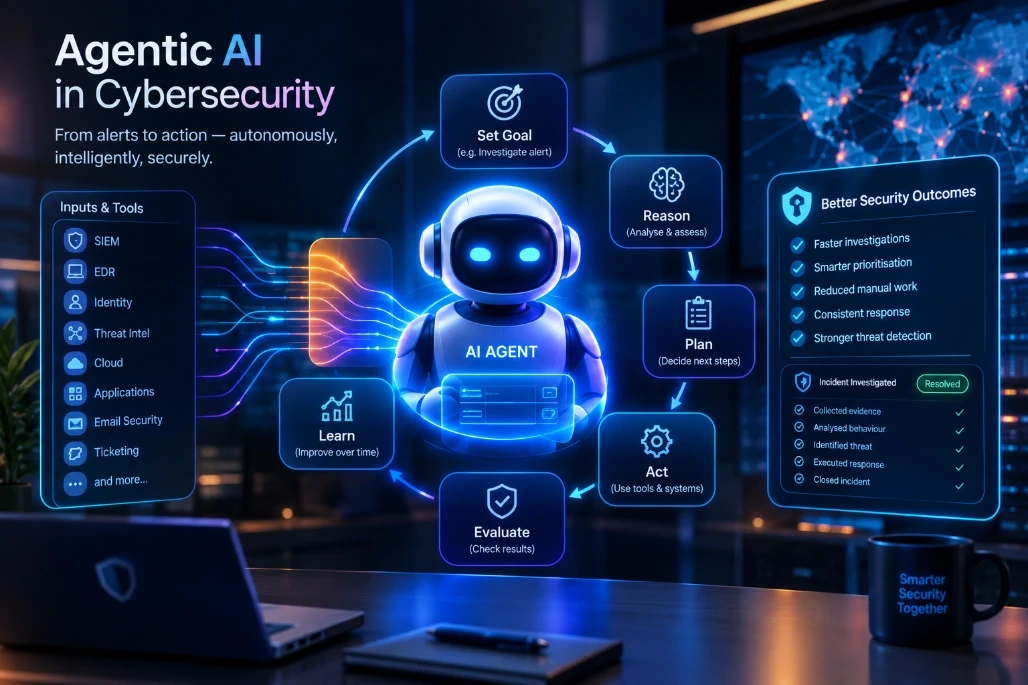
Artificial intelligence has become one of the most frequently discussed topics in cybersecurity. Over the last few years, we have seen conversations move from machine learning and predictive analytics to generative AI, AI copilots, and now Agentic AI.
Everywhere you look, security vendors are talking about autonomous security operations, AI agents, intelligent threat detection, and self-operating security systems.
But there is an important question that deserves a straightforward answer:
What is Agentic AI, and what makes it different from the AI we already use?
Is it simply a chatbot connected to security tools? Is it an advanced version of automation? Can it investigate a cyberattack, decide what to do next, and take action without waiting for a human analyst to guide every step?
To understand Agentic AI properly, we need to move beyond marketing terminology and understand how the technology actually works.
Imagine a security operations centre (SOC) receiving thousands of alerts every day. A security analyst must investigate suspicious logins, correlate endpoint activity, examine network traffic, review threat intelligence, and determine whether an incident is genuine.
Now imagine an AI system that receives an alert, gathers relevant evidence, investigates the user's identity and endpoint, checks for signs of compromise, develops an investigation plan, and recommends or performs an appropriate response according to its permissions.
That is where Agentic AI begins to become interesting.
It is not simply about AI generating an answer. It is about AI working towards a goal, making context-dependent decisions, using available tools, and carrying out multiple steps to achieve an outcome.
In cybersecurity, this could change how organisations investigate threats, manage vulnerabilities, protect identities, secure cloud environments, and respond to incidents.
However, Agentic AI is not magic, and autonomy does not automatically mean intelligence, accuracy, or safety.
Let's understand it from the beginning.
1. What Is Agentic AI?Agentic AI is an approach to artificial intelligence in which one or more AI agents can pursue a defined goal by interpreting information, reasoning about the situation, planning steps, using tools, and taking actions with varying degrees of human supervision.
In simple terms, Agentic AI is AI that can work towards a goal, not just generate an answer.
Traditional AI systems often predict, classify, detect, or recommend. Generative AI creates content in response to instructions. Agentic AI builds on these capabilities by enabling a system to coordinate multiple steps and interact with its environment to accomplish a task.
Consider three examples.
Example 1: Traditional AI
A security system detects that a login attempt is suspicious and assigns it a risk score of 92 out of 100. It has identified a potential problem, but it may not investigate the event or take any further action.
Example 2: Generative AI
An analyst asks an AI assistant to explain the suspicious login. The assistant analyses the information provided and explains why the event might indicate account compromise. It may also suggest investigation steps.
Example 3: Agentic AI
An agent receives the suspicious-login alert and begins investigating it. It checks identity logs, reviews sign-in locations, examines recent privilege changes, retrieves endpoint alerts, and correlates the findings.
It then determines whether additional investigation is necessary, gathers further evidence, and prepares a response.
If the agent has the appropriate permissions and the organisation's policies allow it, it might revoke active sessions or initiate account containment. Alternatively, it may request human approval before taking those actions.
The key distinction is that the agent can coordinate a workflow towards a defined objective instead of stopping at a prediction or explanation.
A simple definition to remember
Think of Agentic AI as a digital worker that has:
A clearly defined objective.
Access to relevant information.
The ability to reason and plan.
Tools it can use to perform tasks.
Permission to take specified actions.
A mechanism to check results and escalate when necessary.
Not every AI agent has all these capabilities, and not every agent operates autonomously. The degree of autonomy depends on its design, tools, permissions, and safeguards.
 2. What Is an AI Agent?
Before understanding Agentic AI, it helps to understand the word agent.
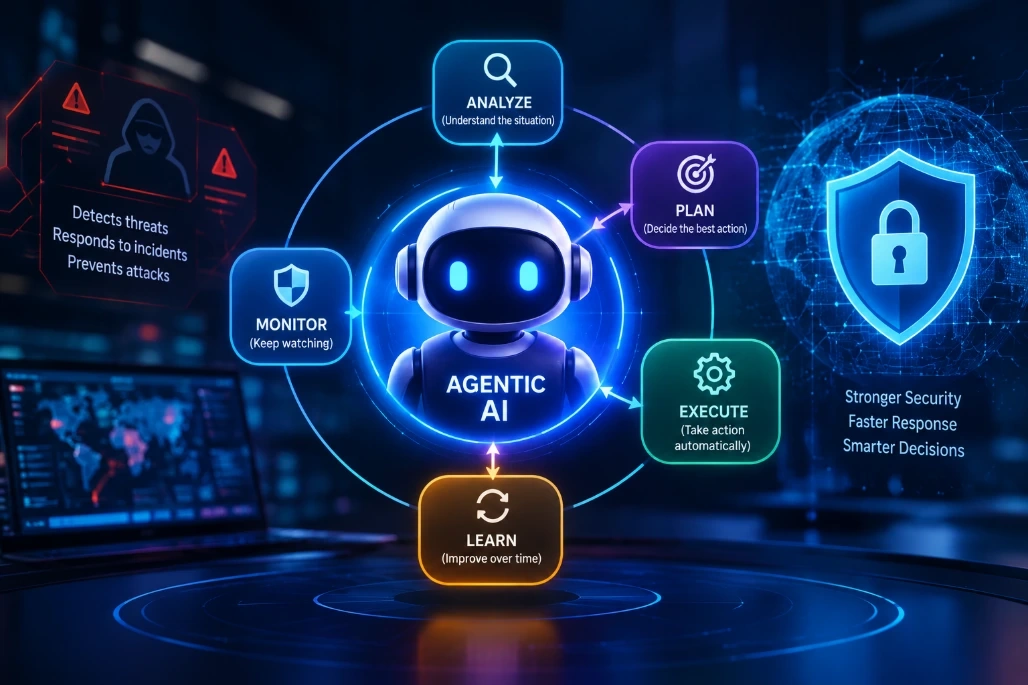
An AI agent is a software-based system that receives information about its environment, uses an AI model and other logic to decide what to do, and may take actions through connected tools or systems.
An agent is not necessarily a robot, a humanoid assistant, or a completely independent digital employee.
It can be a software component that investigates phishing emails, analyses cloud misconfigurations, monitors privileged accounts, or assists with incident response.
For example, a cybersecurity agent might have access to:
A SIEM platform for security logs and alerts.
An EDR platform for endpoint activity.
An identity platform for authentication and access information.
A threat intelligence source for known malicious indicators.
A ticketing system for documenting incidents.
A response tool for performing approved containment actions.
The AI model helps interpret the available information and decide which steps are relevant. The connected tools provide access to evidence and the ability to perform operations.
Without suitable tools, an agent may only be able to analyse and recommend. With tools and permissions, it can do more.
This distinction matters because an AI model alone is not the same thing as a complete Agentic AI system.
A working agent generally needs a model, instructions, context, tool integrations, an execution environment, and controls that govern what it can do.
3. How Does Agentic AI Work?To understand how Agentic AI works, let's follow a practical example.
A company receives an alert that an employee's account has logged in from an unusual location. Shortly afterwards, the same account attempts to access a sensitive cloud application.
The security team wants to determine whether this is legitimate activity or a potential account compromise.
An Agentic AI system can follow an iterative process.
Step 1: Perceive — understand what is happening
The agent receives an alert from a connected security system. It gathers relevant information, such as:
The user's identity and department.
The time and location of the login.
Whether the device is recognised.
Recent authentication failures.
Recent privilege changes.
Other security alerts associated with the account.
The agent now has a starting point for its investigation.
Step 2: Reason — interpret the available evidence
The agent analyses the collected information in context.
For example, a login from another country is not automatically malicious. The employee might be travelling, using an approved VPN, or working remotely.
The agent therefore checks additional evidence rather than making a decision based on one indicator.
It might discover that the login came from an unfamiliar device, was followed by repeated access attempts, and coincided with a suspicious change in authentication settings.
Together, these signals provide a stronger reason for concern.
Step 3: Plan — decide what to investigate next
Based on the evidence, the agent determines which actions could help establish whether the account is compromised.
Its investigation plan might include:
1. Retrieve additional identity logs.
2. Check the device's EDR alerts.
3. Review the account's recent access to sensitive applications.
4. Search for related activity across the organisation.
5. Evaluate whether the evidence meets the incident escalation criteria.
The agent may adapt this plan if new evidence changes the situation.
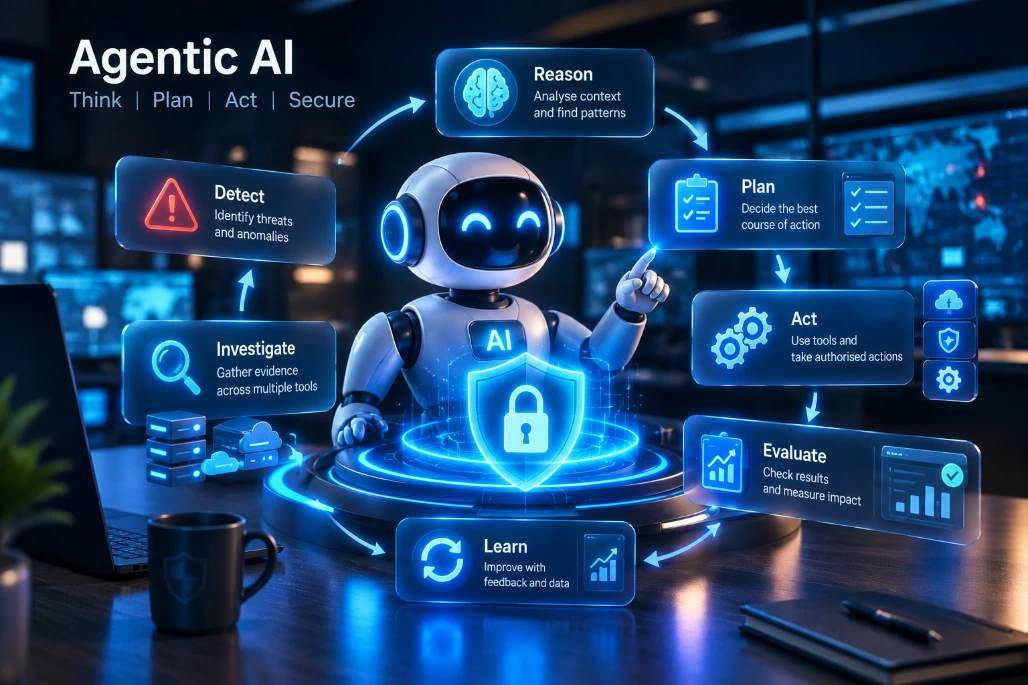
Step 4: Act — use tools to perform the investigation
The agent calls the relevant tools or APIs to retrieve information and carry out permitted operations.
It may query the SIEM, inspect identity logs, retrieve endpoint telemetry, or create an incident ticket.
If the organisation has authorised automatic containment for a specific class of high-confidence incidents, the agent may initiate that response. Higher-risk actions may require explicit approval.
Step 5: Evaluate — check whether the action worked
Suppose the security team approves revoking the account's active sessions.
The agent can verify whether the sessions were revoked and whether suspicious activity continues.
If the original problem persists, it can gather more evidence or escalate the incident.
If the issue is resolved, it can document the investigation, preserve relevant evidence, and prepare a summary for the security analyst.
Step 6: Learn from feedback — improve future decisions
The organisation can use analyst feedback, incident outcomes, and evaluation results to improve the agent's instructions, decision rules, and performance.
This does not mean every AI agent automatically learns from every incident or changes its underlying model in real time. Learning may require a separate, controlled development and evaluation process.
The overall process can be represented as:
Perceive → Reason → Plan → Act → Evaluate → Repeat or Escalate
This is commonly described as an agentic loop. It may continue until the goal is achieved, the available evidence is exhausted, a policy boundary is reached, or a human needs to intervene.
4. What Are the Main Components of Agentic AI?Agentic AI is not one single technology. It is a system of components working together.
4.1 AI model or reasoning engine
The model interprets instructions, analyses context, and helps determine what to do next.
Large language models (LLMs) are commonly used because they can understand natural language, summarise information, and help plan multistep tasks.
However, an agent can also incorporate specialised machine-learning models, deterministic rules, and other decision-making components.
4.2 Goals and instructions
An agent needs a clearly defined objective.
For example:
“Investigate high-risk identity alerts, collect relevant evidence, and recommend containment actions according to the approved incident-response policy.”
This is more useful than an unrestricted instruction such as “Protect the entire organisation from cyberattacks.”
The objective should have measurable outcomes, defined boundaries, and clear escalation conditions.
4.3 Context and memory
An agent needs enough context to make sensible decisions.
Context can include the current alert, previous investigation steps, asset ownership, known business applications, approved maintenance windows, and relevant security policies.
Some agents retain information between tasks; others maintain context only for a particular workflow.
Memory should be designed carefully. Retaining incorrect, sensitive, or outdated information can create additional risks.
4.4 Tools and integrations
Tools enable an agent to interact with other systems.
Examples include APIs, search functions, SIEM queries, endpoint response commands, identity management actions, vulnerability scanners, and ticketing integrations.
The agent's usefulness depends heavily on the quality of these integrations and the permissions assigned to them.
4.5 Planning and orchestration
Planning helps determine the sequence of tasks required to achieve the objective.
Orchestration coordinates the execution of those tasks, including interactions between agents, security platforms, and existing workflows.
The system should be able to handle failed actions, missing information, timeouts, and situations in which the next step requires approval.
4.6 Guardrails and governance
An agent needs clear boundaries.
These may include role-based access controls, least-privilege permissions, approved tool lists, human approval gates, action limits, logging, and emergency shutdown mechanisms.
These controls are not optional extras. They are part of the system's security design.
5. Agentic AI vs Generative AI vs Traditional AutomationOne of the biggest sources of confusion is the assumption that Agentic AI, generative AI, machine learning, and automation all mean the same thing.
They are related, but they serve different purposes.
Capability | Primary function | Cybersecurity example
Traditional machine learning | Predicts, classifies, or detects patterns | Assigns a risk score to a login
Generative AI | Creates or transforms content | Summarises an incident report
Traditional automation | Executes predefined rules and workflows | Blocks an IP when a specific rule matches
AI copilot | Assists a human with analysis and recommendations | Suggests investigation queries
Agentic AI | Pursues a goal through coordinated, multistep actions | Investigates an alert, gathers evidence, and executes permitted response steps
These categories can overlap. An Agentic AI system may use machine learning for detection, a generative model for reasoning, and traditional automation for reliable execution.
Agentic AI vs generative AI: the simplest explanation
Generative AI can tell you how to investigate a suspicious login.
An agentic system can potentially investigate that login using connected tools, decide what additional evidence it needs, and carry out approved steps.
The difference is not simply that one is smarter than the other. It is the ability to operate through a goal-directed workflow.
Agentic AI vs traditional automation
Traditional automation is excellent when a task can be described through predictable rules.
For example:
“If a file matches a known malicious hash, quarantine it.”
Agentic AI becomes useful when the task requires evaluating context, selecting between possible investigation paths, or coordinating several systems.
For example:
“Determine whether this endpoint alert is part of a larger compromise, identify related affected assets, and recommend the safest response.”
The best security architecture often combines both. The agent interprets context and coordinates the investigation, while deterministic automation performs tightly controlled actions.
6. What Is Agentic AI in Cybersecurity?Agentic AI in cybersecurity refers to the use of goal-directed AI agents to assist with, coordinate, or execute security tasks across an organisation's technology environment.
Instead of requiring a security analyst to manually perform every step, an agent can gather evidence, investigate events, coordinate tools, prepare recommendations, and execute actions within defined permissions.
This is particularly relevant because modern cybersecurity environments generate large volumes of telemetry across endpoints, identities, cloud workloads, applications, networks, and SaaS platforms.
A security analyst may need to move between several tools just to determine whether a single alert is genuine.
Agentic AI can reduce this operational burden by coordinating those steps and presenting a more complete picture of the incident.
However, it should not be viewed as a replacement for every existing security control or every security professional. Its value depends on the workflow, the quality of the underlying data, and the safeguards surrounding its actions.
7. Real-World Examples of Agentic AI in CybersecurityLet's look at practical use cases where Agentic AI can make a difference.
7.1 Agentic AI for SOC operations
A security operations centre receives alerts from SIEM, EDR, email security, identity systems, and cloud platforms.
An AI agent can investigate an alert across these systems, correlate related activity, identify missing evidence, and produce an investigation summary.
For example, an alert involving a suspicious PowerShell command may initially appear to be a low-priority endpoint event.
The agent checks whether the command was launched by an unusual parent process, whether the user recently authenticated from an unfamiliar device, and whether other endpoints show similar activity.
If the evidence suggests a coordinated attack, the agent can increase the incident's priority and initiate the appropriate escalation workflow.
Business value: Less repetitive investigation, faster access to relevant evidence, and more consistent triage.
7.2 Agentic AI for phishing investigation
An employee reports a suspicious email.
The agent can:
Analyse the sender and email headers.
Examine URLs and attachment metadata.
Query threat intelligence sources.
Search for similar messages across mailboxes.
Check whether a recipient clicked a suspicious link.
Determine whether additional investigation is necessary.
Prepare a remediation plan or initiate an approved response.
If the investigation confirms a malicious campaign, the agent may help coordinate message removal, block indicators, and notify the relevant security team.
Actions such as deleting messages across the organisation should have appropriate safeguards to prevent legitimate business communications from being removed incorrectly.
Business value: Faster phishing investigations and a more consistent response across affected mailboxes.
7.3 Agentic AI for identity security
Identity-based attacks frequently involve more than one suspicious login.
An attacker may steal credentials, register a new authentication method, access a privileged account, and attempt to reach sensitive applications.
An identity-focused agent can correlate authentication events, privilege changes, device signals, and application access.
For example, it may identify that an account with an unusual login also created a new authentication method and attempted to access an administrative application.
Depending on the evidence and permissions, the agent might request multifactor reauthentication, revoke sessions, disable an account, or escalate to an incident responder.
Business value: Better contextual investigation of identity threats and faster containment of confirmed compromises.
7.4 Agentic AI for cloud security
Cloud environments are dynamic. New workloads are deployed, permissions change, services become publicly accessible, and configurations drift over time.
A cloud security agent can investigate a finding by considering more than its severity score.
For example, it identifies a cloud storage resource with public access.
Rather than immediately treating every public resource as a critical incident, the agent checks the resource's contents classification, access policy, exposure path, ownership, and associated identity permissions.
It may discover that the resource contains sensitive data and is accessible through a public endpoint.
The agent can then identify the relevant owner, assess the potential exposure, create a remediation ticket, and request approval for a corrective change.
For low-risk, well-defined misconfigurations, an organisation may permit automatic remediation. For changes that could interrupt production services, human approval is usually more appropriate.
Business value: Context-aware cloud risk prioritisation and more efficient remediation.
7.5 Agentic AI for vulnerability management
Most organisations have more vulnerabilities than they can immediately remediate.
The challenge is not simply finding vulnerabilities. It is determining which ones present the greatest practical risk to the business.
An agent can combine information such as:
Vulnerability severity.
Evidence of active exploitation.
Internet exposure.
Asset criticality.
Available attack paths.
Existing security controls.
Remediation options and operational constraints.
Suppose two servers have vulnerabilities with similar severity scores.
One is an isolated test server with limited access. The other is an internet-facing production server with access to sensitive systems and a vulnerability known to be exploited in the wild.
The agent can prioritise the second server, identify its owner, suggest a suitable remediation, and track the issue through the approved workflow.
Business value: Better prioritisation based on business exposure rather than severity scores alone.
7.6 Agentic AI for application security
Application security involves reviewing source code, dependencies, APIs, authentication mechanisms, deployment configurations, and runtime behaviour.
An application security agent can help investigate a finding by retrieving relevant code, examining the affected component, checking whether the vulnerable function is reachable, and correlating the issue with available testing results.
For example, a scanner identifies a potential injection vulnerability in an application.
The agent examines the code path, identifies the user-controlled input, checks how that input is handled, and gathers supporting evidence for a developer.
It may suggest a code change, create a development ticket, or trigger an authorised test in a staging environment.
The suggested fix must still be validated. An AI-generated patch can introduce new bugs or fail to address the underlying vulnerability.
Business value: Faster investigation, clearer developer guidance, and better coordination between security and engineering teams.
7.7 Agentic AI for data security
An organisation may use generative AI tools, cloud storage, SaaS applications, and internal business systems that handle sensitive information.
A data security agent can help identify unusual access patterns, investigate potential data movement, and correlate activity with user roles and data classification.
For example, an account downloads an unusually large volume of confidential documents shortly after accessing an unfamiliar application.
The agent checks the user's normal activity, the classification of the documents, the destination, and relevant identity events.
It may flag the incident, gather evidence, and recommend restricting access or initiating an investigation.
Business value: Faster investigation of potential data exposure and improved contextual understanding of suspicious activity.
7.8 Agentic AI for threat intelligence
Threat intelligence becomes more useful when it is connected to the organisation's own environment.
An agent can collect relevant intelligence, extract indicators, check their reliability, and search internal security telemetry for matches.
Suppose a threat report identifies a suspicious domain associated with a campaign targeting a particular industry.
The agent can search DNS logs, proxy records, email telemetry, and endpoint alerts for evidence that the domain has appeared inside the organisation.
If a match is found, it can create a case, collect supporting evidence, and recommend the appropriate investigation steps.
Threat intelligence must be validated before it is used to block legitimate infrastructure or trigger disruptive actions.
Business value: More efficient intelligence enrichment and faster identification of potentially affected assets.
8. A Complete Example: How an Agentic AI System Could Handle a CyberattackTo understand the practical difference, let's walk through a hypothetical incident.
A financial services company detects suspicious activity involving an employee account.
The initial alert indicates a login from an unfamiliar device. A few minutes later, the account accesses a sensitive application and attempts to perform an unusual administrative operation.
Here is how an Agentic AI workflow might operate.
Stage 1 — Detection
The SIEM generates an alert based on identity and access telemetry. The agent receives the alert and creates an investigation record.
Stage 2 — Evidence gathering
The agent queries identity logs, endpoint telemetry, authentication records, and recent privilege changes.
It discovers that the device is unfamiliar and that the account recently registered a new authentication method.
Stage 3 — Correlation
The agent finds another suspicious event associated with the same account and identifies an attempted access to a sensitive administrative resource.
It correlates the events and raises the investigation priority.
Stage 4 — Risk assessment
The agent checks the available evidence against the organisation's incident-response policies.
It identifies a credible possibility of account compromise but records the remaining uncertainty.
Stage 5 — Containment decision
The agent prepares a response plan.
If policy requires approval for disabling an account, it requests authorisation from the designated responder. If a narrowly defined containment action is already authorised for this type of incident, the agent may execute it.
Stage 6 — Verification
After the approved action, the agent checks whether the suspicious session has been terminated and whether additional activity continues.
If the account continues to generate suspicious events, it escalates the case.
Stage 7 — Documentation
The agent produces a timeline, evidence summary, list of affected resources, actions performed, and outstanding recommendations.
The analyst reviews the case and determines whether further investigation or recovery is necessary.
This example illustrates the potential of Agentic AI: it can connect detection, investigation, decision support, response, and verification into a coordinated workflow.
It does not mean every current product can perform all these steps. Actual capabilities depend on the integrations, permissions, data quality, and tested functionality of the deployed system.
9. What Is the Difference Between a Single AI Agent and Multi-Agent AI?Not every Agentic AI system needs multiple agents.
A single-agent architecture may be sufficient when the task is contained and the required tools are straightforward.
A multi-agent architecture divides a larger task among specialised agents that coordinate their work.
Consider an investigation involving a suspicious cloud account.
A multi-agent system might include:
Identity investigation agent: Reviews authentication events, privilege changes, and session activity.
Cloud security agent: Examines cloud configurations, resource exposure, and access paths.
Endpoint investigation agent: Reviews device alerts, process activity, and signs of compromise.
Threat intelligence agent: Checks relevant indicators against external intelligence sources.
Incident coordination agent: Consolidates findings, tracks evidence, and prepares the final incident summary.
The coordination layer combines the results and determines what should happen next, according to the system's design and policies.
This architecture can improve task separation, but it also creates additional challenges. Agents may reach conflicting conclusions, repeat work, share incorrect information, or consume excessive resources.
More agents do not automatically mean better security. A well-designed single agent can be more effective than a poorly coordinated multi-agent system.
10. Agentic AI vs SOAR: Are They Competing Technologies?Security orchestration, automation, and response (SOAR) platforms automate security workflows by connecting tools and executing predefined playbooks.
For example, a playbook might:
1. Receive a phishing alert.2. Extract the sender and URL.3. Check a threat intelligence source.4. Create an incident ticket.5. Notify the security analyst.This is useful, repeatable automation.
Agentic AI can complement this process by evaluating context, deciding which investigative steps are relevant, and coordinating workflows that may vary according to the evidence.
For instance, an agent might decide that an email investigation requires checking identity logs because the recipient entered credentials into a suspicious website.
A different incident may require checking endpoint activity or searching for similar messages.
The agent can help determine the next steps, while SOAR or other deterministic workflows execute the approved operations.
Area | SOAR | Agentic AI
Workflow | Primarily predefined playbooks | Can plan or adapt multistep workflows
Decision-making | Usually rules and conditions | AI-assisted contextual decisions
Handling variation | Requires suitable rules or branches | Can select different paths based on context
Execution | Automated actions | Tool actions within assigned permissions
Governance | Playbook permissions and controls | Requires permissions, policies, evaluation, and oversight
Best use | Repeatable, predictable processes | Context-dependent investigations and coordination
The distinction is not absolute. Modern SOAR platforms may incorporate AI, and agentic systems often depend on traditional automation.
For many organisations, the practical goal is not to replace SOAR but to combine agentic reasoning with reliable, governed execution.
11. What Are the Benefits of Agentic AI in Cybersecurity?When implemented appropriately, Agentic AI can provide several operational benefits.
Faster investigations
Agents can gather evidence from multiple systems without requiring an analyst to manually open every console and query each data source.
Reduced repetitive work
Tasks such as alert enrichment, case documentation, evidence collection, and routine investigation can be partly or substantially automated.
Better contextual prioritisation
Agents can combine multiple signals to help distinguish routine activity from events that warrant urgent attention.
Improved consistency
A properly evaluated agent can apply the same approved investigation process across many similar cases.
Greater operational scalability
Security teams can potentially investigate more alerts and manage more complex workflows without increasing manual effort at the same rate.
More effective use of security expertise
Analysts can spend more time on complex investigations, threat hunting, strategic risk reduction, and decisions that require business context.
These benefits should be measured rather than assumed. An agent that generates excessive false positives or requires constant correction may increase workload instead of reducing it.
12. What Are the Risks of Agentic AI in Cybersecurity?An AI agent that can make mistakes is one problem. An AI agent that can make mistakes and execute actions across production systems is a much bigger problem.
Agentic AI introduces risks that organisations must address before granting significant autonomy.
12.1 Incorrect decisions and hallucinations
An agent may misinterpret logs, draw an incorrect conclusion, or generate an inaccurate explanation.
If that conclusion triggers an automated response, the impact can extend beyond an incorrect answer.
For example, a legitimate user might be incorrectly identified as compromised, resulting in an unnecessary account lockout.
Mitigation includes evidence validation, confidence thresholds, deterministic checks, and approval requirements for high-impact actions.
12.2 Excessive permissions
An agent with unrestricted access to identity systems, cloud environments, endpoints, and administrative interfaces could cause significant damage if compromised or misdirected.
Agents should receive only the permissions necessary for their assigned tasks.
Read-only investigation should be separated from response permissions wherever practical.
12.3 Prompt injection
An agent may encounter malicious instructions hidden in emails, documents, web pages, tickets, or other content it analyses.
For example, a malicious email could contain instructions attempting to persuade an AI agent to disclose sensitive information or misuse its tools.
The system must treat untrusted content as data to analyse, not as instructions that override its authorised operating rules.
Input isolation, tool restrictions, explicit policy enforcement, and security testing are important safeguards.
12.4 Unintended actions
An agent may disable an account, block an IP address, modify a cloud configuration, or isolate a production device based on incomplete information.
These actions can disrupt legitimate business operations.
High-impact operations should require appropriate authorisation, validation, and rollback or recovery procedures.
12.5 Data privacy and confidentiality
Security agents may process sensitive logs, personal information, customer records, credentials, or commercially confidential data.
Organisations need to understand where this data is processed, what is retained, which systems can access it, and whether information is shared with external services.
Data residency, retention, encryption, and contractual requirements must be considered where relevant.
12.6 Agent-to-agent trust issues
In a multi-agent environment, one agent may pass inaccurate or manipulated information to another.
A downstream agent might accept the finding without independently verifying its source.
Agent identities, authenticated communication, provenance, validation, and clear responsibility boundaries become important.
12.7 Auditability and accountability
If an agent performs a sequence of actions, the organisation must be able to reconstruct what happened.
Audit records should capture the triggering event, evidence consulted, tools called, permissions used, approvals received, actions performed, and results observed.
The objective is not simply to log that the AI made a decision. It is to establish a reliable operational record of the entire workflow.
Security guidance from the UK National Cyber Security Centre and the Canadian Centre for Cyber Security highlights the importance of carefully managing the additional risks introduced by agentic systems.
13. How Can Organisations Secure Their Own AI Agents?There is an important distinction between using Agentic AI to improve cybersecurity and securing the Agentic AI systems themselves.
Organisations need to address both.
A practical security framework should include the following controls.
Identity and access management: Give every agent a distinct identity, with narrowly scoped permissions and appropriate authentication.
Least privilege: Separate read access from write access and restrict high-impact operations to specifically authorised workflows.
Human approval: Require approval for actions such as disabling privileged accounts, changing production cloud configurations, or deleting important data when the potential impact warrants it.
Tool governance: Maintain an inventory of approved tools and integrations. Validate tool inputs and outputs, and prevent agents from invoking unauthorised operations.
Prompt-injection defence: Treat retrieved documents, emails, web pages, and other external content as untrusted. Test whether malicious instructions can influence tool use or data disclosure.
Data protection: Minimise sensitive information exposed to agents and enforce suitable encryption, retention, privacy, and residency controls.
Monitoring and audit trails: Record agent activity and make unusual tool usage, privilege escalation attempts, and unexpected behaviour visible to security teams.
Testing and evaluation: Test normal scenarios, edge cases, malicious inputs, incorrect evidence, failed integrations, and unsafe action requests before deployment.
Kill switches and recovery: Ensure that administrators can suspend an agent, revoke its credentials, and recover from unwanted changes.
Continuous review: Reassess permissions, models, integrations, policies, and performance as the environment evolves.
Agentic AI security should be treated as an ongoing operational discipline, not a one-time configuration exercise.
14. How Should a Business Start Implementing Agentic AI in Cybersecurity?Organisations do not need to begin with fully autonomous security operations.
A more practical approach is to start with a narrow, measurable use case and expand autonomy only after the system has demonstrated reliable performance.
Phase 1: Identify a suitable workflow
Look for a repetitive, time-consuming security task with clearly defined inputs and measurable outcomes.
Examples include alert enrichment, phishing investigation, vulnerability prioritisation, or incident documentation.
Phase 2: Connect the necessary data sources
Ensure that the agent can access relevant information from approved security systems.
Poor-quality, incomplete, or inconsistent telemetry will limit the quality of its decisions.
Phase 3: Begin with read-only access
Allow the agent to gather evidence, analyse events, and prepare recommendations without modifying production systems.
Compare its findings with those of experienced analysts.
Phase 4: Evaluate performance
Measure investigation accuracy, false positives, missed incidents, evidence quality, analyst correction rates, and time saved.
Test how the system behaves when information is missing, contradictory, or deliberately manipulated.
Phase 5: Introduce controlled actions
Permit a small set of low-risk actions, with appropriate logging and safeguards.
For higher-risk operations, require human approval and enforce policy checks independently of the model.
Phase 6: Expand gradually
Increase the scope of the agent only when evidence demonstrates that the workflow is reliable and the organisation can govern its behaviour.
The objective is not to maximise autonomy as quickly as possible. It is to achieve better security outcomes with an acceptable level of risk.
15. How Do You Measure the Success of Agentic AI?A successful Agentic AI deployment should produce measurable operational improvements.
Useful metrics include:
Mean time to investigate (MTTI): How long it takes to understand an alert or incident.
Mean time to respond (MTTR): How long it takes to respond to an incident, with the exact definition established by the organisation.
Investigation accuracy: How often the agent's findings agree with validated investigation outcomes.
False-positive rate: How frequently the agent incorrectly flags benign activity, using a clearly defined measurement method.
Analyst acceptance rate: How often analysts accept the agent's findings or recommendations without significant correction.
Automation success rate: How often approved workflows complete successfully.
Policy violation rate: How often the agent attempts or performs actions outside its permitted boundaries.
Cost per investigation: The operational cost of processing and resolving an investigation.
Business impact: Reduction in avoidable disruption, exposure, investigation backlog, or other outcomes relevant to the organisation.
These metrics should be measured against a baseline.
For example, if an investigation previously required 30 minutes of analyst effort, a pilot could measure whether the agent reduces the time required without increasing errors or operational risk.
Time saved alone is not enough. A faster agent that misses genuine threats or causes disruptive containment actions is not a successful security investment.
16. Is Agentic AI Going to Replace Cybersecurity Analysts?The more useful question is not whether Agentic AI will replace cybersecurity professionals, but which parts of their work can be safely delegated.
Security analysts perform several kinds of work: gathering evidence, following investigation procedures, interpreting technical findings, understanding business context, deciding how much risk is acceptable, and coordinating incident response.
Agents may automate or accelerate parts of evidence collection, enrichment, correlation, documentation, and routine decision-making.
However, human expertise remains essential for complex investigations, ambiguous incidents, business-sensitive decisions, incident command, legal considerations, and accountability.
A well-designed security team may increasingly operate through a combination of human analysts, deterministic security controls, AI copilots, and specialised agents.
The analyst's role can shift towards supervising automated workflows, validating difficult decisions, managing exceptions, and improving the organisation's security strategy.
The real opportunity is to reduce the time spent on repetitive work while preserving human judgement where it matters most.
17. What Does the Future of Agentic AI in Cybersecurity Look Like?Agentic AI is likely to become more deeply integrated into security operations as models, integrations, evaluation methods, and governance mature.
Several developments are worth watching.
More coordinated security workflows
Agents may increasingly connect identity, endpoint, cloud, application, and data security investigations.
Greater use of specialised agents
Organisations may deploy agents for narrowly defined tasks instead of relying on one general-purpose agent for everything.
More context-aware response
Security systems may combine exposure, identity, asset criticality, and threat intelligence to make better-informed decisions.
Continuous security validation
Agents may help coordinate authorised security tests, investigate findings, and track remediation, subject to strict testing boundaries.
More attention to AI-agent security
As agents gain access to sensitive systems and business processes, organisations will need stronger controls over agent identity, tool permissions, data access, and operational accountability.
Human-supervised autonomy
Many high-impact workflows will continue to need approval gates, auditability, and mechanisms for intervention.
The future is not necessarily a completely autonomous SOC in which humans disappear.
It may instead be a security environment where humans set objectives and policies, AI agents handle suitable multistep tasks, traditional controls enforce reliable rules, and analysts supervise the outcomes.
That is a more practical and defensible vision of autonomous security.
18. Frequently Asked Questions About Agentic AIWhat is Agentic AI in simple words?
Agentic AI is AI that can work towards a defined goal by interpreting information, planning steps, using tools, and taking actions with varying levels of independence.
Unlike a system that only generates an answer, an agent can coordinate a sequence of activities to achieve an outcome.
What is Agentic AI in cybersecurity?
Agentic AI in cybersecurity uses AI agents to investigate threats, gather evidence, prioritise risks, coordinate security tools, and perform approved response actions.
Examples include phishing investigation, SOC alert triage, identity threat investigation, cloud security remediation, and vulnerability prioritisation.
What is the difference between AI and Agentic AI?
Artificial intelligence is the broader field of systems that perform tasks associated with capabilities such as prediction, classification, reasoning, or content generation.
Agentic AI describes systems designed to pursue goals through coordinated decisions and actions. It is an approach within the broader AI landscape, not a completely separate form of intelligence.
What is the difference between Agentic AI and generative AI?
Generative AI creates content, such as text, images, summaries, or code. Agentic AI can use generative models and other AI components to plan and carry out multistep workflows through connected tools.
Generative AI may explain how to investigate an alert; an agentic system may investigate it using authorised security integrations.
What is an example of Agentic AI?
A SOC agent receives a suspicious-login alert, checks identity logs and endpoint activity, correlates related events, prepares an investigation, and requests approval for account containment if the evidence warrants it.
The precise degree of autonomy depends on the agent's configuration and permissions.
Is Agentic AI the same as an AI agent?
The terms are closely related but not identical.
An AI agent is an individual system or component that can perform tasks using AI and, where applicable, tools. Agentic AI describes the approach or broader system design that enables agents to pursue goals through coordinated, potentially autonomous actions.
Is Agentic AI better than traditional automation?
Not in every situation.
Traditional automation is often more predictable for stable, rule-based tasks. Agentic AI may be more useful for complex investigations requiring contextual analysis and flexible task selection.
The strongest architecture often combines both.
Can Agentic AI prevent cyberattacks?
Agentic AI can help identify suspicious activity, investigate exposure, prioritise vulnerabilities, and execute approved defensive actions. These capabilities may reduce the time between detection and response.
However, it cannot guarantee prevention of every cyberattack. Its effectiveness depends on the available evidence, system integrations, decision quality, permissions, and operational safeguards.
What are the risks of Agentic AI?
Key risks include incorrect decisions, prompt injection, excessive permissions, data exposure, unintended actions, conflicting agents, inadequate monitoring, and loss of operational control.
These risks should be addressed through least privilege, testing, validation, approval workflows, logging, and recovery mechanisms.
Is Agentic AI fully autonomous?
No. Agentic AI systems can operate at different levels of autonomy.
Some only recommend actions. Others execute approved tasks independently. More advanced configurations may coordinate several workflows with limited human intervention.
Autonomy should be designed around the task's risk rather than treated as an objective in itself.
What is a multi-agent AI system?
A multi-agent AI system uses several specialised agents to perform different parts of a broader task.
In cybersecurity, separate agents might investigate identity events, endpoint alerts, cloud exposure, and threat intelligence before combining their findings into a coordinated investigation.
How can a business start using Agentic AI?
A business can begin with a repetitive, low-risk workflow such as alert enrichment or incident summarisation.
Start with read-only access, measure accuracy and operational impact, introduce controlled actions gradually, and maintain appropriate human oversight.
Conclusion: Agentic AI Is About Outcomes, Not Just IntelligenceThe excitement around Agentic AI is understandable. Cybersecurity teams are dealing with increasingly complex environments, growing volumes of security telemetry, and the need to make decisions quickly.
But the real value of Agentic AI is not in giving a system an impressive name or connecting a language model to every security tool.
It is in enabling a system to pursue a well-defined objective, gather relevant evidence, coordinate multiple steps, take authorised actions, and verify whether those actions achieved the intended result.
For cybersecurity, that could mean faster investigations, more effective risk prioritisation, reduced repetitive work, and more consistent response workflows.
The challenges are equally important. Agents need reliable data, carefully scoped permissions, strong security controls, transparent audit trails, and appropriate human oversight.
Organisations that approach Agentic AI as an engineering and security discipline, rather than a marketing trend, will be better positioned to realise its potential.
The future of cybersecurity may not be about replacing the human analyst with AI. It may be about giving every analyst a team of specialised digital agents—and ensuring that every agent operates within boundaries the organisation can trust.


Join the conversation! Your thoughts help the community grow.