

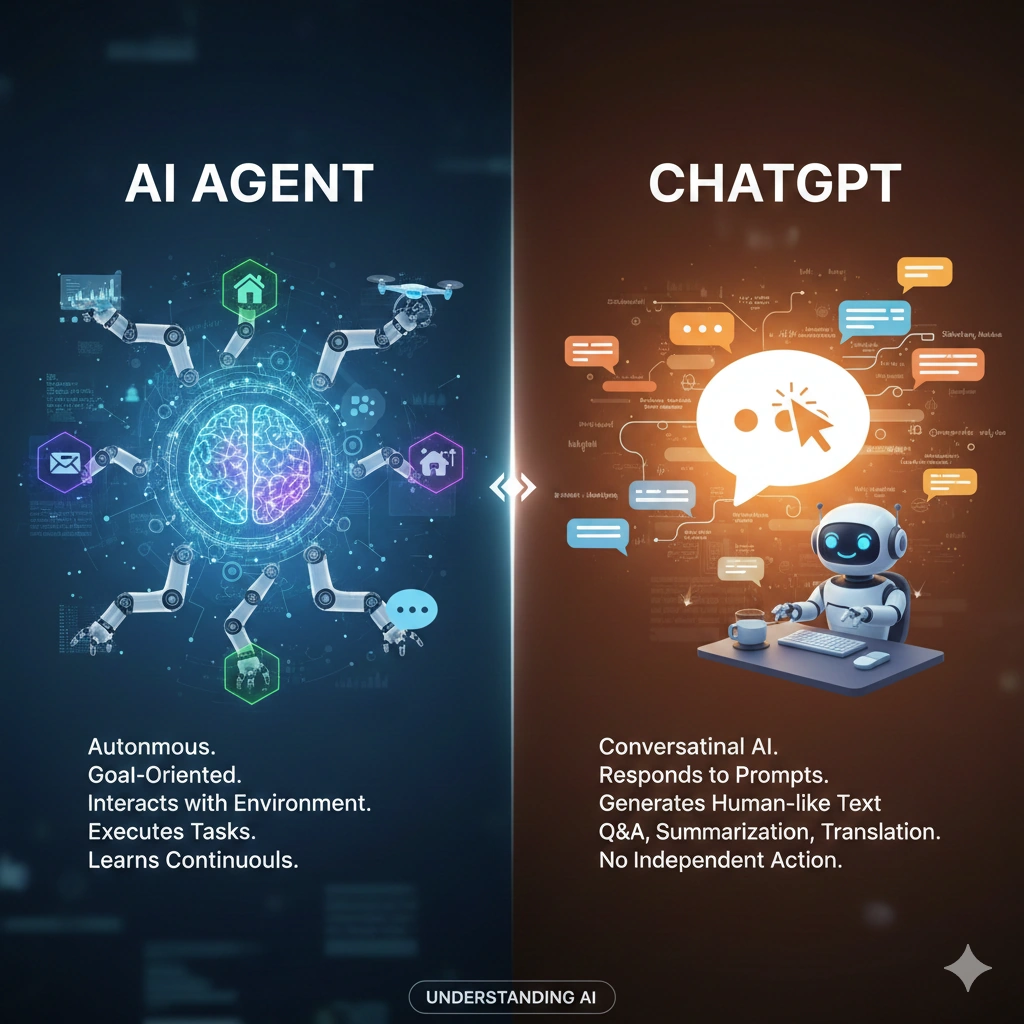
Introduction
As artificial intelligence becomes more common in business, the terminology has started to blur. Executives hear phrases like AI agent, ChatGPT, copilots, automation, and assistants used interchangeably. They are not the same thing, and misunderstanding the difference often leads to poor technology decisions.
This article explains what an AI agent actually is, how it differs from ChatGPT and AI copilots, and why businesses are increasingly shifting toward agent based systems.
What Is an AI Agent?
An AI agent is a software program or application that is designed to achieve a goal by taking actions, not just generating responses.
At a practical level, an AI agent can observe information, decide what to do next, and execute actions using tools, APIs, or other systems. It is built to complete tasks end to end, often with minimal human involvement. An AI agent may read incoming data, interpret it, apply rules or reasoning, interact with multiple systems, and produce a real world outcome such as updating a record, sending an approval, triggering a workflow, or escalating an issue.
For example, a simple AI office assistant can watch a mailbox of a CEO, select important emails, write reply emails, and put in the priority list for the CEO to review and approve them. To read emails, it will connect to the email system, for reading, understanding, and writing it may use an LLM such as GPT-5, and to notify CEO, it may use a notification service.
You can think of an AI Agent as a worker that can replace a human.
What Is ChatGPT?
ChatGPT is a conversational AI model. Its purpose is to generate human like responses to text prompts. It is extremely good at explaining concepts, drafting content, summarizing information, and helping users think through problems. However, it is fundamentally reactive. It waits for a prompt and produces a response.
ChatGPT does not independently decide to take action. It does not monitor systems. It does not carry goals forward unless a user repeatedly guides it. On its own, it cannot execute business processes. In business terms, ChatGPT is a powerful knowledge assistant, not a worker.
What Are AI Copilots?
AI copilots sit between chat based tools and full AI agents. Copilots are embedded into existing software products such as development tools, office applications, design platforms, or CRM systems. Their role is to assist a human user while they are working.
They suggest code, draft emails, summarize meetings, recommend next steps, or speed up repetitive tasks. The key distinction is control. The human remains in charge, and the copilot responds to direct interaction. Copilots improve productivity, but they do not replace workflows.
The Practical Difference
The easiest way to understand the difference is through responsibility. ChatGPT provides answers. Copilots assist humans. AI agents take responsibility for outcomes.
A chatbot can tell you how to process an invoice. A copilot can help you fill out the invoice faster. An AI agent can receive the invoice, validate it, route it for approval, update the accounting system, and notify stakeholders.
How AI Agents Work Behind the Scenes
AI agents are not magic, and they are not a single model running unchecked. Behind the scenes, most production grade agents follow a structured architecture.
The agent is given a goal or responsibility. This could be processing invoices, resolving support tickets, monitoring systems, or coordinating tasks across departments.
The agent observes inputs. These may come from user requests, system events, documents, databases, APIs, or message queues.
The agent reasons about what to do next. This is where large language models or decision engines are used to interpret context, apply rules, and determine the next action. In well designed systems, this reasoning layer is constrained by business logic, permissions, and domain rules.
The agent takes action through tools. These tools may include internal APIs, third party services, databases, workflow engines, or messaging systems.
Finally, the agent evaluates the outcome and decides whether the goal has been achieved, whether another step is required, or whether human intervention is needed.
This observe decide act loop is what separates an AI agent from a chatbot. The agent is continuously moving toward completion, not waiting passively for the next prompt.
AI Agents Versus Traditional Automation Tools
Traditional automation works best when processes are stable, predictable, and rule based. If a workflow can be clearly defined with fixed conditions and minimal variation, standard automation or RPA tools are often the simplest and safest option.
AI agents become valuable when workflows involve ambiguity, unstructured data, or changing conditions. Examples include interpreting emails, handling exceptions, coordinating across systems, or making contextual decisions.
In practice, AI agents do not replace automation. They extend it. Many successful systems use automation for deterministic steps and AI agents for judgment, coordination, and exception handling. The mistake is trying to force AI agents into problems that are already well solved by simpler tools, or expecting automation tools to handle complex reasoning they were never designed for.
Why Businesses Are Moving Toward AI Agents
Businesses are under pressure to operate faster, reduce costs, and scale without adding headcount. While chatbots and copilots help individuals work more efficiently, they do not fundamentally change how a business operates.
AI agents do.
Well designed agents can automate entire workflows, coordinate across departments, and operate continuously. They can handle customer service actions, billing processes, compliance checks, monitoring tasks, and internal operations at a scale that humans cannot match.
This is why many organizations are shifting from experimenting with conversational AI to investing in agent based architectures.
Risks and Governance
AI agents introduce real responsibility, which also means real risk. Poorly designed agents can make incorrect decisions, act on incomplete data, or operate without sufficient oversight. This is why professional implementations include guardrails such as permission controls, approval steps, logging, monitoring, and domain constraints. The risk is not the concept of AI agents. The risk is deploying them without proper architecture, governance, and accountability.
Conclusion
ChatGPT changed how people interact with information. Copilots changed how people work inside tools. AI agents are changing how work itself gets done. Understanding this distinction matters. Companies that treat all AI as the same tool will struggle to see meaningful returns. Companies that understand where agents belong will gain speed, efficiency, and competitive advantage.
Join the conversation! Your thoughts help the community grow.