

"iOS 11 sets a new standard for the world’s most advanced mobile operating system. Your apps can now become more intelligent using the power of machine learning with Core ML. You can create incredible augmented reality experiences with ARKit. And you can deliver a more unified and immersive user experience with new multitasking features, including drag and drop for iPad, the new Files app, new camera APIs, new SiriKit domains, Apple Music integration, and more." ~ Apple Inc.
Journey of iOS
Apple's Steve Jobs introduced the iPhone to the world in 2007. In the years that followed, the iPhone, iPad, and iPod Touch have literally redefined the entire world of mobile computing. During the original iPhone announcement, Apple proclaimed that it ran on the same Unix core as Mac OS X and that it used many of the same tools. However, it was evident from the start that while there may be some shared elements between OS X and this new phone OS, it will soon require an operating system for its requirements. When the original iPhone launched, the operating system was called "iPhone OS" which changed to iOS with the release of iOS 4 in the June month of 2010. It is intriguing to know that when the original iPhone was introduced, Windows Mobile, Palm OS, Symbian, and even BlackBerry were all much ahead of it with a wide and deep array of features which Apple didn’t provide. It was actually well behind the competition when it came to a strict feature-by-feature comparison; for example, the iPhone didn't support 3G, multitasking, 3rd party apps, MMS, tethering, Exchange push email, voice dialing, editing Office documents, copy or paste text etc. Even you couldn't attach arbitrary files to emails, and it didn't have a customizable home screen, it hid the file system from users.
Yet, all of those missing features hardly mattered and people lapped up the iPhone almost instantly because instead of competing on specs, Apple focused on getting the core experience right. It focused on speed, consistency between apps, and making a few features radically better than anything else that was available in 2007. The culture of innovation has made Apple into a technology giant and to develop a ‘cult’ following among people. Following its tradition, Apple introduced the next-generation version of iOS on June 5, 2017, at the Worldwide Developers Conference. Apple CEO Tim Cook said on stage, the update takes the best and most advanced operating system and turns it up to 11.
What's new in iOS 11
iOS 11 has a lot to offer to both- the iPhone and the iPad. These features are all quite simple and focus on productivity, but they're a key to making the device more powerful and useful.
New features
iOS for iPhone X features an all-screen Super Retina display for absolutely delightful app experiences and Face ID secures the device to unlock, authenticate, and pay with ease and confidence. The TrueDepth camera works with ARKit, and the A11 Bionic chip is designed for Core ML and Metal 2.
- iOS 11 introduces subtle design changes throughout the operating system; for example, the text is bolder, the Lock screen and Control Center have been redesigned, and apps like Calculator and Phone sport a new look.
- The Control Center is customizable and there are options to include a wider range of settings.
- 3D Touch integration has been expanded and you no longer need to open the Settings app.
- The Lock screen has been merged with Notification Center.
- All the notifications are now at one place and available when you swipe down on the screen to access notifications.
- Siri is now better integrated with Apple Music.
- Siri is more adaptive now. It can learn user preferences and sync that information across multiple devices, allowing the personal assistant to learn more about a user and anticipate what they want.
- Siri can also translate English into different languages like Spanish and Chinese, and more deeper.
iPad-exclusive features in iOS 11 make it more capable than ever before, allowing access to your favorite and most frequently used apps or files quickly and easily from any screen. For iPad, Apple has introduced a host of new features like -
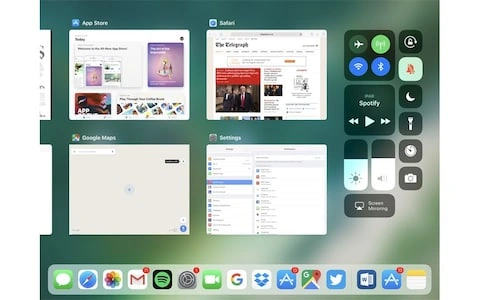
- A persistent Dock at the bottom of the display makes it easy to launch and switch between apps.
- App Switcher allows users to glance at everything they are working on.
Source: Apple
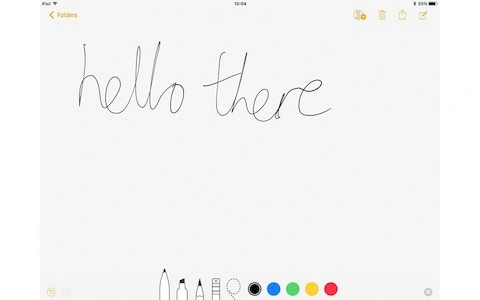
- Apple Pencil supports inline drawing and taking notes instantly.
Source: Google
Features common to both iPad and iPhone
- Drag and Drop lets you drag the content like images and links from one app and drop it in another by hovering over the icon, made possible by Spring-loading.

Source: Google
- Multi-select
iOS 11 introduces a fast and easy way to select multiple items. Start dragging one item and then tap others to add them. - Systemwide Integration
Drag and drop have been integrated throughout iOS and can be used in the following places: Home screen, Dock, Reminders, Calendar, Messages, Spotlight, Files, Safari, Contacts, iBooks, News, Notes, Photos, Maps, Keynote, Pages, and Numbers. Using a simple and powerful API, you can adopt drag and drop in your app.
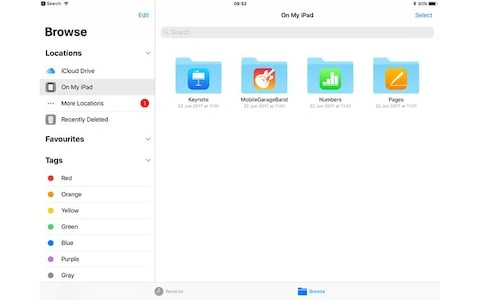
- Files app provides a central space for users to browse, search, and organize files — including files in your apps, on other iOS devices, in iCloud Drive, and across other services, like Box and Dropbox.
Source: Apple
- Users can open files right within your app with the new, standard document manager in iOS 11. Take advantage of service-specific APIs from cloud storage providers and use iCloud Sharing to let users easily share their files.
- Finder-style Files app lists all files stored locally, in iCloud Drive, in apps, and in third-party cloud services like Dropbox and Google Drive, allowing easy management.
- The one-handed keyboard features, with "Flick" option for typing numbers and symbols more quickly on the iPad.
- Notes app includes searchable handwriting and document scanning.
- Now, iOS includes indoor maps for malls and airports; along with lane guidance, speed limit info etc.
- MusicKit on iOS lets users play Apple Music and their local music library natively from your apps and games. When a user provides permission to their Apple Music account, the app can create playlists, add songs to their library, and play any of the millions of songs in the Apple Music catalog. If your app detects that the user is not yet an Apple Music member, you can offer a trial from within your app.
- AirPlay lets the user stream content to displays and audio systems with AirPlay. Using Media Player APIs that support AirPlay, users can play content from an iOS device on a high-definition TV using Apple TV or to an AirPlay-enabled sound system.
- Business Chat is a powerful new way for businesses to connect with customers directly in messages. Customers can find your business and start conversations from Safari, Maps, Spotlight, and Siri. The following customer service platforms have already been integrated with Business Chat — LivePerson, Salesforce, Nuance, and Genesys.
- iOS 11's Messages app has been updated with several new features including a new app drawer which contains stickers, the new Apple Pay peer-to-peer feature that lets you pay contacts via iMessage, and lots more.

- Portrait Mode and Live Photos have been improved with new capabilities in the camera app. Photos and videos also take up less space through the adoption of new HEIF and HEVC formats.
- Do Not Disturb mode for driving, muting notifications while a vehicle is in motion
- A new App Store is there in iOS 11 with two distinct sections for apps and games. You'll see new Collections, a Daily List centered around a particular theme, and even tutorials that show you how to do particular things in the new apps.
App store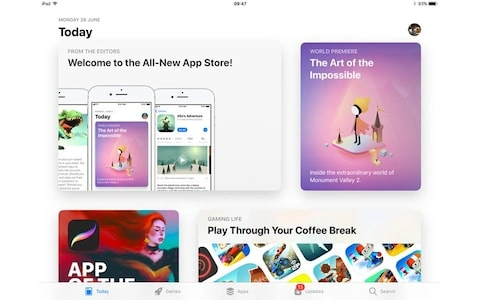
Source: Apple - One of the signature features of Google Now is finally coming to the iOS: When you type in iOS 11, the keyboard will suggest words you may have recently viewed on your phone — from your Messages app, for example, or Safari.
- Improved data tracking: Within the Mobile Data section of the Settings app, a bunch of new options and menus have been added. There's a new addition to iOS that'll make it much easier to manage mobile data without the need to download a third-party app from the App Store. Now, the user will be able to find out how much data they have used and how much they have left in the Settings app. It will allow users to even change data plan from within the Settings app. This feature, however, will have to be compatible with the service provider.
Apple is introducing new APIs mainly CoreML and ARKit for better app and gaming experience. CoreML provides machine learning tools to developers, while ARKit lets developers build complex and richly detailed augmented reality features into their apps. Let us explore these two features in detail to understand what they are capable of.
CoreML
Core ML delivers blazingly fast performance with easy integration of machine learning models enabling you to build apps with intelligent new features using just a few lines of code. It lets developers integrate a broad variety of machine learning model types into any app. In addition to supporting extensive deep learning with over 30 layer types, it also supports standard models such as tree ensembles, SVMs, and generalized linear models. Because it’s built on top of low-level technologies like Metal and Accelerate, Core ML seamlessly takes advantage of the CPU and GPU to provide maximum performance and efficiency. It is possible to run machine learning models on the device so data doesn't need to leave the device to be analyzed.
Supported features include face tracking, face detection, landmarks, text detection, rectangle detection, bar code detection, object tracking, and image registration.
- Natural Language Processing
The natural language processing APIs in Foundation use machine learning to deeply understand text using features such as language identification, tokenization, lemmatization, part of speech, and named entity recognition. - Models
Developers can build apps with the ready-to-use Core ML models like- MobileNets - is based on a streamlined architecture that has depth-wise separable convolutions to build lightweight, deep neural networks. Detects the dominant objects present in an image from a set of 1000 categories such as trees, animals, food, vehicles, people, and more.
- Squeezenet - Detects the dominant objects present in an image from a set of 1000 categories such as trees, animals, food, vehicles, people, and more. With an overall footprint of only 5 MB, SqueezeNet has a similar level of accuracy as AlexNet but with 50 times fewer parameters.
- Places205- GoogLeNet: Detects the scene of an image from 205 categories such as an airport terminal, bedroom, forest, coast, and more.
- Other models available include ResNet50, Inception v3 and VGG16 or use Core ML Tools to easily convert models into the Core ML format
ARKit
iOS 11 introduces ARKit, a new framework that allows developers to easily create unparalleled augmented reality experiences for iPhone and iPad. By blending digital objects and information with the environment around you, ARKit takes apps beyond the screen, freeing them to interact with the real world in entirely new ways. ARKit comes handy in the following apps and features
- TrueDepth Camera
iPhone X and ARKit enable a revolutionary capability for robust face tracking in augmented reality apps. Using the TrueDepth camera, an app can detect the position, topology, and expression of the user’s face, with high accuracy and in real time, making it easy to apply live selfie effects or use facial expressions to drive a 3D character. - Visual Inertial Odometry
ARKit uses Visual Inertial Odometry (VIO) to accurately track the world around it. VIO fuses camera sensor data with CoreMotion data. These two inputs allow the device to sense how it moves within a room with a high degree of accuracy, and without any additional calibration. - Scene Understanding and Lighting Estimation
With ARKit, iPhone and iPad can analyze the scene presented by the camera view and find horizontal planes in the room. ARKit can detect horizontal planes like tables and floors, and can track and place objects on smaller feature points as well. ARKit also makes use of the camera sensor to estimate the total amount of light available in a scene and applies the correct amount of lighting to virtual objects. - High-Performance Hardware and Rendering Optimizations
ARKit runs on the Apple A9, A10, and A11 processors. These processors enable fast scene understanding and allow creating detailed and compelling virtual content on top of real-world scenes. ARKit can be optimized for Metal, SceneKit, and third-party tools like Unity and Unreal Engine.
Other than the features listed above, the iOS 11 has some more fancy surprises up its sleeves. It makes the need for saving passwords for WiFi network obsolete. So, now if you need a WiFi password for a given network, all that is needed is to find someone who is already using the network and hold the device near theirs. The password will be transferred instantly. iOS11 allows customization of a new device way easier by allowing import of all your settings, preferences, and iCloud Keychain passwords from the old one by holding it close to an iOS device you already own
Reference
- https://developer.apple.com/
- https://www.macrumors.com/roundup/ios-11/
- https://www.cnet.com
- http://www.macworld.co.uk/feature/iosapps/new-ios-11-latest-news-uk-release-date-new-features-3647951/
- http://www.telegraph.co.uk
- http://www.businessinsider.in/tech/13-things-everyone-is-going-to-love-about-ios-11/slidelist/59531085.cms
Hadshana KamalanathanPosted Jul 22, 2018, 4:08 AM
Good one..
Sundaram SubramanianPosted Sep 28, 2017, 5:56 AM
Great one !!!. Thanks for sharing !!!
Khaja MoizuddinPosted Sep 20, 2017, 2:32 PM
Article written with great research, a lot new things to learn...