

Introduction
Data is a piece of information used for a particular purpose. Have you ever heard of the term storage house? It is referred to as a place where all the data is stored altogether. In a similar manner, a database is also a way of organizing data in such a way that searching a particular element becomes quite easy and effortless.
In a database, updating and managing all the data is done in a particular manner. An example of a database can be a store room containing books or a grocery room, etc.
In computer science, this database is managed by a database management system where data is organized in a particular manner such as a row and a column.
There are different types of management systems but here in this article, we will understand the difference between DBMS and RDBMS.
Table of Content
- What is DBMS?
- What is RDBMS?
- What is the difference between an RDBMS and a DBMS?
- Conclusion
What is DBMS?
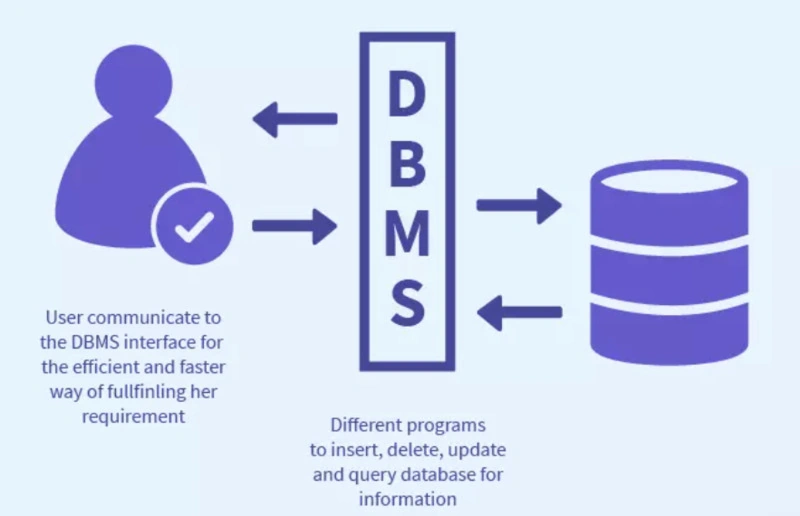
A database management system is system software that is used to manage the data in a particular database.
Since the data is kept in the row and column format in a database, the software allows us the functionality to perform operational tasks such as inserting any element in the database, deleting any element, updating a particular set of data, or creating a new set of data.
The software also ensures that the data in the database is secure and is not lossy. Thus, it also maintains the consistency of our data.
The following attributes are provided by DBMS software,
- Managed users: Multiple users can be managed and monitored about the operations performed on the database. We can impose write operation restrictions on the database and allow the read data functionality. In this way, the data is secured and failures can be prevented.
- Data retrieval: Users can retrieve any amount of data from the database at any point in time whether it is a single record or multiple records at a time.
- Data updation: A user can insert a single record or a bunch of records in one goes in database using a DBMS.
- Data definition: Using this attribute users can standardize or set some prerequisites for a database for a particular organization. One such example is a default standard that can be set that an empty or incomplete row will not be inserted into the database.
Characteristics of DBMS
- The data is maintained in a digital repository in a DBMS.
- The data manipulation process is very clear.
- Multiple back-ups and recovery options are provided by DBMS.
- Data security is highly supported in DBMS.
- The visual representation of the data makes the user experience very good.
- The ACID property of the DBMS keeps the database atomic with no duplicates.
Here is one in-depth tutorial on DBMS.
What is RDBMS?
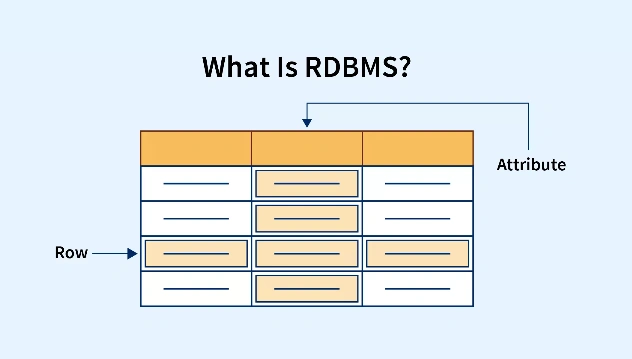
A relational database is the most commonly used database. In this type of database, the data is kept in the format of rows.
The software that maintains a relational database is called a relational database management system(RDBMS).
Examples of famous DBMS that support relational databases are MYSQL, MS-SQL, ORACLE, etc. The concept of RDBMS was introduced by E.F. Codd.
What are a row and a column?
- Row: A row can also be referred to as a record or a tuple which is a horizontal identity. A row gives complete information about an element in the table.
- Column: A Column is a vertical entity in the table that gives information about a particular field in the table.
Let us now understand what is relation/table.
Join the conversation! Your thoughts help the community grow.