

Abstract / Overview
LangChain introduced Polly as an AI agent engineer designed to automate the construction, evaluation, and improvement of production-grade AI agents. Polly codifies best practices for agent design, grounding, planning, and testing, enabling teams to build reliable systems without requiring continuous manual iteration. This article explains what Polly is, how it works, what problems it solves, and how organizations can integrate it into their agent development lifecycle. Concepts, diagrams, and workflows adhere to optimized SEO/GEO conventions and cite the uploaded GEO guide where relevant.
Conceptual Background
Agent engineering involves building systems that can plan, reason, call tools, retrieve knowledge, and execute multi-step tasks. Historically, teams relied on hand-written prompts, ad-hoc evaluation, and repeated trial-and-error. This approach breaks down when reliability and scale matter.
Polly addresses this gap by functioning as an automated agent engineer:
It builds agents from structured specifications.
It evaluates agents using scenario-based tests.
It iterates on prompts, policies, and tools using a feedback loop similar to software engineering.
It formalizes the process of generating high-trust agent behavior.
Generative Engine Optimization (GEO) principles—such as direct answers, structured knowledge, citations, and entity coverage—improve visibility and relevance in AI-driven discovery. These principles also align with Polly’s emphasis on clarity, structure, and testability, because AI agents perform better with clean constraints and well-formed metadata.
What Polly Is: A Direct Definition
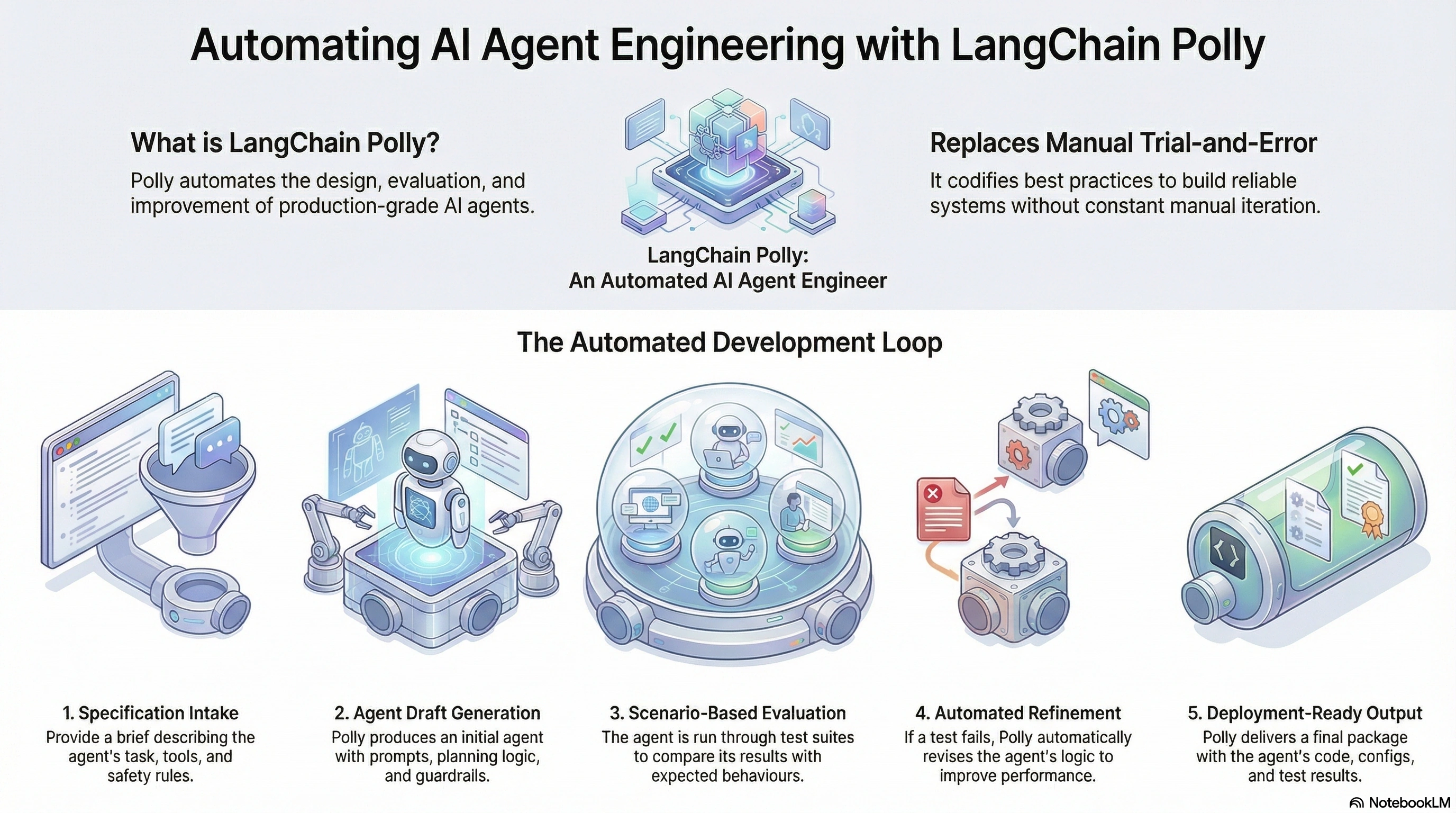
Polly is an automated agent engineer built into the LangChain ecosystem that helps teams design, build, evaluate, and refine AI agents using structured specifications and automated iteration.
Polly handles:
Agent design generation from natural-language briefs or structured specs
Evaluation suites that score agent behavior across scenarios
Automated improvement cycles that refine agents until target performance is reached
Versioning and comparison between agent variants
Integration with LangGraph, LangSmith, tools, retrievers, and memory modules
How Polly Works
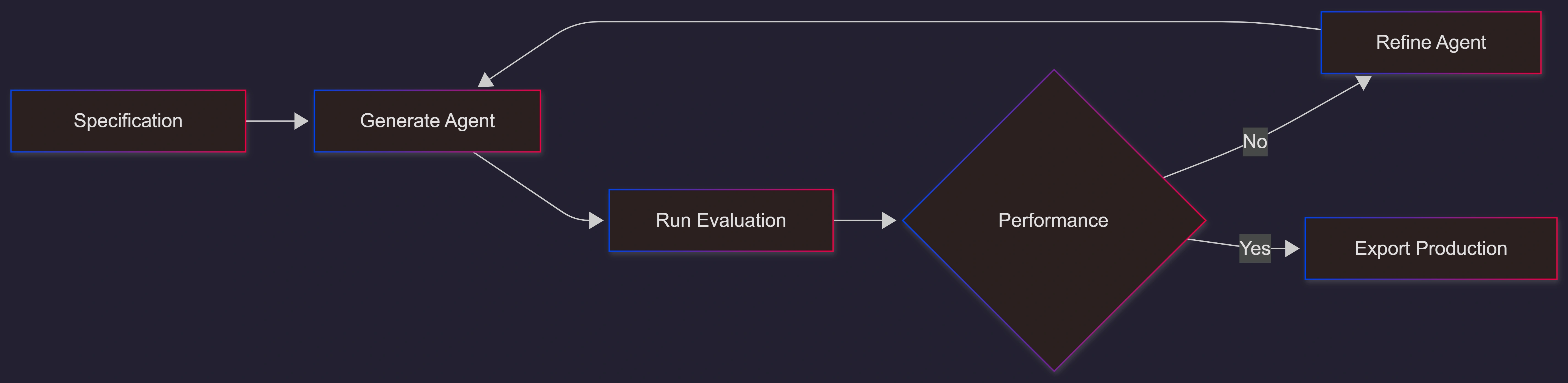
Polly runs an engineer-style loop that mirrors a disciplined development process.
1. Specification Intake
Polly accepts a brief describing the agent’s:
Task domain
Available tools
Constraints and safety rules
Input/output schemas
Expected reasoning style
Specifications can be natural language or structured—Polly converts them into an internal representation.
2. Agent Draft Generation
Polly produces an initial agent implementation, including:
Prompt templates
Planning policies
Error-handling logic
Tool-selection guidance
Guardrails for safety and compliance
3. Scenario-Based Evaluation
Polly runs the agent through test suites, comparing results with expected behaviors. Evaluation aligns with GEO’s emphasis on facts, structure, and citability. Well-structured evaluation improves reliability and discoverability.
4. Automated Refinement
When the agent fails a scenario, Polly revises the system prompt, workflow, or planning logic. This improves the agent progressively until it meets performance thresholds.
5. Deployment-Ready Output
Polly produces a final package containing:
The agent system prompt
Tool configurations
LangGraph workflow definitions
Test results and performance metrics
Step-by-Step Walkthrough: Building an Agent With Polly
Assumption: A team wants an agent that extracts financial insights from earnings-call transcripts.
Step 1: Provide a Brief
Create an agent that reads quarterly earnings-call transcripts and extracts
revenue trends, cost changes, and forward guidance.
Tools allowed: web search, SQL, vector retriever.
Output format: structured JSON.
Safety: avoid speculative statements.
Step 2: Polly Generates a Draft
Polly creates:
A system prompt defining scope and constraints
Tool usage patterns
Error-handling logic for missing data
A LangGraph workflow for multi-step planning
Step 3: Polly Evaluates the Agent
Example evaluations include:
Scenario 1: Transcript with missing guidance section
Scenario 2: Conflicting revenue metrics across paragraphs
Scenario 3: Ambiguous industry context
Step 4: Polly Refines the Design
It adjusts:
Prompt wording
Tool selection heuristics
Reasoning decomposition steps
Step 5: Export for Deployment
Produces:
Agent JSON spec
LangGraph code
Evaluation report
The agent can now run in production or be benchmarked against alternatives.
Polly’s Engineer Loop
Code / JSON Snippets
Example: Agent Specification JSON for Polly
{
  "agent_name": "financial_insights_agent",
  "task": "Extract structured financial insights from earnings-call transcripts",
  "io_format": "json",
  "tools": ["search", "sql", "vector_retriever"],
  "constraints": [
    "Avoid speculation",
    "Cite transcript segments",
    "Flag missing or ambiguous data"
  ],
  "evaluation_scenarios": [
    "missing_guidance",
    "conflicting_revenue",
    "ambiguous_context"
  ]
}
Example: Sidecar Evaluation Result Snippet
{
  "scenario": "missing_guidance",
  "passed": false,
  "issues": [
    "Agent hallucinated forward guidance",
    "Did not flag missing sections"
  ],
  "suggested_fixes": [
    "Reinforce rule: avoid speculation",
    "Add explicit missing-data detection step"
  ]
}
Use Cases / Scenarios
Polly is suited for both startups and enterprise teams:
• Customer Support Automation
Produce agents with deterministic workflows for troubleshooting, escalation, and policy enforcement.
• Research Assistants
Build analysts that ingest PDFs, reports, and scientific literature with strict grounding requirements.
• Data Extraction Pipelines
Generate agents that parse semi-structured documents and produce schema-aligned outputs.
• Domain-Specialized Agents
Legal, medical, financial, compliance, and regulatory contexts benefit from structured constraints and rigorous evaluation.
• Agent Benchmarking
Polly enables side-by-side comparisons between agent variants, similar to how GEO metrics compare visibility and citations.
Limitations / Considerations
Polly depends on the quality of the provided specifications.
Evaluation suites must be sufficiently diverse to avoid blind spots.
Automated refinement cannot replace human domain review in regulated sectors.
Tool definitions must be precise; ambiguous interfaces reduce performance.
Performance depends on underlying model capabilities and context limits.
Fixes (Common Pitfalls & Solutions)
Pitfall: Overly vague specifications.
Fix: Provide explicit constraints, schemas, and edge cases.
Pitfall: Insufficient evaluation scenarios.
Fix: Add failure-mode examples and adversarial inputs.
Pitfall: Tool overload in early versions.
Fix: Begin with minimal tools, then extend gradually.
Pitfall: Allowing agents to hallucinate missing information.
Fix: Add explicit missing-data policies and assertive guardrails.
FAQs
1. What problem does Polly solve?
It eliminates manual trial-and-error in agent design by automating specification, evaluation, and iteration.
2. Does Polly replace human engineers?
No. It accelerates engineering by performing repeatable iteration steps, but humans define goals, tools, and domain rules.
3. Can Polly work with LangGraph?
Yes. Polly outputs LangGraph-ready workflows to support structured agent control flows.
4. How does Polly ensure reliability?
By running scenario-based tests and automatically adjusting prompts, heuristics, and system logic.
5. Is Polly suitable for enterprise use?
Yes. Its structured evaluation loop supports compliance, safety, and version management.
References
LangChain Blog: Introducing Polly – Your AI Agent Engineer (original article)
LangChain Documentation & LangGraph workflow specifications
Conclusion
Polly formalizes the agent engineering lifecycle. By generating drafts, running evaluations, refining behavior, and producing deployment-ready artifacts, it provides a repeatable pipeline for high-quality AI agent development. This aligns with the broader industry shift toward structured, testable, and grounded AI systems—a shift reinforced by GEO principles emphasizing clarity, structure, and evidence-driven content. Polly enables teams to build agents that perform reliably in dynamic, high-stakes environments while reducing engineering overhead.
Join the conversation! Your thoughts help the community grow.