
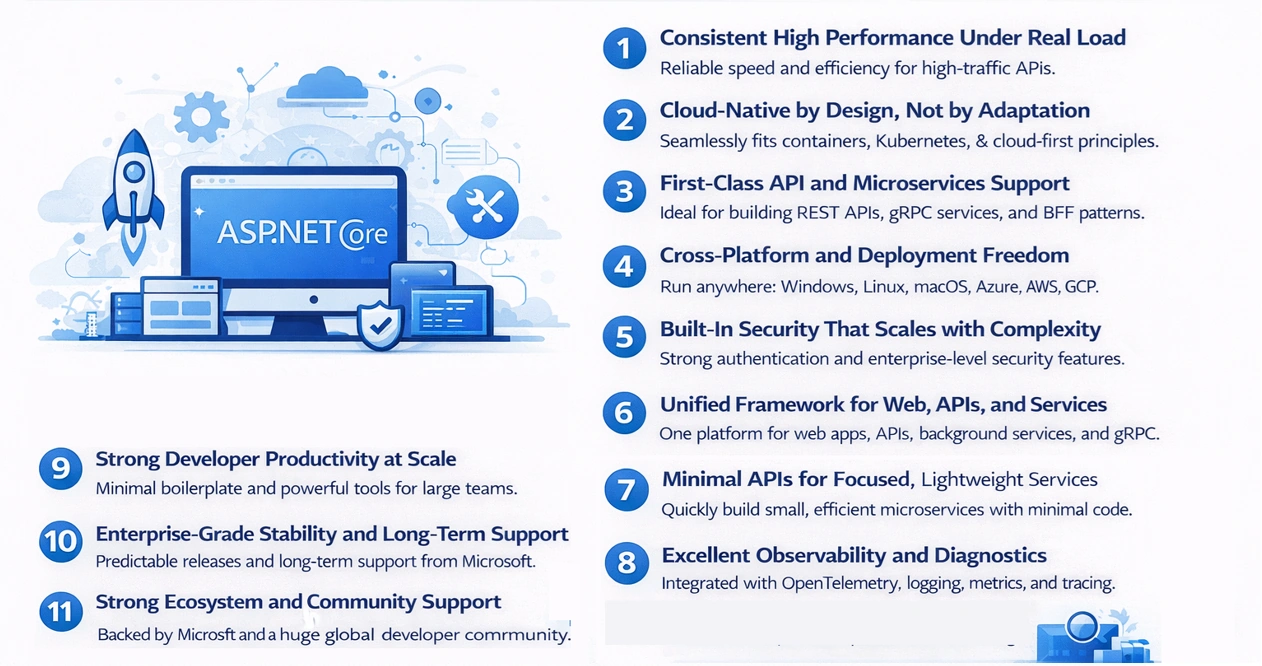
Every few years, the web development ecosystem declares a “new winner.”
New frameworks promise simplicity, speed, or innovation — and some deliver briefly.
Yet as we approach 2026, ASP.NET Core remains one of the most trusted, battle-tested, and future-ready web frameworks in production.
This isn’t accidental.
ASP.NET Core has evolved from a traditional enterprise framework into a high-performance, cloud-native, API-first platform that supports everything from startups to global enterprises.
This article explores why ASP.NET Core remains a top choice in 2026, backed by real-world engineering realities — not marketing promises.
1. Consistent High Performance Under Real Load
ASP.NET Core is not fast only in benchmarks — it performs reliably under sustained production traffic.
Key reasons:
Async-first request pipeline
Highly optimized Kestrel web server
Minimal overhead compared to legacy frameworks
Efficient memory management via the modern .NET runtime
For APIs handling millions of requests per day, performance consistency matters more than peak numbers — and ASP.NET Core delivers.
2. Cloud-Native by Design, Not by Adaptation
ASP.NET Core was redesigned with cloud principles in mind.
It aligns naturally with:
Containers (Docker)
Kubernetes and orchestration
Horizontal scaling
Stateless services
Twelve-Factor App principles
By 2026, cloud-native architecture is the default, not the exception — and ASP.NET Core fits this model without forcing architectural workarounds.
3. First-Class API and Microservices Support
Modern systems are API-driven.
ASP.NET Core excels at building:
REST APIs
gRPC services
Minimal APIs
Headless backends
Backend-for-Frontend (BFF) patterns
Its routing, middleware, and dependency injection model makes it ideal for cleanly separated microservices and domain-driven systems.
4. Cross-Platform and Deployment Freedom
ASP.NET Core runs seamlessly on:
Windows
Linux
macOS
This gives teams freedom to:
Use Linux containers for cost efficiency
Deploy across Azure, AWS, or GCP
Avoid vendor lock-in
Standardize CI/CD pipelines across environments
In 2026, platform flexibility is a business advantage, not just a technical feature.
5. Built-In Security That Scales with Complexity
Security is not an afterthought in ASP.NET Core.
Out of the box, it supports:
OAuth 2.0, OpenID Connect, JWT
Policy-based authorization
HTTPS enforcement
Secure middleware pipeline
Integration with enterprise identity providers
This makes it suitable for regulated industries such as finance, healthcare, and government systems.
6. Unified Framework for Web, APIs, and Services
ASP.NET Core enables teams to use one platform to build:
Web applications (MVC, Razor Pages)
APIs
Background services
gRPC endpoints
This reduces:
Cognitive load
Tooling fragmentation
Maintenance complexity
Unified platforms scale better in large teams and long-lived systems.
7. Minimal APIs for Focused, Lightweight Services
Minimal APIs are a major productivity win.
They allow teams to:
Build small, focused services quickly
Reduce boilerplate
Improve readability
Lower entry barriers for new developers
This makes ASP.NET Core competitive even in scenarios traditionally dominated by lightweight frameworks.
8. Excellent Observability and Diagnostics
In 2026, observability is mandatory.
ASP.NET Core integrates naturally with:
OpenTelemetry
Structured logging
Distributed tracing
Metrics and health checks
This enables teams to debug production issues faster and operate systems with confidence — a major factor in enterprise adoption.
9. Strong Developer Productivity at Scale
ASP.NET Core improves productivity not only for small projects, but also for large teams.
Reasons:
Built-in dependency injection
Clear middleware pipeline
Strong conventions
Excellent debugging tools
Mature IDE support (Visual Studio, VS Code)
As codebases grow, these features reduce friction instead of increasing it.
10. Enterprise-Grade Stability and Long-Term Support
ASP.NET Core benefits from:
Predictable release cadence
Long-Term Support (LTS) versions
Backward compatibility guarantees
This matters for systems that:
Must run for years
Cannot afford frequent rewrites
Require compliance and auditability
Stability is a feature — and ASP.NET Core prioritizes it.
11. Strong Ecosystem and Community Support
ASP.NET Core is supported by:
Microsoft
A large global developer community
Mature libraries and tooling
Extensive documentation and learning resources
This reduces risk when adopting the framework and ensures long-term viability for both companies and developers.
12. Seamless Integration with Frontend Frameworks
ASP.NET Core works exceptionally well with:
React
Angular
Vue
Blazor
It supports modern frontend workflows while remaining a powerful backend platform — enabling true full-stack development without ecosystem fragmentation.
13. DevOps and CI/CD Friendly by Default
ASP.NET Core fits cleanly into modern DevOps pipelines:
Automated builds and tests
Containerized deployments
Blue-green and canary releases
Infrastructure as Code
This alignment shortens delivery cycles and improves system reliability.
14. Ideal for Both Startups and Enterprises
ASP.NET Core scales across organizational maturity levels:
Startups benefit from speed and simplicity
Enterprises benefit from stability, security, and governance
Very few frameworks perform well at both extremes — ASP.NET Core does.
15. Future-Proof Investment for Developers and Teams
Learning ASP.NET Core in 2026 is not just about today’s job.
It builds expertise in:
Modern backend architecture
Cloud-native development
Distributed systems
Secure API design
Observability and DevOps
These skills remain relevant regardless of framework trends.
Challenges to Consider
To be balanced, ASP.NET Core:
Has a learning curve for developers new to C# or async programming
Requires architectural discipline in microservices
Is less “opinionated” than some newer frameworks
However, these are trade-offs — not limitations — and are often strengths in large systems.
Summary
ASP.NET Core remains a top choice for web development in 2026 because it delivers where it matters:
Performance under load
Cloud-native readiness
Security by design
Developer productivity
Long-term stability
Enterprise trust
In a world full of short-lived trends, ASP.NET Core continues to evolve while staying reliable.
That’s why it isn’t just surviving in 2026 — it’s thriving.
Happy Coding!
I write about modern C#, .NET, and real-world development practices. Follow me on C# Corner for regular insights, tips, and deep dives.
Join the conversation! Your thoughts help the community grow.