

If you stay in crypto long enough, you start seeing the same movie replay over and over. Thousands of projects launch with excitement, hype, influencers, videos and promises. A year later, you check the charts and more than ninety percent of them are either dead or irrelevant.
Crypto failures are not random. They follow patterns. Once you understand these patterns, you can predict with brutal accuracy which projects will survive and which will disappear.
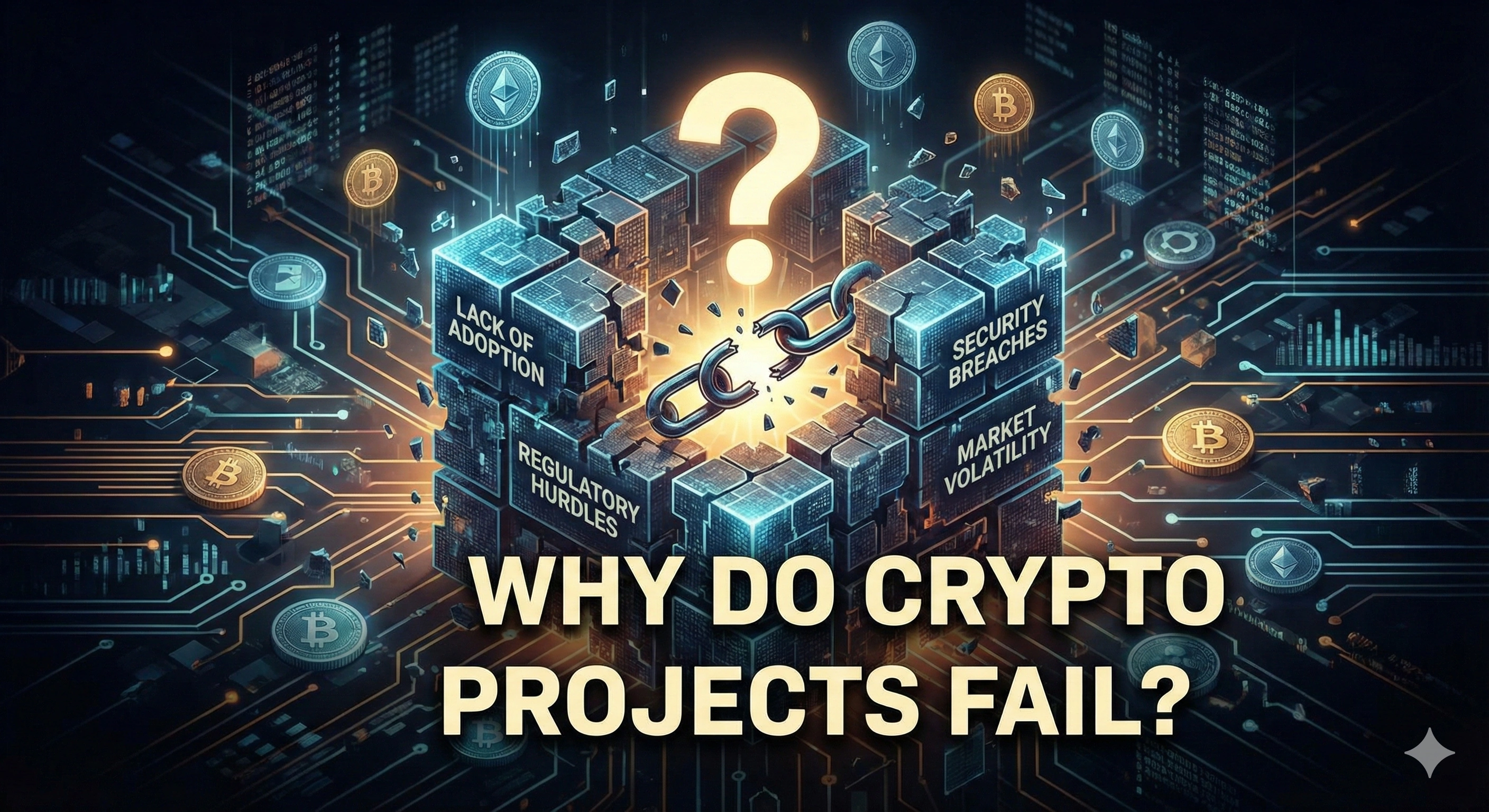
Lack of Real Utility 🚫
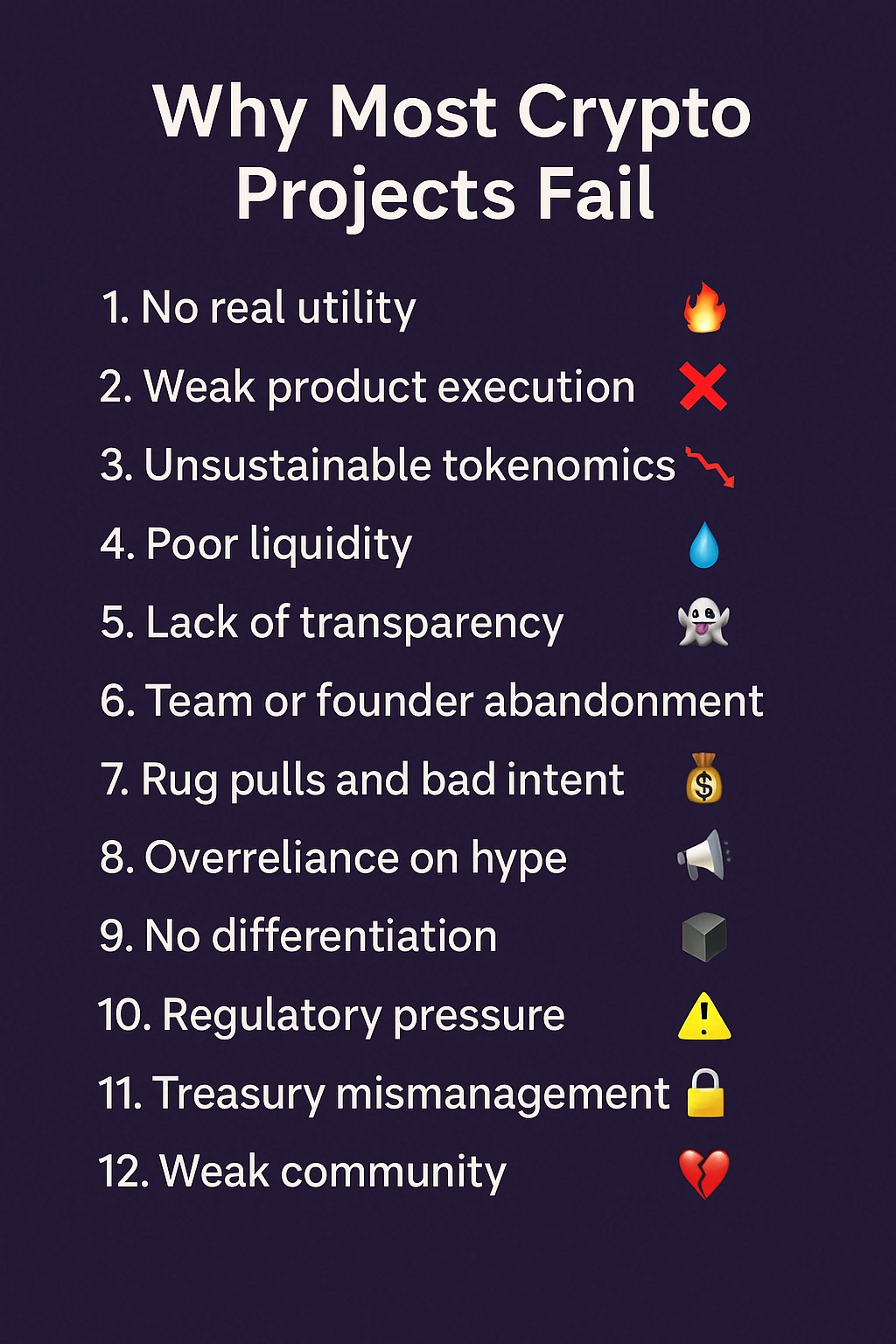
Most crypto projects launch a token before they figure out what the token is actually for. Founders come up with an idea without validating it and having a plan to acquire users and utility around it. This backward approach almost always leads to failure. A token without real utility becomes a gambling chip. It has no economic purpose. It does not power a system, solve a user problem or unlock value.
Projects like Bitconnect, Luna and countless Web3 apps relied on temporary incentives instead of real utility. Once interest slowed down, nothing remained to keep the system alive. Tokens without long term demand will always trend toward zero.
We've also seen the cycles of monkeys and dogs NFTs and now its meme tokens. At the end of the day, this kind of tokens serve no purpose. They solve no problem. Real world doesn't need them. They are not sustainable.
Inexperience Team or Incomplete Product Execution 🧱
Creating and launching a token is lot more work that putting a token on chain. Not only its creating the technology but also product, applications, and utility of the token. Once the product is built, onboarding users is another challenge,
Most token teams do not have prior experience of successful token launches. Many teams overestimate their ability to deliver real, working products. Development delays, missing features, broken apps and lack of progress slowly kill confidence.
EOS raised billions but never shipped enough compelling functionality to retain its early momentum. Many GameFi projects like Star Atlas promised cinematic worlds but delivered minimal gameplay. In crypto, execution is credibility. Without continuous delivery, a project loses its heartbeat.
Unsustainable Tokenomics 💣
Tokenomics is the engine of a crypto project. If the engine is designed badly, everything breaks. High inflation, unlimited emissions, oversized team allocations, weak vesting schedules, no burn mechanics and no real sink for the token guarantee long term collapse.
Axie Infinity is a well known example. The economic rewards paid out more tokens than the demand could absorb. The system collapsed under its own inflation. Tokenomics must support stability, not drain value.
Pi token is another example that minted more tokens over the years than it could consume at their release and token token price is tanked to almost 90% of its launch price.
Poor Liquidity Management 🌊
Liquidity is the lifeline of a token. Not only its a need but also the biggest challenge in the market today. Without enough liquidity on exchanges or decentralized pools, users cannot buy or sell without losing money due to slippage. Low liquidity signals weakness, and once trust is gone, liquidity disappears even faster.
Projects that launch without proper liquidity planning often die quietly because the token becomes untradeable, even if the underlying idea is good.
Lack of Transparency and Communication 🕵️
Crypto communities are extremely sensitive to silence. When teams stop communicating, hide treasury balances, delay updates or make major changes without explanation, the community immediately assumes something bad is happening.
Wonderland is a perfect example. Once leadership credibility issues surfaced, the entire project unraveled. Transparency is not optional in crypto. It is oxygen.
Rug Pulls and Malicious Intent 💀
Unfortunately, a large percentage of tokens fail because the founders never planned to build anything real. They focus on making quick money. Liquidity drains, stealth minting, contract backdoors and sudden disappearances are still common. These tokens are designed to fail the moment the founders profit.
The Squid Game token famously rugged overnight, wiping out millions. This is the extreme version of failure, but it is still part of the ecosystem.
Hype Driven Marketing With No Substance 🎭
Some projects rely entirely on influencers, celebrities, and short term hype. They skyrocket for a week and crash forever. They are many tokens are like that. Most of the meme tokens in the market are like that. SafeMoon became a global trend, but momentum alone cannot build an ecosystem.
When hype is the main product, the project dies the moment attention shifts elsewhere.
Competition and No Differentiation ⚔️
Crypto is brutally competitive. If a project does not stand out, it gets ignored. In 2021, hundreds of Doge clones launched. Almost all of them disappeared because they offered nothing new.
The industry rewards projects that innovate, solve problems or deliver unique capabilities.
At one time, the top L1 and L2 chains are struggling because of lack of innovation and competition.
Regulatory and Legal Issues ⚖️
Many projects fail simply because they are structured in a way that violates regulatory expectations. Tokens that resemble securities without compliance planning face delistings, lawsuits or forced shutdowns.
Kik’s Kin token suffered a devastating regulatory battle that cost millions and slowed development. Legal pressure can kill even promising ecosystems.
Treasury Mismanagement 🧨
Even a strong idea dies if the treasury runs out. Many teams burn through funds quickly or store the entire treasury in their own token. When the market drops, they suddenly have no money to operate.
Celsius and Voyager collapsed largely due to reckless treasury behavior. Proper treasury planning is essential for survival.
Team and Leadership Failures 🧑✈️
This is one of the biggest reasons projects fail and one of the least discussed. Teams shape everything. If the team breaks, the project breaks.
Here are the common patterns
Founders quit once the token pumps
Teams lose motivation during bear markets
Leadership underestimates the workload
Team members fight internally
Founders disappear after raising money
A huge number of meme coin and GameFi projects died because founders simply walked away after getting paid. The market never forgets leadership failures.
Community Weakness 🧩
A token lives or dies by its community. Building community is very difficult. Projects with passive, divided or inactive communities fade quickly. Strong communities can carry a project through bear markets.
Shiba Inu survived multiple cycles because holders treated it as a movement. Community is not marketing. Community is long term energy.
Market Cycles And Poor Timing 🌪
Some projects fail because they launch at the wrong time. Bull markets hide weaknesses because money flows everywhere. Bear markets expose everything.
Many tokens that launched at the peak of hype lost ninety percent or more when reality returned. Crypto cycles punish weak foundations.
What Separates the Winners from the Failures 🏆
Launching is token is no different than building a sustainable business that solves real world problems. The projects that survive are not lucky. They share real, concrete traits and build real utility and solve real problems. Some of the qualities of them are:
A token has true utility
The team delivers consistently
Its tokenomics is sustainable
Liquidity is stable
Leadership communicates openly
Founders stay committed for years
Community remains active
Treasury is managed professionally
The vision evolves with the market
Besides all the above points, the last part that makes a token success is getting users onboarded and use the token. This process not only requires good products, utilities, but also marketing, and customer service.
These are not optional ingredients. These are survival requirements.
Looking to launch our own token 🚀
If you are launching your own token and want expert guidance on token launch strategy, tokenomics, growth, compliance planning and long term sustainability, you can hire Mahesh Chand for professional consulting and ecosystem design.
Contact here: https://www.c-sharpcorner.com/consulting
Join the conversation! Your thoughts help the community grow.