Security  

Zero Trust Architecture

Pre-requisite to understand this

  • Networking basics – Understanding IP, ports, protocols, and network boundaries

  • Authentication & Authorization – Knowing how identity verification and access control work

  • Traditional perimeter security – Firewalls, VPNs, and trusted internal networks

  • Cloud & distributed systems – Applications running across cloud, on-prem, and hybrid setups

  • Security threats – Malware, lateral movement, insider threats, and data breaches

Introduction

Zero Trust Architecture (ZTA) is a modern security model based on the principle “Never Trust, Always Verify.” Unlike traditional security approaches that assume everything inside a network is trusted, Zero Trust treats every user, device, application, and request as untrusted by default, regardless of location. Access is granted only after continuous verification of identity, device posture, context, and policy. This approach is especially critical in today’s world of cloud computing, remote work, and API-driven architectures.

What problem we can solve with this?

Traditional perimeter-based security fails when attackers breach the network boundary, because internal traffic is often implicitly trusted. Zero Trust eliminates this implicit trust and reduces the attack surface significantly. It prevents attackers from freely moving laterally within systems and limits damage even if credentials are compromised. Zero Trust also provides better visibility and control across hybrid and multi-cloud environments. It aligns well with compliance requirements and modern DevSecOps practices. By enforcing least-privilege access and continuous validation, organizations can significantly improve resilience against advanced threats.

Problems addressed:

  • Prevents lateral movement after a breach

  • Reduces impact of stolen credentials

  • Secures remote and hybrid workforce

  • Improves visibility and monitoring

  • Enforces least-privilege access

  • Supports cloud-native and microservices architectures

How to implement/use this?

Implementing Zero Trust requires a shift in mindset and architecture rather than a single product. The process starts with identifying critical assets, users, and data flows, followed by strong identity management. Every access request is evaluated using policies based on identity, device health, location, and risk. Network segmentation and application-level controls are applied to limit exposure. Continuous monitoring and logging ensure threats are detected early. Over time, automation and adaptive policies help mature the Zero Trust posture.

Key implementation steps:

  • Strong Identity Provider (IdP) – Centralized identity and authentication

  • Multi-Factor Authentication (MFA) – Verifies user authenticity

  • Device posture checks – Validates device security state

  • Micro-segmentation – Limits network access paths

  • Policy engine – Makes dynamic access decisions

  • Continuous monitoring – Detects anomalies in real time
Sequence Diagram

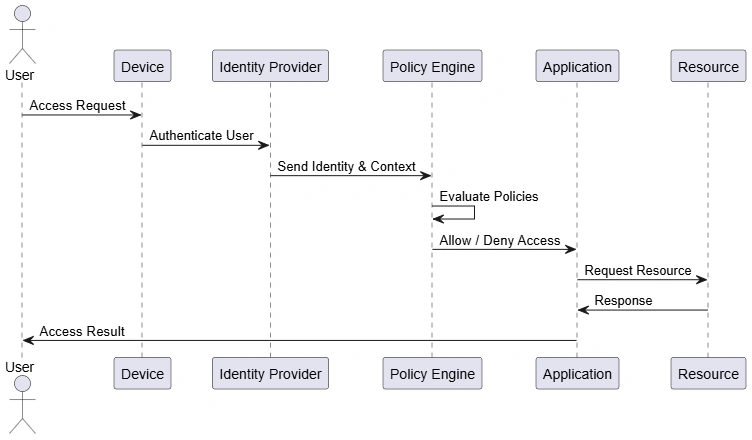
This sequence diagram illustrates how Zero Trust evaluates every access request dynamically. When a user initiates a request, the device first authenticates with the Identity Provider. Identity, device posture, and contextual data are sent to the policy engine for evaluation. Based on defined security policies, access is either granted or denied. Even after approval, access is limited only to the specific resource requested. This ensures no implicit trust and enforces continuous verification at every step.

seq

Key takeaways:

  • Every request is explicitly authenticated

  • Policies are evaluated dynamically

  • Access is resource-specific

  • No direct trust between user and resource

Component Diagram

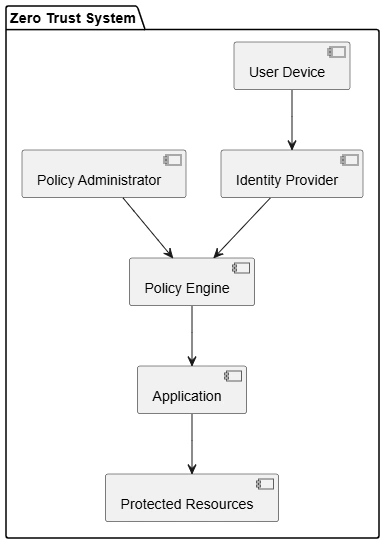
This component diagram shows the core building blocks of a Zero Trust Architecture and how they interact. The user device never directly accesses protected resources. Instead, identity verification and policy evaluation act as intermediaries. The Policy Administrator defines rules that the Policy Engine enforces. Applications become controlled gateways rather than trusted endpoints. This modular structure allows scalability and consistent enforcement across environments.

comp

Key components:

  • User Device – Initiates access requests

  • Identity Provider – Handles authentication

  • Policy Engine – Decides access

  • Policy Administrator – Defines rules

  • Application – Enforces decisions

  • Protected Resources – Data and services

Deployment Diagram

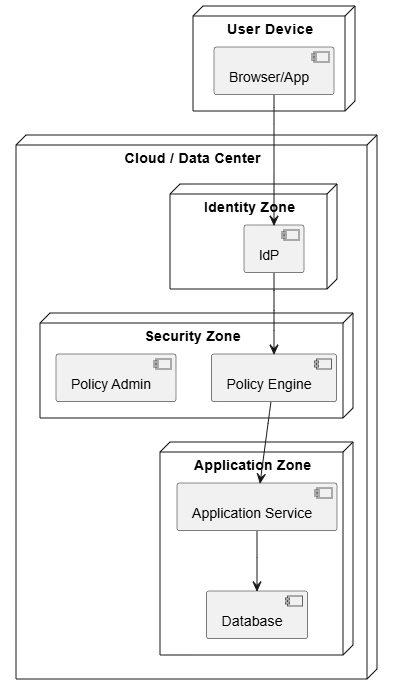
The deployment diagram highlights how Zero Trust spans across physical and logical environments. Identity services, policy enforcement, and applications are deployed in separate zones to reduce risk. Communication between zones is strictly controlled and authenticated. Even internal services must verify identity and authorization before accessing data. This layered deployment ensures strong isolation and minimizes blast radius during attacks.

depl

Deployment principles:

  • Zone-based isolation

  • Secure service-to-service communication

  • No implicit internal trust

  • Scalable across cloud and on-prem

Advantages

  • Improved security posture – Reduces attack surface

  • Least privilege access – Users get only what they need

  • Better visibility – Continuous monitoring and logging

  • Resilient to breaches – Limits lateral movement

  • Cloud-friendly – Designed for modern architectures

  • Compliance-ready – Supports regulatory requirements

Summary

Zero Trust Architecture is a fundamental shift from traditional perimeter-based security to an identity and policy-driven approach. By assuming no trust and continuously validating every request, Zero Trust significantly reduces security risks in modern, distributed environments. It protects organizations against credential theft, insider threats, and advanced attacks while enabling secure remote work and cloud adoption. Rather than being a single technology, Zero Trust is a strategy that evolves over time, strengthening security through visibility, control, and continuous verification.