

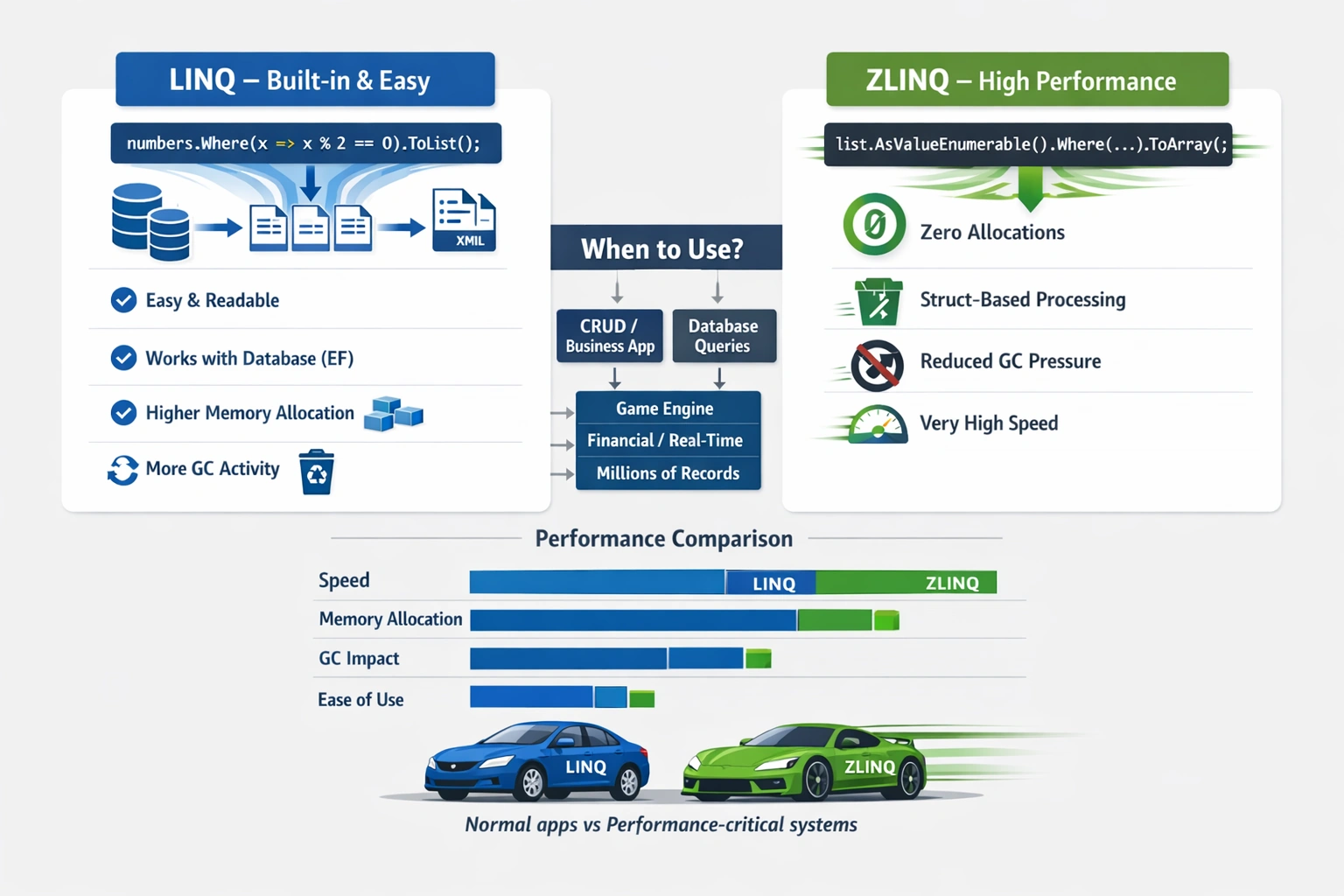
What is LINQ?
Language Integrated Query (LINQ) is a feature introduced in .NET that allows developers to write queries directly in C# code to work with:
Collections (List, Array, Dictionary)
Databases (via Entity Framework)
XML
In-memory objects
It provides a consistent way to query data using a readable syntax.
Example (Standard LINQ)
var evenNumbers = numbers.Where(x => x % 2 == 0).ToList();What is ZLINQ?
ZLinq is a high-performance alternative to standard LINQ designed to reduce memory allocations and improve speed, especially when working with large in-memory collections.
ZLINQ focuses on:
Zero allocations
Struct-based enumerators
High performance
Reduced GC pressure
It is mainly used for performance-critical applications.
WHERE to Use?
| Use Case | LINQ | ZLINQ |
|---|---|---|
| Database queries | ✅ Yes | ❌ No |
| Entity Framework | ✅ Yes | ❌ No |
| In-memory collections | ✅ Yes | ✅ Yes |
| High-performance systems | ⚠️ Moderate | ✅ Best |
| Game engines | ⚠️ | ✅ |
| Real-time systems | ⚠️ | ✅ |
WHY Use ZLINQ Instead of LINQ?
Standard LINQ:
Creates temporary objects
Uses heap allocations
Causes garbage collection in heavy loops
ZLINQ:
Uses structs instead of classes
Avoids heap allocations
Reduces GC pressure
Improves performance in tight loops
If performance matters (e.g., 1M+ records), ZLINQ is better.
WHEN to Use?
Use LINQ When:
Building CRUD applications
Using Entity Framework
Writing readable business logic
Performance is not critical
Use ZLINQ When:
Processing millions of records in memory
Developing games
Working in financial trading systems
Writing high-frequency processing code
Performance benchmarking shows LINQ is slow
HOW to Use?
Using Standard LINQ
var result = list
    .Where(x => x.Age > 18)
    .Select(x => x.Name)
    .ToList();
Using ZLINQ
After installing ZLINQ package:
var result = list
    .AsValueEnumerable()
    .Where(x => x.Age > 18)
    .Select(x => x.Name)
    .ToArray();
Notice:
AsValueEnumerable()avoids allocations.Faster iteration.
Compatibility Comparison Table
| Feature | LINQ (.NET Framework) | LINQ (.NET Core) | ZLINQ (.NET Framework) | ZLINQ (.NET Core) |
|---|---|---|---|---|
| Built-in | ✔ Yes | ✔ Yes | ❌ No | ❌ No |
| NuGet Required | ❌ No | ❌ No | ✔ Yes | ✔ Yes |
| EF Support | ✔ Yes | ✔ Yes | ❌ No | ❌ No |
| In-memory Support | ✔ Yes | ✔ Yes | ✔ Yes | ✔ Yes |
| High Performance | ⚠ Moderate | ⚠ Moderate | ✔ High | ✔ Very High |
| Recommended Usage | All apps | All apps | Limited | Performance-critical apps |
Real-World Recommendation by Project Type
| Project Type | Framework | Recommended Option |
|---|---|---|
| ASP.NET MVC (Legacy) | .NET Framework 4.7 | LINQ |
| ASP.NET Core Web API | .NET 6/8 | LINQ (default) |
| Financial Engine | .NET 6+ | ZLINQ |
| Game Development | .NET 6+ | ZLINQ |
| Enterprise ERP | .NET Framework | LINQ |
LINQ vs ZLINQ – Pros and Cons Comparison
| Criteria | LINQ | ZLINQ |
|---|---|---|
| Availability | ✔ Built-in in .NET | ❌ Requires external NuGet package |
| Ease of Use | ✔ Very easy and readable | ⚠ Slightly more complex |
| Performance | ⚠ Moderate | ✔ High performance |
| Memory Allocation | ❌ Creates heap allocations | ✔ Zero / minimal allocations |
| Garbage Collection (GC) | ❌ Higher GC pressure in large loops | ✔ Reduced GC pressure |
| Database Support (EF) | ✔ Fully supported | ❌ Not supported |
| In-Memory Collections | ✔ Supported | ✔ Optimized for this |
| Community Support | ✔ Very large | ⚠ Smaller |
| Learning Curve | ✔ Beginner friendly | ⚠ Intermediate/Advanced |
| Best For | Business apps, CRUD apps | High-performance systems |
| Debugging | ✔ Easier | ⚠ Slightly complex |
| Deferred Execution | ✔ Supported | ✔ Supported (optimized) |
| Real-Time Systems | ⚠ Not ideal for heavy loads | ✔ Suitable |
Limitations
LINQ Limitations
Performance overhead in large loops
Deferred execution confusion
Harder debugging in complex chains
ZLINQ Limitations
Not compatible with Entity Framework
Limited documentation
Mainly for advanced use cases
Requires performance knowledge
Real Time Example
Scenario: Payroll Processing System
Company processes salary for 5 million employees.
Using LINQ:
var totalSalary = employees
    .Where(e => e.IsActive)
    .Sum(e => e.Salary);
Works fine, but may create temporary objects.
Using ZLINQ:
var totalSalary = employees
    .AsValueEnumerable()
    .Where(e => e.IsActive)
    .Sum(e => e.Salary);
Faster and more memory-efficient.
Performance Comparison (Conceptual)
| Feature | LINQ | ZLINQ |
|---|---|---|
| Memory Allocation | Higher | Very Low |
| Speed | Moderate | High |
| GC Impact | Medium | Low |
| Ease of Use | Very Easy | Moderate |
Join the conversation! Your thoughts help the community grow.