

In this blog, I am going to explain how to convert XML/JSON file to C# class.
Recently, I faced the problem that I had a big file in JSON format but I needed it in C# class. So, I found a quick solution in Visual Studio.
This is very easy and requires only 3 steps to do it.
First of all, it requires Visual Studio 2012+.
The 3 steps are as follows.
Step 1
Copy the XML file data.
Copy the XML file data.
- <address>
- <to>SKN</to>
- <from>LKO</from>
- </address>
Step 2
Add new, empty class file and put your XML data here and copy this data.
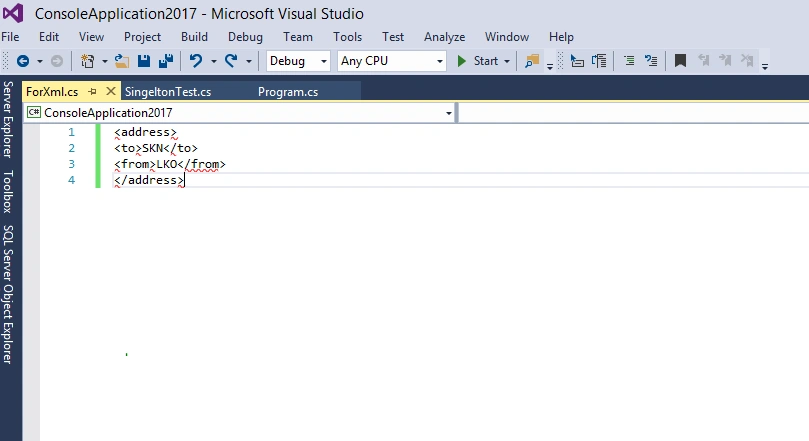
Add new, empty class file and put your XML data here and copy this data.
Step 3
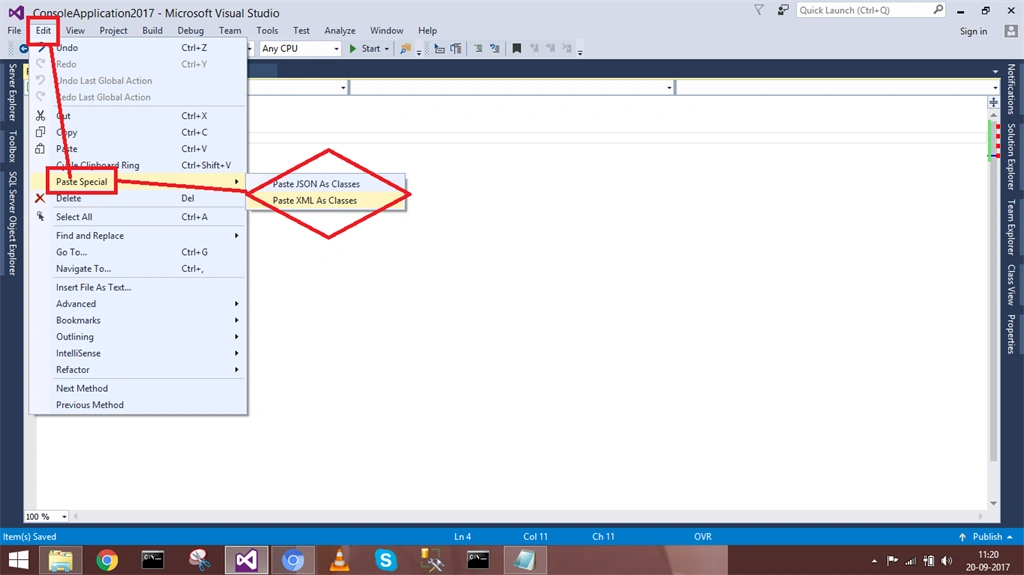
Open that file and in menu, go to Edit >> Paste Special >> Paste XML As Classes.
Open that file and in menu, go to Edit >> Paste Special >> Paste XML As Classes.
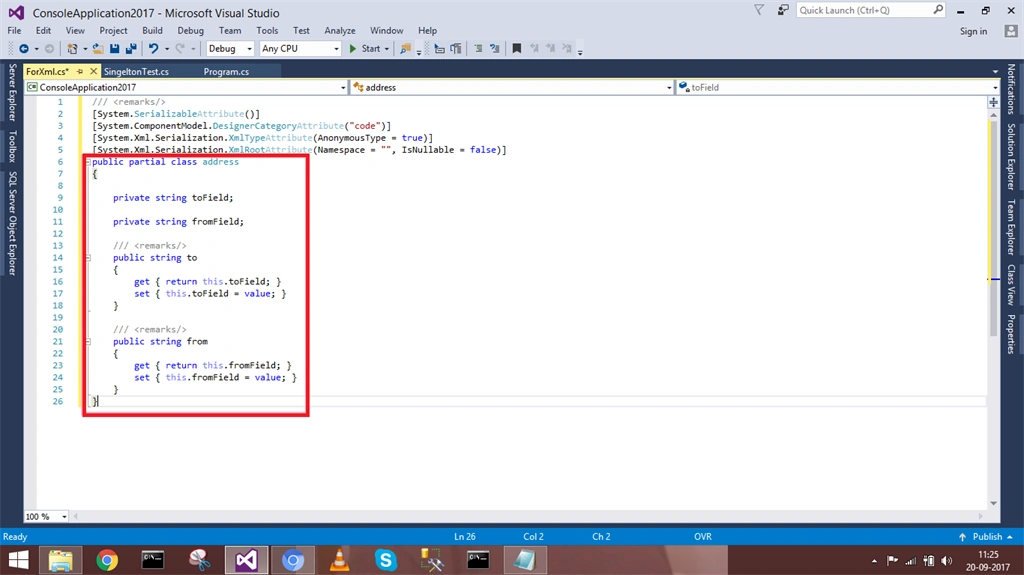
Result
- [System.SerializableAttribute()]
- [System.ComponentModel.DesignerCategoryAttribute("code")]
- [System.Xml.Serialization.XmlTypeAttribute(AnonymousType = true)]
- [System.Xml.Serialization.XmlRootAttribute(Namespace = "", IsNullable = false)]
- public partial class address
- {
- private string toField;
- private string fromField;
- /// <remarks/>
- public string to
- {
- get { return this.toField; }
- set { this.toField = value; }
- }
- /// <remarks/>
- public string from
- {
- get { return this.fromField; }
- set { this.fromField = value; }
- }
- }
Note
While choosing the Edit > Paste Special menu, ensure that the Visual Studio venture that your class record is under, has its 'Objective Framework' set to .NET Framework 3.5+ for 'Glue JSON as Classes' and .NET Framework 4.5+ for 'Glue XML as Classes'; otherwise, these choices don't show up.
While choosing the Edit > Paste Special menu, ensure that the Visual Studio venture that your class record is under, has its 'Objective Framework' set to .NET Framework 3.5+ for 'Glue JSON as Classes' and .NET Framework 4.5+ for 'Glue XML as Classes'; otherwise, these choices don't show up.
Zubair HasanPosted May 25, 2022, 5:45 AM
Bullshit, pathetic