

Step 1
Create one table named Employee.
Create one table named Employee.
The table script is given below.
- CREATE TABLE [dbo].[Employee](
- [Name] [nvarchar](50) NULL,
- [Address] [nvarchar](50) NULL,
- [Age] [int] NULL,
- [ID] [int] IDENTITY(1,1) NOT NULL,
- CONSTRAINT [PK_Employee] PRIMARY KEY CLUSTERED
- (
- [ID] ASC
- )WITH (PAD_INDEX = OFF, STATISTICS_NORECOMPUTE = OFF, IGNORE_DUP_KEY = OFF, ALLOW_ROW_LOCKS = ON, ALLOW_PAGE_LOCKS = ON) ON [PRIMARY]
- ) ON [PRIMARY]
- GO
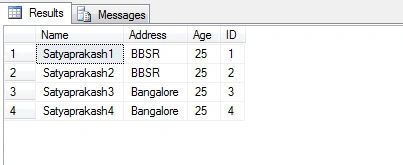
I entered some dummy data.
- select * from Employee
Step 3
Create one stored procedure named Sp_EmployeeFullQuery.
Create one stored procedure named Sp_EmployeeFullQuery.
- Create procedure Sp_EmployeeFullQuery
- (
- @ID VARCHAR(200)
- )
- as
- begin
- DECLARE @FullQuery NVARCHAR(MAX)
- set nocount on;
- SET @FullQuery='select * from Employee where Employee.ID=' + CAST(@ID AS VARCHAR) + ''
- end
- PRINT @FullQuery
- EXEC (@FullQuery)
Declare one variable @FullQuery.
- DECLARE @FullQuery NVARCHAR(MAX)
- SET @FullQuery='select * from Employee where Employee.ID=' + CAST(@ID AS VARCHAR) + ''
- PRINT @FullQuery
- EXEC (@FullQuery)
- exec Sp_EmployeeFullQuery 1
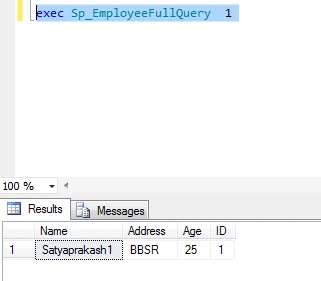
You will get all the details of SQL query with already passed parameter value.
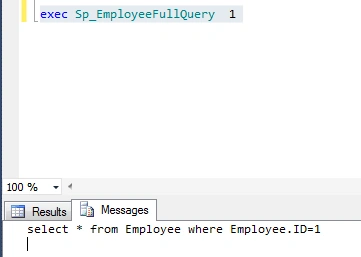
Summary
Create procedure.
Using primary key, autogenerate id column value showing the records.
Also, generate SQL query, which is defined in stored procedure by passing parameter value.
Join the conversation! Your thoughts help the community grow.