

Before going through this article I recommend to go through the basics of jquery. There are lots of articles in c-sharpcorner.com.
Step 1: Create a custom Class named Employee.
using System;
using System.Collections.Generic;
using System.Linq;
using System.Web;
namespace MethodInvocation
{
public class Employee
{
public string FirstName { get; set; }
public string LastName { get; set; }
public string FullName { get; set; }
}
}
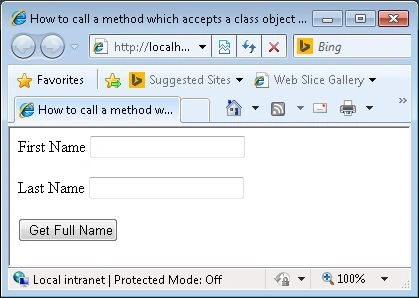
Step 2: Design a web form with two textbox and a button as shown
<body>
<form id="form1" runat="server">
<div>
First Name :<input type="text" id="txtFirstName" />
<br />
<br />
Last Name :<input type="text" id="txtLastName" />
<br />
<br />
<asp:Button ID="btnAdd" runat="server" Text="Get Full Name" Width="100px" />
</div>
</form>
</body>
Step 3: Implement the Web Method.
[WebMethod]
public static Employee GetFullName(Employee employee)
{
Employee emp=employee;
emp.FullName = string.Concat(emp.FirstName, " ", emp.LastName);
return emp;
}
Step 4: Implement the button click event
<script type="text/javascript">
var employee;
$(document).ready(function () {\
$("#btnAdd").click(function () {
var employee = {};
employee.FirstName = $("#txtFirstName").val();
employee.LastName = $("#txtLastName").val();
$.ajax({
type: "POST",
url: "Invoke.aspx/GetFullName",
data: "{employee:" + JSON.stringify(employee) + "}",
contentType: "application/json; charset=utf-8",
dataType: "json",
success: function (result) {
alert("Welcome" + " "+ result.d.FullName);
},
error: function (error) { alert(error.d) }
});
});
});
</script>
We need to pass an Employee object to the GetFullName Web Method.
For that purpose create an object as shown below.
var employee = {};
employee.FirstName = $("#txtFirstName").val();
employee.LastName = $("#txtLastName").val();
Now this employee object sis passed as the data in the Ajax code.
data: "{employee:" + JSON.stringify(employee) + "}"
For a better understanding I have uploaded the source code.
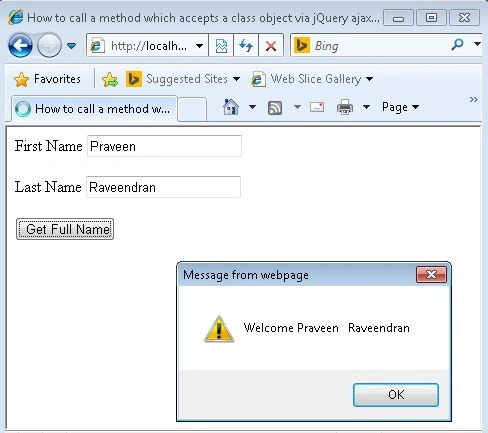
Output
Join the conversation! Your thoughts help the community grow.