

An extension method is the special type of static method which allows us to define a static method that appears to be a member of another type.
We can extend the value type and reference type like classes, interfaces. We can even extend sealed type using extension method; however, sealed type does not allow inheritance.
An extension method gives the flexibility to access static method with instance syntax.
Following are the steps in order to create an extension method.
- First, create a static class, as extension method is always defined in a static class.
- The method should be static, it’s obvious, a static class must have static members.
- The first parameter of an extension method always is a “this” modifier. It tells the compiler that you are dealing with an extension method.
Following is an extension method which takes IEnumerable<T>, T means any type which implements IEnumerable.
- class static class ExtentionMethods {
- public static int GetCount < T > (this IEnumerable < T > sequence) {
- int count = 0;
- foreach(var item in sequence) {
- count += 1;
- }
- return count;
- }
- }
- We create a static class ExtentionMethods.
- The first parameter is this modifier in the above method.
- Then we create a static method which gets the count of any type which implements IEnumerable.
- Then we write business logic to count from the sequence.
How do we get to benefit from extension method?
Let’s suppose we have a student class.
- class Student {
- public int Id {
- get;
- set;
- }
- public string Name {
- get;
- set;
- }
- }

Let’s see in the above code when we access extension method instance variable “students” using dot operator, IntelliSense gives a suggestion, and we can see the extension method which we created in suggestion.
We can identify an extension method. It has a signature. If a method has a down arrow, it means this is an extension method. As we can see in the above code, GetCount() extension method has a down arrow in front of it.
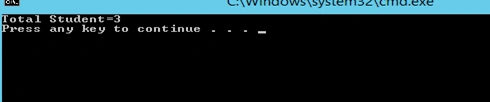
Below is the console output,
Extension methods is heavily used in Lambda expressions, following are some,
- First()
- FirstOrDefault()
- Single()
- SingleOrDefault()
- Where()
- Take()
There are many other extension methods available for the lambda expression. We will take a deep dive in the next article.
Viknaraj ManogararajahPosted Jul 21, 2018, 11:05 PM
Nice Article, Thank you for sharing
Gajanan ChavhanPosted Apr 20, 2018, 2:31 AM
Good. Keep it up...
Bhavesh JadavPosted Apr 17, 2018, 4:22 AM
Good, thanks to share it.