
This blog is related to a crud operation. In this blog, I show how to add, edit, delete, and get data from a database. I used Visual Studio 2022 and SQL Server 2019 for this crud operation. GitHub URL
Step 1. Create a .net core MVC project version 7 as well as an SQL Server database.

Create Project .NET core MVC (version 7.0)
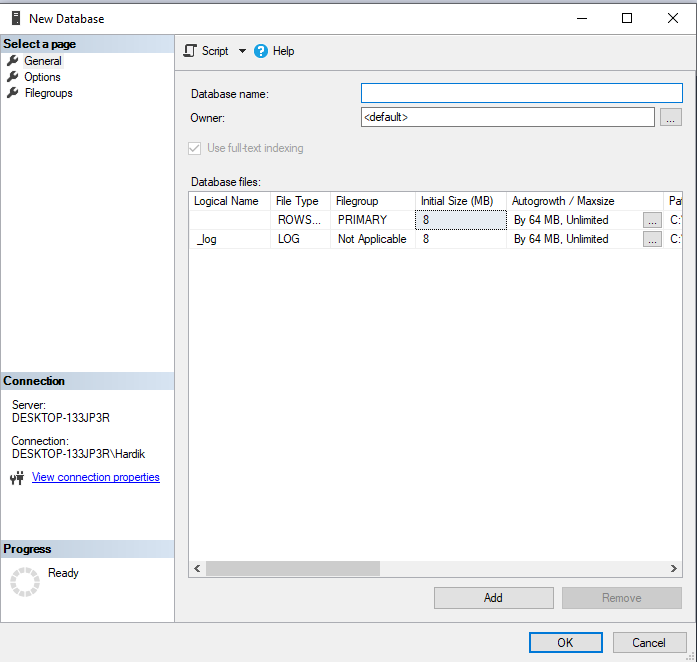
Create a database in SQL Server
Step 2. Put the default connection string in appsettings.js.
{
  "Logging": {
    "LogLevel": {
      "Default": "Information",
      "Microsoft.AspNetCore": "Warning"
    }
  },
  "AllowedHosts": "*",
  "ConnectionStrings": {
    "DefaultString": "Server=***sqlservername***;database=EfCore;Trusted_connection=true"
  }
}
Step 3. Add database connection server setup integration in startup.cs class.
using EFCore.Data;
using Microsoft.EntityFrameworkCore;

var builder = WebApplication.CreateBuilder(args);

// Add services to the container.
builder.Services.AddControllersWithViews();

builder.Services.AddDbContext<EFCoreDBContext>(service =>
    service.UseSqlServer(builder.Configuration.GetConnectionString("DefaultString")));

var app = builder.Build();

// Configure the HTTP request pipeline.
if (!app.Environment.IsDevelopment())
{
    app.UseExceptionHandler("/Home/Error");
}

app.UseStaticFiles();
app.UseRouting();
app.UseAuthorization();

app.MapControllerRoute(
    name: "default",
    pattern: "{controller=Student}/{action=Students}/{id?}");

app.Run();
Step 4. Create two classes The first is a student, and the second is a pager (for pegging).
public class Pager
{
    public int TotalItems { get; set; }
    public int CurrentPage { get; set; }
    public int PageSize { get; set; }
    public int TotalPages { get; set; }
    public int StartPage { get; set; }
    public int EndPage { get; set; }

    public Pager()
    {
    }

    public Pager(int totalItems, int page, int pageSize = 10)
    {
        int totalPages = (int)Math.Ceiling((decimal)totalItems / (decimal)pageSize);
        int currentPage = page;

        int startpage = currentPage - 5;
        int endpage = currentPage + 5;

        if (startpage <= 0)
        {
            endpage = endpage - (startpage - 1);
            startpage = 1;
        }

        if (endpage > totalPages)
        {
            endpage = totalPages;
            if (endpage > 10)
            {
                startpage = endpage - 9;
            }
        }

        TotalItems = totalItems;
        CurrentPage = currentPage;
        PageSize = pageSize;
        TotalPages = totalPages;
        StartPage = startpage;
        EndPage = endpage;
    }
}
namespace EFCore.Models
{
    public class Student
    {
        public int Id { get; set; }
        public int RollNumber { get; set; }
        public string Name { get; set; }
        public string Email { get; set; }
        public string Class { get; set; }
        public DateTime BirthDate { get; set; }
    }
}
Step 5. Create a data folder in this application and add one more file named EFCoreDBContext.cs.
Add Nuget package for connection to the database
- Microsoft.EntityFrameworkCore.SqlServer (7.0.0)
- Microsoft.EntityFrameworkCore.Tools(7.0.0)
- Microsoft.VisualStudio.Web.CodeGeneration.Design (7.0.0)
Create a student table in the SQL Server database. Following that, you can navigate to Tools. Nuget Package Manager => Write the following command in the Package Manager Console to connect to the database.
- Add-Migration “initial Migration”
- Update-Database
public class EFCoreDBContext : DbContext
{
    public EFCoreDBContext(DbContextOptions options) : base(options)
    {
    }

    // Write these commands:
    // Add-Migration "initial Migration"
    // Update-Database
    public DbSet<Student> Students { get; set; }
}
Step 6. Insert the following code into the Student Controller. cs file.
public class StudentController : Controller
{
    public readonly EFCoreDBContext dBContext;

    public StudentController(EFCoreDBContext _dBContext)
    {
        this.dBContext = _dBContext;
    }

    [HttpGet]
    public async Task<IActionResult> Students(string search, int page = 1, int pageSize = 10)
    {
        search = search ?? "";
        try
        {
            var students = await dBContext.Students
                .Where(t => t.Name.Contains(search) || t.Email.Contains(search) || t.Class.Contains(search))
                .ToListAsync();

            if (page < 1)
            {
                page = 1;
            }

            int recsCount = students.Count;
            var pager = new Pager(recsCount, page, pageSize);
            var recSkip = (page - 1) * pageSize;
            students = students.Skip(recSkip).Take(pager.PageSize).ToList();

            ViewBag.Pager = pager;
            ViewBag.Search = search;

            return View(students);
        }
        catch (Exception)
        {
            throw;
        }
    }

    [HttpGet]
    public async Task<IActionResult> StudentGrid(string search = "", int page = 1, int pageSize = 10)
    {
        search = search ?? "";
        try
        {
            var students = await dBContext.Students
                .Where(t => t.Name.Contains(search) || t.Email.Contains(search) || t.Class.Contains(search))
                .ToListAsync();

            if (page < 1)
            {
                page = 1;
            }

            int recsCount = students.Count;
            var pager = new Pager(recsCount, page, pageSize);
            var recSkip = (page - 1) * pageSize;
            students = students.Skip(recSkip).Take(pager.PageSize).ToList();

            ViewBag.Pager = pager;
            ViewBag.Search = search;

            return PartialView("StudentGrid", students);
        }
        catch (Exception)
        {
            throw;
        }
    }

    [HttpGet]
    public IActionResult AddStudent()
    {
        return View();
    }

    [HttpPost]
    public async Task<IActionResult> AddStudent(Student student)
    {
        if (student.Id == 0)
        {
            await dBContext.AddAsync(student);
        }
        else
        {
            var dstudent = await dBContext.Students.FindAsync(student.Id);
            if (dstudent != null)
            {
                dstudent.RollNumber = student.RollNumber;
                dstudent.Name = student.Name;
                dstudent.Email = student.Email;
                dstudent.Class = student.Class;
                dstudent.BirthDate = student.BirthDate;
            }
        }

        await dBContext.SaveChangesAsync();
        return RedirectToAction("Students");
    }

    [HttpGet]
    public async Task<IActionResult> EditStudent(int id)
    {
        var student = await dBContext.Students.FirstOrDefaultAsync(x => x.Id == id) ?? new Student();
        return View("AddStudent", student);
    }

    [HttpGet]
    public async Task<IActionResult> DeleteStudent(int id)
    {
        var student = await dBContext.Students.FindAsync(id) ?? new Student();
        if (student != null)
        {
            dBContext.Students.Remove(student);
            await dBContext.SaveChangesAsync();
        }
        return RedirectToAction("Students");
    }
}
Join the conversation! Your thoughts help the community grow.