

Google has announced a new Data Tables feature for NotebookLM, designed to help users transform unstructured information from their sources into clean, structured tables. The update aims to simplify analysis and organization of complex material by automatically synthesizing scattered data into formats that are ready for review, comparison, and export.
Credit: Google
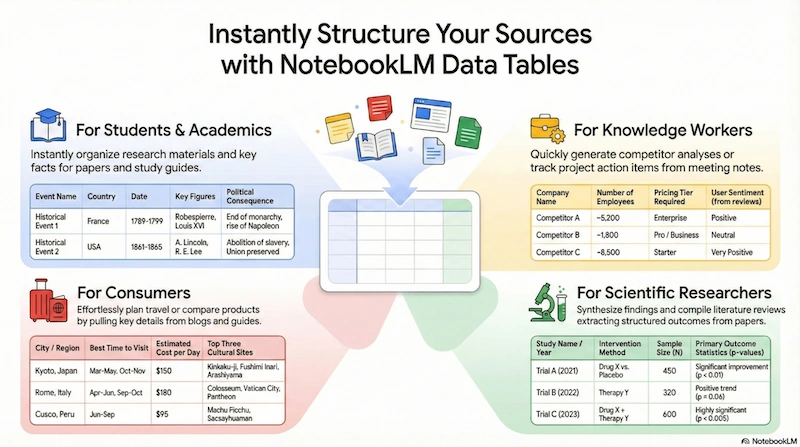
With Data Tables, NotebookLM can extract key facts from documents and present them in organized rows and columns, which users can export directly to Google Sheets. The feature is intended to reduce the manual effort typically required to compile information from multiple sources, making it easier to study, plan, and analyze across a wide range of use cases.
Google highlights several practical applications for the new capability. Students can prepare for exams by generating study tables that organize historical events by date, key figures, and outcomes. Professionals can convert meeting transcripts into structured action-item tables grouped by owner and priority, or create competitor comparison tables analyzing pricing and business strategies. Educators can streamline curriculum planning by aligning learning objectives, standards, and assessments, while researchers can synthesize clinical trial results across papers to track metrics such as sample size, timelines, and outcomes.
The Data Tables feature will be available to users of all ages and does not include any additional admin controls. It is rolling out gradually to both Rapid Release and Scheduled Release domains, with full visibility expected within up to 15 days. The feature is supported across a wide range of Google Workspace editions, including Business, Enterprise, Education, Nonprofits, and Frontline plans, as well as Google AI Pro for Education.
With this update, Google continues to position NotebookLM as a practical AI-powered research and productivity tool, focused on turning raw information into structured, actionable insights without requiring manual data cleanup.
Join the conversation! Your thoughts help the community grow.