

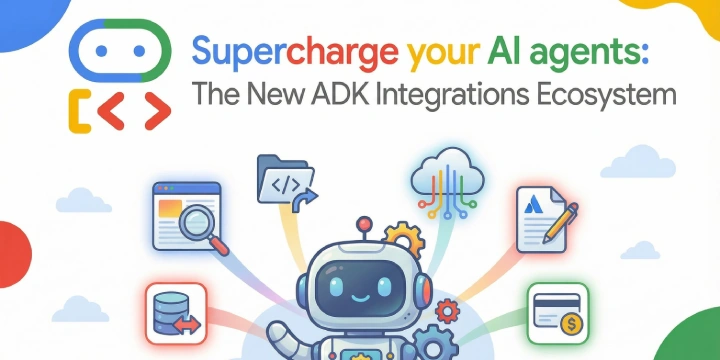
Google has announced a major expansion of its Agent Development Kit (ADK) — an open-source framework that lets developers build intelligent, autonomous AI agents — by introducing a robust ecosystem of third-party integrations that connects agents directly to real-world services and development tools. The update creates new possibilities for agents that don’t just reason but can act on behalf of users across workflows, from code management to project tracking and database queries.
Dubbed the ADK Tools and Integrations Ecosystem, the initiative aims to transform AI agents from isolated assistants into capable collaborators capable of executing tasks across platforms without complex coding or custom integrations.
Agents That Do More Than Chat
At its core, Google’s ADK — designed to simplify the creation, orchestration, and deployment of autonomous AI agents — is meant to make building production-grade, multi-step workflows feel like traditional software development. While ADK itself abstracts agent logic and decision making, the new integration ecosystem brings practical functionality to these agents by linking them with widely used developer and business tools.
Rather than relying solely on prompt engineering and prediction outputs, ADK agents can now interact directly with services such as code repositories, project management platforms, and databases, empowering developers to build agents that execute real tasks across an organization’s systems.
Deep Tool Integrations for Real-World Workflows
The newly announced tool ecosystem connects ADK agents with an array of popular services:
🛠 Development and Code Tools
Agents can manipulate real source code, run commands, test APIs, and manage files in secure workspaces through integrations with:
Daytona (sandboxed code execution)
GitHub (automate pull requests, issues, and workflows)
GitLab (CI/CD inspection and merge management)
Postman (API test automation)
Restate (durable, resumable agent sessions)
These integrations turn agents into interacting development assistants capable of hands-on code management, testing, and debugging.
📅 Project & Work Management
Built-in support for platforms like Asana, Atlassian (Jira & Confluence), Linear, and Notion empowers agents to track issues, update tickets, and create or search documentation — meaning agents can participate in daily team workflows beyond passive recommendations.
📊 Data and Memory Support
Agents can now query databases and perform vector semantic search with systems such as Chroma, MongoDB, and Pinecone, while persistent memory support through GoodMem and Qdrant allows agents to maintain context across sessions for long-running interactions.
Autonomous AI agents have long been a vision in tech — systems that not only understand instructions but execute them, adaptively and reliably. The expanded ADK ecosystem moves the industry closer to that reality by making it easier for developers to embed real actions and workflows into agent logic.
“The greatest limitation of earlier agentic models wasn’t reasoning — it was the inability to interact with developer workflows and tools in meaningful ways,” says one AI industry observer. “Google’s integrations bridge that gap by letting agents act in the world, not just chat about it.”
This means AI agents can now do things like automatically update tickets based on code changes, monitor production issues and initiate rollback procedures, or synthesize documentation from project milestones — all without human micromanagement.
A Step Toward Real-World Agentic Applications
The ADK integrations ecosystem comes at a time when companies are actively experimenting with autonomous AI workflows in areas ranging from customer support automation to enterprise analytics. By democratizing access to integrations with tools developers already use daily, Google is betting that practical agentic utility — not mere conversational prowess — will define the next generation of developer-focused AI platforms.
Analysts predict that as AI agents gain the ability to interact with business systems and maintain persistent context, adoption in enterprise environments will accelerate — particularly for intelligent automation use cases such as CI/CD orchestration, automated reporting, and contextual task management.
Google’s ADK continues to evolve alongside its broader Vertex AI and Gemini tooling, increasingly offering paths from development to production for agentic systems. With support for multi-model integrations and real-world tooling, ADK represents a flexible foundation for building scalable, reliable AI agents across industries.
As developers adopt ADK’s growing integrations and contribute back to its open-source ecosystem, the future of autonomous AI — one where agents actively support engineering workflows and business operations — appears closer than ever.
Source: Google
Join the conversation! Your thoughts help the community grow.