

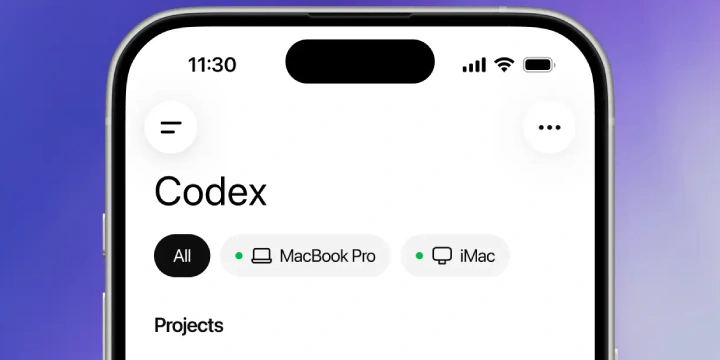
OpenAI has announced that Codex is now available inside the ChatGPT mobile app, allowing developers to monitor, manage, and interact with AI coding workflows directly from their phones. The feature is currently rolling out in preview for both iOS and Android users.
The update marks another major step in OpenAI’s push toward agentic software development, where AI systems can independently handle long-running coding tasks while developers supervise and collaborate remotely.
According to OpenAI, Codex on mobile is designed to keep developers connected to active work running across laptops, devboxes, Mac minis, and remote environments. Instead of writing code directly on the phone, users can review outputs, approve actions, redirect workflows, and start new tasks while away from their computers.
OpenAI described the new experience as a “fully-featured mobile experience” that syncs with the live state of running environments, including approvals, plugins, project context, screenshots, and test results.
The announcement reflects a broader trend in AI-assisted software engineering. As coding agents become capable of handling multi-step development tasks autonomously, developers increasingly need ways to stay connected without remaining tied to a desktop setup.
Industry observers say the feature addresses a real developer workflow problem. Many Codex users reportedly kept laptops partially open just to monitor long-running AI tasks. OpenAI even referenced this emerging behavior while introducing the mobile integration.
The mobile release comes during intense competition in the AI coding assistant market. OpenAI has recently expanded Codex aggressively with cloud-based execution, IDE integrations, multi-agent workflows, desktop automation, and the launch of GPT-5.3-Codex, its latest coding-focused model.
Initially introduced as a research preview in 2025, Codex has evolved from a simple code-generation assistant into a full software engineering agent capable of debugging applications, reviewing pull requests, generating features, answering repository-level questions, and running tasks in isolated environments.
Reuters reported that the mobile expansion is part of OpenAI’s larger enterprise and developer strategy as competition with tools like Anthropic’s Claude Code continues to intensify.
Several reports also indicate that Codex adoption is accelerating rapidly. OpenAI recently stated that millions of users are already using Codex weekly, while enterprise partnerships with consulting firms and large technology service providers continue to grow.
Security and infrastructure remain a major focus for OpenAI as well. The company recently detailed its sandbox architecture for Windows support, emphasizing isolated execution environments for safer autonomous coding operations.
For developers, the mobile integration signals something bigger than just convenience. AI coding agents are increasingly becoming asynchronous collaborators that continue working in the background while humans supervise, approve, and guide them from anywhere.
The Codex mobile preview is now available through the ChatGPT app across Free, Go, Plus, Pro, Business, Edu, and Enterprise plans, although some enterprise deployments may require administrator setup.
Developers can learn more through OpenAI’s official announcement.
Join the conversation! Your thoughts help the community grow.