

Introduction
The String object is used to manage a series of characters. The String object contains complete information about strings. In TypeScript, String objects are created with "new String()".
In this article, I am describing the TypeScript charAt and charCodeAt string methods.
chatAt() Method
Syntax
- string.charAt(position)
position: is a required parameter; represents the position of the character.
Function
A sample use of charAt is:
- charAt(str: string) {
- var position = str.charAt(0);
- var span = document.createElement("span");
- span.innerText = "charAt Method \n Display the first character of a string-> " + position + "\n";
- document.body.appendChild(span);
- }
charCodeAt() Method
In TypeScript the charCodeAt() method returns a number that represents the Unicode value of the character at the given position.
Syntax
- string.charCodeAt(position)
position: is a required parameter; the position value is between 0 and the position of the last character, which is 1 less than the length of the string. The default position is 0.
Function
A sample use of charCodeAt is:
- charCodeAt(str: string) {
- var unicode = str.charCodeAt(str.length - 1);
- var span = document.createElement("span");
- span.style.color = "green";
- span.innerText = "charCodeAt Method \n Display the unicode of the last character in a string-> " + unicode + "\n";
- document.body.appendChild(span);
- }
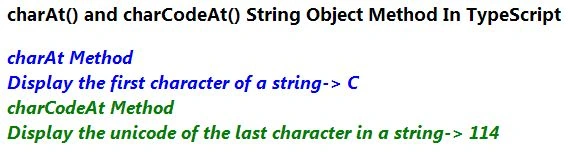
The following example shows how to use charAt and charCodeAt methods in TypeScript. In this example, we get a string from the user. The charAt() method returns the character at the specified position and the charCodeAt() method returns a Unicode character at a specified index.
Complete Program
chatAt_charCodeAt.ts
- class charAt_charCodeAt {
- charAt(str: string) {
- var position = str.charAt(0);
- var span = document.createElement("span");
- span.innerText = "charAt Method \n Display the first character of a string-> " + position + "\n";
- document.body.appendChild(span);
- }
- charCodeAt(str: string) {
- var unicode = str.charCodeAt(str.length - 1);
- var span = document.createElement("span");
- span.style.color = "green";
- span.innerText = "charCodeAt Method \n Display the unicode of the last character in a string-> " + unicode + "\n";
- document.body.appendChild(span);
- }
- }
- window.onload = () => {
- var obj = new charAt_charCodeAt();
- var str = prompt("Please enter a string");
- obj.charAt(str);
- obj.charCodeAt(str);
- };
chatAt_charCodeAt_MethodDemo.htm
- < !DOCTYPE html >
- <
- html lang = "en"
- xmlns = "http://www.w3.org/1999/xhtml" >
- <
- head >
- <
- meta charset = "utf-8" / >
- <
- title > TypeScript HTML App < /title>
- <
- link rel = "stylesheet"
- href = "app.css"
- type = "text/css" / >
- <
- script src = "charAt_charCodeAt.js" > < /script>
- <
- /head>
- <
- body >
- <
- h3 > charAt() and charCodeAt() String Object Method In TypeScript < /h3>
- <
- div id = "content" / >
- <
- /body>
- <
- /html>
chatAt_charCodeAt.js
- var charAt_charCodeAt = (function() {
- function charAt_charCodeAt() {}
- charAt_charCodeAt.prototype.charAt = function(str) {
- var position = str.charAt(0);
- var span = document.createElement("span");
- span.innerText = "charAt Method \n Display the first character of a string-> " + position + "\n";
- document.body.appendChild(span);
- };
- charAt_charCodeAt.prototype.charCodeAt = function(str) {
- var unicode = str.charCodeAt(str.length - 1);
- var span = document.createElement("span");
- span.style.color = "green";
- span.innerText = "charCodeAt Method \n Display the unicode of the last character in a string-> " + unicode + "\n";
- document.body.appendChild(span);
- };
- return charAt_charCodeAt;
- })();
- window.onload = function() {
- var obj = new charAt_charCodeAt();
- var str = prompt("Please enter a string");
- obj.charAt(str);
- obj.charCodeAt(str);
- };
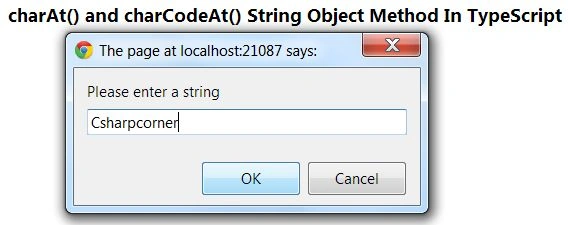
Output 1
Enter a string and click on "Ok":
Output 2
Nitin BhardwajPosted Feb 4, 2013, 7:47 AM
Thank U Romil
romil shaheditedPosted Feb 4, 2013, 6:43 AMEdited Feb 4, 2013, 6:43 AM
nice article