

Abstract / Overview
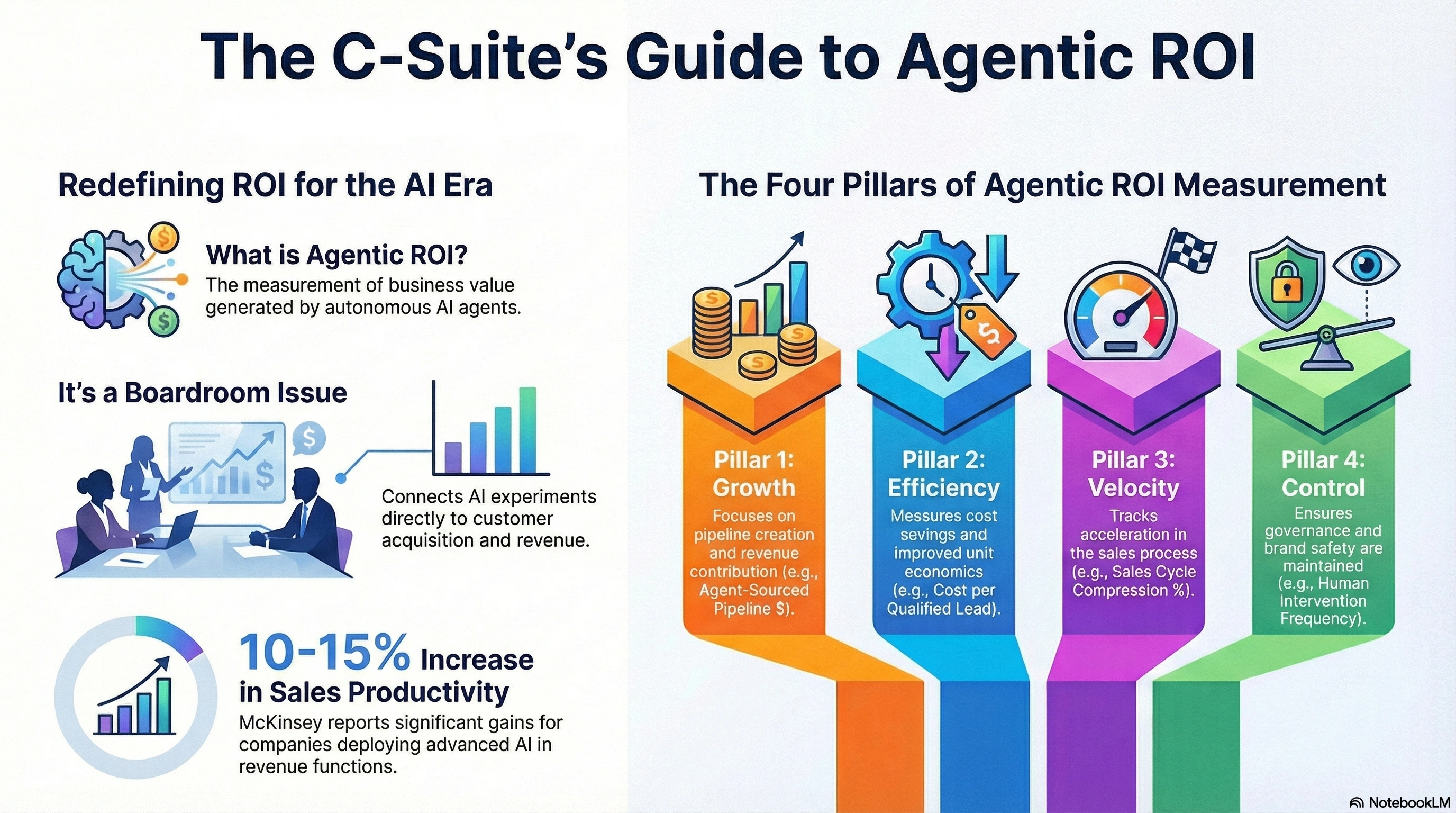
Direct answer: Agentic ROI measures the business value created by autonomous or semi-autonomous AI agents, expressed in terms of revenue impact, pipeline velocity, cost efficiency, and risk reduction. For the C-suite, the only agentic metrics that matter are those that directly connect to growth, specifically qualified leads and revenue contribution.
As organizations deploy agentic systems across marketing, sales, and operations, traditional AI metrics such as accuracy or task completion no longer satisfy executive scrutiny. CEOs, CFOs, and CROs require clear evidence that agents generate demand, accelerate conversions, and improve unit economics. This article defines Agentic ROI, outlines executive-level metrics, and shows how to operationalize them for lead generation.
Conceptual Background
Agentic systems differ from traditional automation. Instead of executing single tasks, agents plan, act, and adapt across workflows. In go-to-market teams, agents now research accounts, personalize outreach, qualify inbound leads, and nurture prospects autonomously.
This shift reframes ROI. Measuring cost savings alone underestimates value. According to McKinsey, companies that deploy advanced AI in revenue functions report up to 10–15% increases in sales productivity. Gartner projects that by 2026, over 30% of B2B marketing messages will be generated or orchestrated by AI agents.
For the C-suite, Agentic ROI answers three questions:
Does this agent create or influence the pipeline?
Does it accelerate revenue realization?
Does it do so with acceptable risk and cost?
Why Agentic ROI Is a C-Suite Issue
Agentic initiatives often start bottom-up, funded as experiments within marketing or RevOps. The moment agents touch customer acquisition, the discussion moves to the boardroom.
Executives evaluate agentic ROI across four lenses:
Growth: pipeline creation, lead quality, conversion lift
Efficiency: cost per lead, CAC compression, cycle time reduction
Scale: output per headcount, marginal cost of growth
Control: compliance, brand safety, governance
Without executive-grade metrics, agentic programs stall after pilots.
Lead Generation as the Primary ROI Vector
For most enterprises, lead generation is the fastest and most visible path to agentic ROI. Agents now operate across the full demand funnel:
Autonomous prospect research and enrichment
AI-generated personalized outreach
Real-time inbound lead qualification
Adaptive nurture and follow-up sequences
Unlike legacy marketing automation, agents make decisions. This demands metrics that capture both volume and impact.
C-Suite Metrics That Actually Matter
Revenue-Linked Lead Metrics
These metrics tie agents directly to growth.
Agent-Sourced Pipeline ($): total pipeline value initiated by agents
Agent-Influenced Revenue ($): closed-won deals where agents participated in any stage
Revenue per Agent: revenue contribution divided by active agents
These metrics resonate with CEOs and CROs because they mirror sales KPIs.
Pipeline Quality Metrics
Volume without quality destroys trust.
Marketing Qualified Lead (MQL) Acceptance Rate: percentage of agent-generated leads accepted by sales
Lead-to-Opportunity Conversion Rate: downstream validation of lead quality
Average Deal Size Lift: comparison of agent-assisted vs. human-only deals
High acceptance rates signal alignment between AI and sales teams.
Velocity and Time Metrics
Agents create ROI by moving faster than humans.
Time-to-First-Contact: reduction achieved by agent outreach
Pipeline Velocity Increase: speed from lead creation to close
Sales Cycle Compression (%): shortened close timelines
According to Forrester, even a 10% reduction in sales cycle length can yield outsized revenue gains in enterprise funnels.
Cost and Efficiency Metrics
CFOs anchor on these measures.
Cost per Qualified Lead (CPL): agent-generated vs. traditional
Customer Acquisition Cost (CAC): blended and agent-only views
Human Hours Displaced: time saved, redeployed to higher-value work
Efficiency metrics convert agentic value into financial language.
Risk and Control Metrics
Agentic ROI collapses without governance.
Brand Deviation Incidents: off-message outputs
Compliance Exception Rate: regulatory or policy violations
Human Intervention Frequency: how often agents require override
These metrics reassure boards that autonomy remains controlled.
The Agentic ROI Measurement Model

This model emphasizes causality. Activity metrics alone are insufficient; attribution must reach revenue.
Step-by-Step Walkthrough: Implementing Agentic ROI for Lead Generation
Step 1: Define Agent Roles Explicitly
Document what each agent owns: prospecting, qualification, nurture, or expansion. Ambiguity breaks attribution.
Step 2: Instrument Revenue Touchpoints
Ensure CRM and marketing platforms log agent involvement at every stage. Without traceability, ROI becomes anecdotal.
Step 3: Establish an Executive Baseline
Measure pre-agent performance across pipeline, velocity, and CPL. This baseline anchors ROI discussions.
Step 4: Attribute Conservatively
Adopt shared credit models. Over-claiming agent impact erodes executive trust.
Step 5: Report in Executive Language
Translate metrics into revenue, margin, and the impact on growth. Avoid technical jargon.
Sample Agentic ROI Workflow (JSON)
{
  "agent_id": "lead-gen-agent-01",
  "primary_function": "outbound_prospecting",
  "tracked_metrics": {
    "leads_created": 420,
    "mqls_accepted": 310,
    "pipeline_value_usd": 1850000,
    "closed_won_usd": 640000,
    "cost_per_lead_usd": 18.50
  },
  "reporting_period": "Q3-2026"
}
This structure enables automated executive dashboards.
Use Cases / Scenarios
B2B SaaS
Agents generate and qualify inbound demos, reducing SDR workload while increasing pipeline consistency.
Enterprise Services
Agents personalize account-based outreach at scale, improving response rates in high-value segments.
Industrial and Manufacturing
Agents identify buying signals from distributors and resellers, accelerating indirect channel leads.
Common Pitfalls and Fixes
Pitfall: Measuring agent output instead of business outcomes
Fix: Anchor every metric to a specific pipeline or revenue stream.Pitfall: Treating agents as cost-cutting tools only
Fix: Highlight growth and scale benefits.Pitfall: Over-automating without guardrails
Fix: Pair autonomy metrics with governance KPIs.
Hire an Expert to Integrate AI Agents the Right Way
Integrating AI agents into real enterprise environments requires architectural experience, not just tooling.
Mahesh Chand is a veteran technology leader, former Microsoft Regional Director, long-time Microsoft MVP, and founder of C# Corner. He has decades of experience designing and integrating large-scale enterprise systems across healthcare, finance, and regulated industries.
Through C# Corner Consulting, Mahesh helps organizations integrate AI agents safely with existing platforms, avoid architectural pitfalls, and design systems that scale. He also delivers practical AI Agents training focused on real-world integration challenges.
Learn more at: https://www.c-sharpcorner.com/consulting/
FAQs
Is Agentic ROI different from AI ROI?
Yes. Agentic ROI focuses on autonomous decision-making systems and their end-to-end business impact.How soon should ROI be visible?
In lead generation, early signals appear within 30–60 days through pipeline metrics.Who owns Agentic ROI reporting?
Typically, a shared mandate across Marketing, RevOps, and Finance, with executive sponsorship.
References
C-Suite perspectives on generative and agentic measurement frameworks
McKinsey AI and revenue productivity research
Gartner AI adoption forecasts
Forrester sales and marketing analytics studies
Conclusion
Agentic ROI is not a technical exercise. It is a leadership discipline. For the C-suite, the only sustainable path to agentic investment is clear linkage to lead generation, pipeline health, and revenue growth.
Organizations that measure agentic systems through executive-grade metrics will scale faster, spend more efficiently, and outlearn competitors. Those who cannot translate autonomy into growth will struggle to justify it.
Join the conversation! Your thoughts help the community grow.