

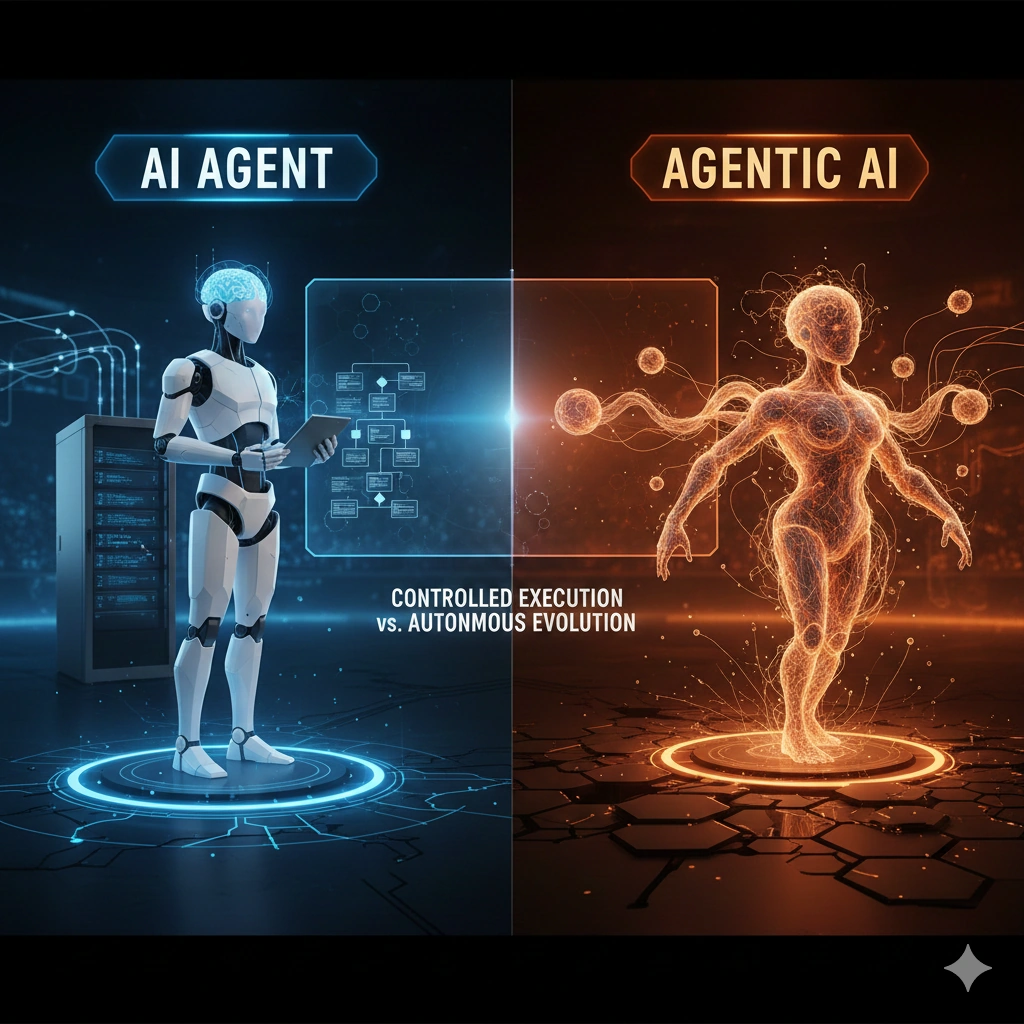
Artificial intelligence has entered a new phase where we are no longer talking only about chatbots that answer questions or models that generate text. Today, the conversation has shifted toward AI agents and Agentic AI, two closely related concepts that are often used interchangeably but are not the same thing.
This confusion is understandable. Both terms deal with autonomy, decision making, and goal driven behavior. But the distinction is important, especially if you are a business leader, product builder, architect, or investor trying to understand where AI is headed and how to apply it correctly.
This article breaks down the difference in simple terms, then goes deep into architecture, capabilities, real world use cases, and future implications. If you read only one article on this topic, make it this one.
🧠 Understanding the Basics
Before comparing the two, we need a shared baseline.
What Is an AI Agent
An AI agent is a software entity designed to perform a specific task or a small set of tasks on behalf of a user or system.
At its core, an AI agent has four defining traits.
• It receives input from a user or environment
• It processes that input using rules, models, or logic
• It performs an action
• It stops when the task is done
Think of an AI agent as a doer. It is focused, scoped, and usually short lived.
Examples of AI agents include
• A customer support chatbot that answers FAQs
• An AI that schedules meetings based on your calendar
• A code generation assistant that writes a function
• A fraud detection bot that flags suspicious transactions
Most AI agents today are reactive. They wait for an instruction, execute it, and return a result. They do not truly plan, reason over long time horizons, or change their behavior unless explicitly retrained or reconfigured.
What Is Agentic AI
Agentic AI is not a single agent. It is a system level capability where AI exhibits agency. Agency means the ability to
• Set or refine goals
• Plan multiple steps
• Take actions autonomously
• Monitor outcomes
• Adapt behavior over time
Agentic AI systems often consist of multiple AI agents working together, guided by memory, reasoning loops, feedback mechanisms, and sometimes human oversight.
If an AI agent is a doer, Agentic AI is a decision maker and executor combined. Agentic AI behaves less like a tool and more like a digital worker or digital organization.
🔍 AI Agent vs Agentic AI Core Differences
The following table summarizes the core differences between an AI Agent and Agentic AI.
| Aspect | AI Agent | Agentic AI |
|---|---|---|
| Core idea | Executes a specific task when instructed | Achieves goals autonomously using planning and reasoning |
| Scope | Narrow and well defined | Broad and flexible |
| Autonomy level | Low to moderate | High |
| Behavior | Reactive | Proactive and adaptive |
| Decision making | Follows predefined instructions or prompts | Makes decisions based on goals and context |
| Goal setting | Goals are given by humans | Can refine or break down goals into sub goals |
| Planning ability | Minimal or none | Strong multi step planning |
| Memory usage | Little or no long term memory | Uses short term and long term memory |
| Feedback loops | Rare or manual | Continuous self evaluation and adjustment |
| Number of agents | Usually single agent | Often multiple agents working together |
| Coordination | No internal coordination | Orchestrates and coordinates agents dynamically |
| Adaptability | Limited | High |
| Learning over time | Requires retraining | Can improve behavior through feedback |
| Tool usage | Uses predefined tools | Chooses tools dynamically |
| Human involvement | Required for most decisions | Optional with human checkpoints |
| Risk level | Lower | Higher if not governed properly |
| Governance needs | Simple controls | Advanced governance and guardrails |
| Transparency | Easier to understand and debug | More complex to audit and explain |
| Best use cases | Customer support, data extraction, simple automation | Research, autonomous workflows, AI driven teams |
| Example | Chatbot answering FAQs | AI system running an end to end business process |
🧩 Architecture Differences Explained
AI Agent Architecture
Most AI agents follow a linear flow.
Input → Model → Action → Output
To achieve this, AI agents often use a prompt, a machine learning model, a rules engine, and a single API call.
AI agents usually do not maintain long term memory. They do not coordinate with other agents unless explicitly orchestrated by external code. This simplicity is their strength. They are easy to build, test, deploy, and control.
Agentic AI Architecture
Agentic AI architectures are layered and dynamic. Agentic AI systems are designed to solve large and complex problems and often involves multiple agents, communication with external agents, and other non AI systems.
A typical Agentic AI system includes
One or more AI agents
A planning module
A memory store
A tool execution layer
A feedback or evaluation loop
The system works more like this.
Goal → Plan → Execute → Observe → Adjust → Repeat
This loop continues until the goal is met or constraints stop execution.
Agentic AI systems may
• Break goals into sub goals
• Assign tasks to specialized agents
• Retry failed actions
• Change strategy when results are poor
🧠 Intelligence and Autonomy Levels
Intelligence in AI Agents
AI agents operate within predefined boundaries. They are intelligent within their task but blind outside it. For example, a code review agent may detect bugs but cannot decide to refactor the entire system architecture unless explicitly told to.
Intelligence in Agentic AI
Agentic AI systems demonstrate emergent intelligence. They can decide which tools to use, choose which agent should act next, change execution order, and stop or escalate tasks. This makes them powerful but also risky if not designed properly. Agentic AI systems need guardrails, human in the loop checkpoints, audit logs, and clear constraints. Without these, autonomy can become unpredictability.
🧪 Real World Examples
Let's look at some real world examples.
AI Agent Examples
Customer support chatbot: It responds to user queries using predefined knowledge.
Invoice processing agent: It extracts fields from invoices and uploads data to accounting software.
Marketing content generator: It creates a blog post or social media caption based on a prompt.
Agentic AI Examples
AI Dev team system where one agent plans features, one agent writes code, one agent tests, one agent fixes bugs, and the system also connect with external agents and APIs to use agentic capabilities that it does not have. For example, it may use a mailer agent to send emails and GPT-5 LLM, and API from a third-party and store data in memory and databases,
An autonomous research assistant that understands a research question, searches multiple sources, summarizes findings, identifies gaps, and suggests next steps.
🏗️ When to Use AI Agent vs Agentic AI
When to Use AI Agents
Use AI agents when the task is well defined, the scope is narrow, predictability matters, and compliance and control are critical. These are often used on finance, healthcare workflows, compliance reporting, and customer support. AI agents are safer, faster to deploy, and easier to explain to stakeholders.
When to Use Agentic AI
Use Agentic AI when the problem is complex, steps are not always known in advance, adaptation is required, and the outcomes matter more than exact steps. For example, product design, research and discovery, business process automation, and AI driven operations.
⚠️ Risks and Challenges
Risks with AI Agents
The risks are mostly operational. It could have incorrect outputs, data bias, and over reliance on automation.
Risks with Agentic AI
The risks are strategic and systemic. For example, unintended actions, over optimization, goal misalignment, and lack of transparency. Agentic AI can take actions you did not explicitly instruct if the goal is poorly defined.
🔐 Governance and Control
Governing AI Agents
AI agents are governed through access controls, input validation, output review, and limited permissions.
Governing Agentic AI
Agentic AI requires a new mindset. You must define what the system is allowed to do, what it is never allowed to do, when humans must approve actions, and how decisions are logged, Think of Agentic AI governance like managing a team, not a script.
🚀 Why Agentic AI Is the Future
AI agents are already everywhere, deployed and working. But agentic AI is just getting started. Today, businesses demand faster execution, continuous optimization, lower operational overhead and integration with other agents and third party systems. Agentic AI is the way to build it.
🧩 Will Agentic AI Replace AI Agents
This is a silly question. Its like saying will hospitals replace doctors? AI Agents are the building blocks of Agentic AI and they both need to work together to achieve larger business goals.
📌 Final Summary
Agentic AI is the future and AI agents are the building blocks. In this article, we learned the difference between the two. When deciding if you need just an AI agent or build a full fledged AI system, the decision is simple. When you need a worker that does one task and can be guided, controlled, and predictable, build an agent. Agentic AI is for building large complex autonomous AI systems.
👤 Build AI Agents or Agentic AI With Expert Guidance
If you are looking to build AI agents, multi agent systems, or full Agentic AI platforms, consider working with Mahesh Chand, a veteran technology leader with decades of experience architecting large scale enterprise platforms.
Mahesh has led engineering teams and advisory engagements across AI, cloud, blockchain, and automation for Fortune 500 companies, global startups, and public sector organizations. He specializes in turning complex ideas into real, deployable AI systems, including:
• Task based AI agents for enterprise workflows
• Multi agent orchestration and agentic architectures
• AI governance, safety, and human in the loop design
• AI platforms for education, healthcare, finance, and Web3
• End to end AI strategy from architecture to execution
Whether you are experimenting with your first AI agent or planning to deploy a fully autonomous Agentic AI system, working with an experienced architect can save months of trial and error and prevent costly design mistakes.
👉 Hire Mahesh Chand for AI Agent and Agentic AI consulting, architecture, and implementation through C# Corner Consulting.
This is especially valuable for organizations that want
Enterprise grade reliability
Clear governance and controls
Scalable multi agent systems
Long term AI strategy, not just demos
Contact Mahesh here: https://www.c-sharpcorner.com/consulting/
❓ AI Agents vs Agentic AI FAQ
What is an AI agent in simple terms
An AI agent is a software program that performs a specific task based on instructions or inputs. It reacts to a request, completes the task, and stops. Most AI agents are designed for narrow, well defined use cases like answering questions, generating code, or processing data.
What is Agentic AI and how is it different from an AI agent
Agentic AI refers to a system where AI has agency. Instead of just responding to instructions, it can set goals, plan steps, take actions autonomously, evaluate results, and adjust its behavior over time. Agentic AI often uses multiple AI agents working together as a coordinated system.
Is Agentic AI the same as autonomous AI
Agentic AI is a form of autonomous AI, but not all autonomous AI systems are truly agentic. Agentic AI specifically includes goal setting, planning, execution, and feedback loops, which go beyond basic automation or rule based autonomy.
Can an AI agent become Agentic AI
A single AI agent does not become Agentic AI on its own. Agentic AI emerges when multiple agents are combined with memory, planning, reasoning, and orchestration layers. Agentic AI is a system level design, not just a smarter agent.
What are real world examples of AI agents
Common examples of AI agents include customer support chatbots, meeting scheduling assistants, document summarization tools, fraud detection bots, and code generation assistants. These agents focus on one task and operate within strict boundaries.
What are real world examples of Agentic AI
Examples of Agentic AI include autonomous research assistants, AI software development teams, AI operations managers, and multi agent business workflow systems. These systems can decide what to do next, coordinate tasks, and adapt strategies based on outcomes.
Which is better for business AI agents or Agentic AI
Neither is universally better. AI agents are best for predictable, repeatable tasks where control and compliance matter. Agentic AI is better for complex problems that require planning, adaptation, and decision making. Many enterprises use both together.
What are the risks of Agentic AI
The main risks of Agentic AI include unintended actions, goal misalignment, lack of transparency, and over autonomy. Without proper governance, Agentic AI systems may take actions that were not explicitly approved. Strong guardrails and human oversight are essential.
Do AI agents require less governance than Agentic AI
Yes. AI agents typically require simpler governance because they operate within narrow scopes. Agentic AI requires more advanced governance frameworks, including permissions, approval checkpoints, audit logs, and continuous monitoring.
Is Agentic AI replacing traditional automation
Agentic AI does not replace traditional automation but extends it. Automation follows predefined rules, while Agentic AI can adapt, plan, and optimize workflows dynamically. Many modern systems combine automation, AI agents, and Agentic AI orchestration.
How do multi agent systems relate to Agentic AI
Multi agent systems are a core building block of Agentic AI. Agentic AI systems often use specialized agents that collaborate, with an orchestration layer deciding which agent acts next and how goals are achieved.
Why is Agentic AI considered the future of AI
Agentic AI is considered the future because it moves AI from passive tools to active participants. It enables AI systems to manage workflows, improve over time, and operate in complex environments where fixed rules and simple agents are not enough.
Join the conversation! Your thoughts help the community grow.