The Rise of AI Software Factories: Are We Entering the Era of Self-Building Applications?
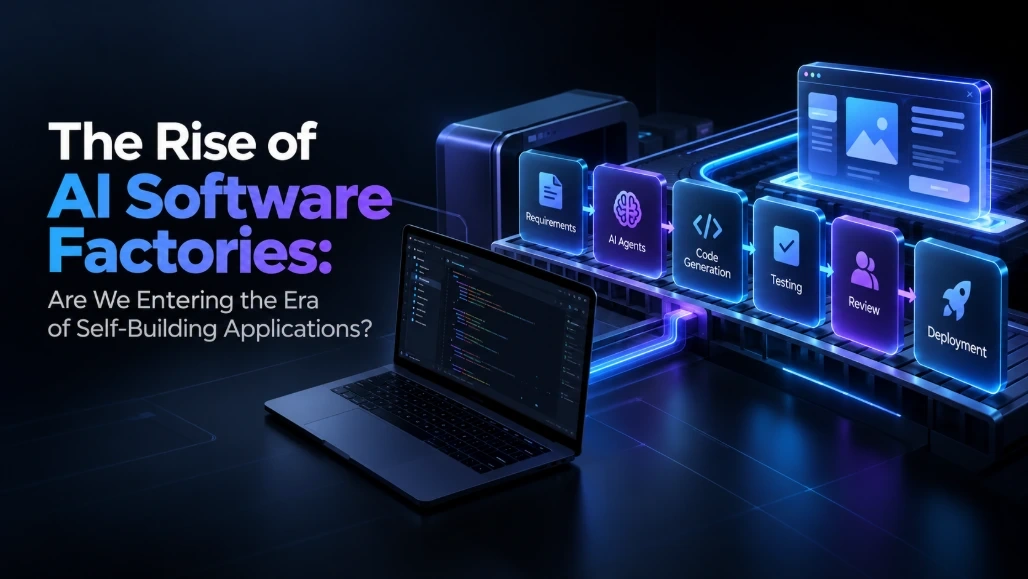
In June 2026, software development company Factory introduced what it called Software Factory 2.0, describing a system designed to coordinate AI agents across software engineering workflows.
The concept goes beyond asking an assistant to generate code. Business requirements, reported bugs, testing results, code reviews, and production feedback become inputs for a connected development process.
This is the idea behind AI software factories: integrated systems that coordinate software creation and delivery using autonomous agents, engineering tools, and automated verification.
The ambition is significant. Instead of developers manually coordinating every stage, AI systems could help translate requirements into code, test changes, prepare releases, and identify problems after deployment.
But generating functioning code is different from delivering software that remains reliable under real-world conditions.
Are we entering the era of self-building applications, or witnessing the beginning of a more automated engineering workflow?
From AI Coding Assistants to AI Software Factories
AI-assisted development has evolved through several distinct stages.
Early coding assistants focused on autocomplete and short suggestions. Conversational tools later enabled developers to explain requirements and request complete functions, tests, or architectural guidance.
Autonomous coding agents introduced another capability: executing development tasks rather than only recommending changes.
A repository-based agent might inspect an issue, locate affected files, modify an implementation, run tests, and prepare a pull request.
An AI software factory attempts to connect these activities across a broader delivery process.
Instead of treating bug reports, implementation, testing, and deployment as disconnected tasks, a coordinated system manages their relationships.
For example, a failed integration test could generate a new development task. An agent might investigate the failure, create a patch, and submit it to an independent validation workflow.
That feedback loop matters more than the number of agents involved.
A collection of coding assistants is not necessarily a software factory. The defining feature is orchestration across engineering stages, supported by shared context, measurable results, and controlled handoffs.
What Exactly Is an AI Software Factory?
An AI software factory is an integrated development environment in which AI agents and automated engineering services coordinate selected activities involved in building, testing, delivering, and maintaining software.
A typical conceptual architecture contains several components.
Requirement intake converts issues, feature requests, and product requirements into development tasks.
Planning and orchestration divide those tasks into manageable assignments and determine which agents or engineering services should handle them.
Code generation and repository management produce changes while tracking branches, dependencies, and implementation history.
Validation and delivery infrastructure execute tests, review changes, enforce deployment policies, and collect operational feedback.
Not every product described as a software factory includes all these capabilities. Some platforms concentrate on implementation and testing, while others connect more stages of the lifecycle.
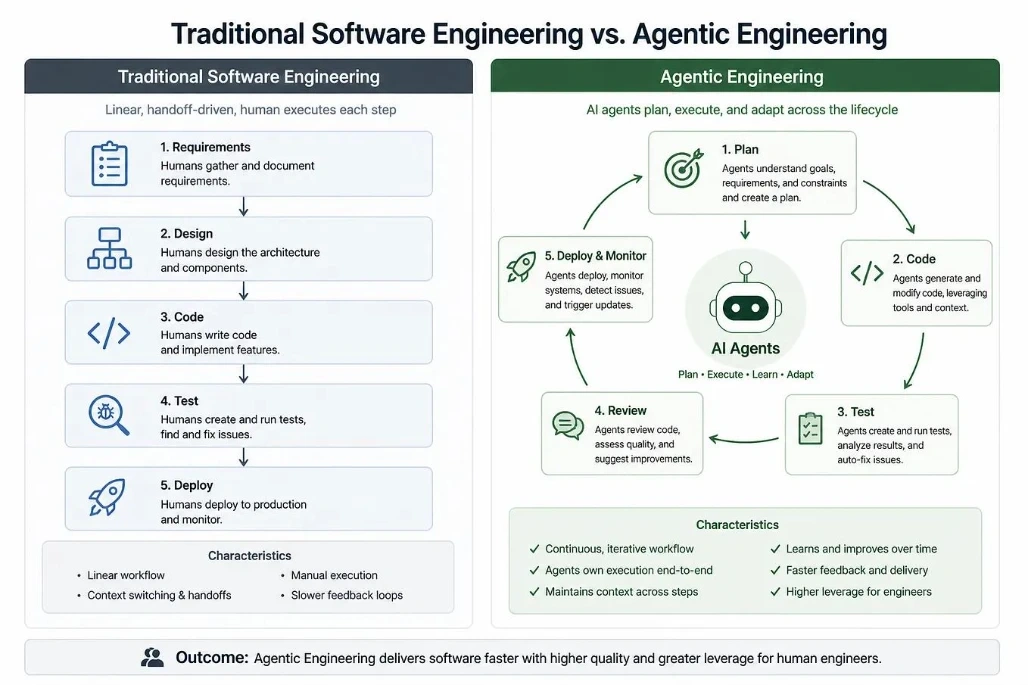
Traditional Development vs. AI Coding Assistants vs. AI Software Factories
Factor | Traditional Development | AI Coding Assistant | AI Software Factory |
|---|
Task planning | Primarily human-led | Human-led with AI support | Potentially agent-orchestrated |
Code generation | Developer-written | AI-assisted | Agent-executed within workflows |
Testing | Developer and CI-driven | AI can suggest tests | Automated tests linked to agent tasks |
Coordination | Teams and project tools | Individual interactions | Shared orchestration and feedback |
Deployment | Controlled release process | Usually external to assistant | Integrated with approval gates |
Human involvement | Across most stages | Direct supervision | Oversight based on task and risk |
The distinction is architectural rather than simply a measure of automation.
Inside an AI Software Factory: The Engineering Workflow
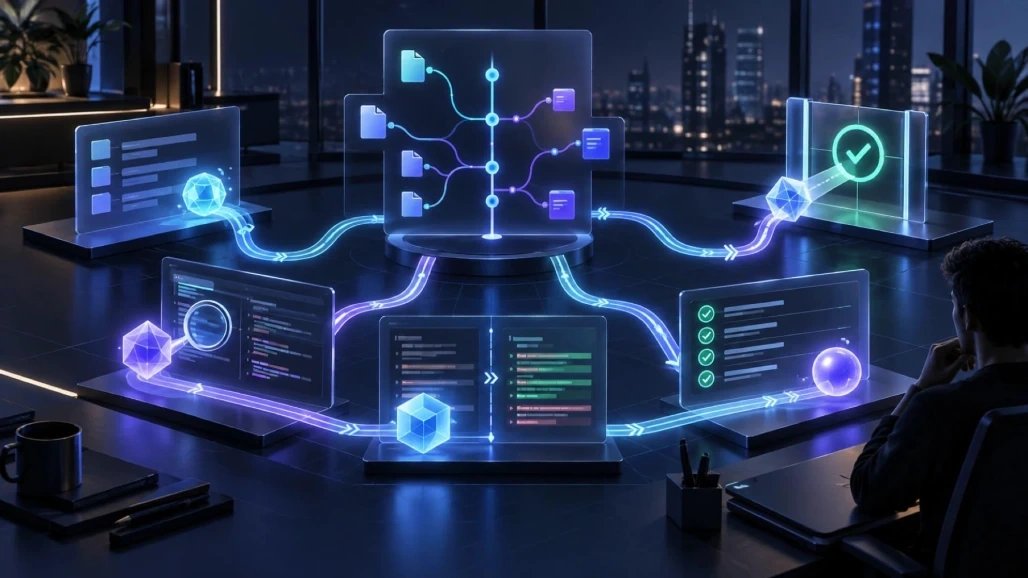
A generalized AI software factory follows a connected sequence:
Business Requirement → Task Planning → Agent Assignment → Code Generation → Testing → Review → Deployment Approval → Monitoring
Imagine a SaaS development team receiving a request to add an export feature to an analytics dashboard.
The requirement-intake system identifies the affected application components and creates development tasks.
An orchestration layer could assign API changes to one agent and interface changes to another. Both agents receive relevant repository context and shared interface requirements.
The generated changes are combined into a development branch.
Automated tests check expected behavior, while integration tests verify communication between the new API and frontend.
A separate review process examines maintainability, security, and compatibility.
If the proposed release passes validation, an authorized engineer or deployment policy can approve its promotion.
Monitoring then provides feedback about failures or unexpected behavior.
This is an illustrative architecture, not a claim that every current platform can perform the entire process autonomously.
There are also coordination challenges. Parallel agents can modify conflicting files or make incompatible assumptions about shared interfaces.
Reliable orchestration therefore requires dependency tracking, consistent task specifications, version control, and mechanisms for resolving conflicting changes.
Successful task execution alone is not enough. The assembled application must still behave as a coherent system.
Real-World Developments Behind the Software Factory Trend
Several developments in 2026 illustrate how AI-driven software engineering is moving toward coordinated workflows.
Factory's Software Factory 2.0
In its June 15, 2026 announcement, Factory described an architecture combining model routing, persistent agent execution, shared organizational context, and feedback from development and production activities.
The company also emphasized that organizations adopt increasing levels of autonomy gradually.
Those are vendor-described capabilities and ambitions. They should not be interpreted as independent proof that all participating organizations achieve fully autonomous software delivery.
GitHub's Repository-Based Coding Agents
GitHub's Copilot documentation describes agents that can investigate repositories, plan changes, modify files, execute tests, and create pull requests within cloud development environments.
This demonstrates how autonomous task execution can operate inside established development infrastructure.
The workflow still includes review and repository controls rather than assuming every generated change should be deployed automatically.
Security-Focused Software Factory Platforms
An October 15, 2026 TechTarget report examined products from Harness and Chainguard incorporating isolated environments and verification mechanisms for AI-driven development.
The report reflects growing attention to operating agents as controlled engineering workloads rather than granting them unrestricted developer access.
Together, these developments suggest a shift from isolated coding automation toward managed software delivery systems. Their maturity and effectiveness still vary by product and organization.
Why Self-Building Applications Are Harder Than They Sound
A system that generates working code has solved only part of the software engineering problem.
Requirements are often ambiguous. Product managers may describe expected behavior without specifying unusual conditions, failure handling, or compatibility requirements.
Architecture introduces further complications.
Consider a hypothetical SaaS application that manages customer subscriptions.
An agent could generate a billing API, subscription dashboard, and notification service. Each component might pass its individual tests.
Yet the system could still experience problems when duplicate payment events arrive, users change plans during billing cycles, or external payment providers become unavailable.
These situations involve interactions across components, not isolated implementation errors.
AI-generated changes can also introduce inconsistent design patterns, hidden dependencies, or modifications that are difficult to maintain.
Long-running projects create another challenge: requirements evolve, and earlier design decisions constrain future changes.
Agents need accurate context about existing architecture, data contracts, deployment infrastructure, and prior decisions.
Even with that information, developers must evaluate whether an implementation fits the broader system.
A genuinely self-building application would need to handle requirements, architecture, integration, validation, and maintenance reliably across changing conditions.
Current systems can automate meaningful portions of that work. General-purpose, unsupervised delivery remains a substantially harder problem.
The Role of CI/CD, Automated Testing, and Human Verification
As AI agents generate more code, software delivery infrastructure becomes increasingly important.
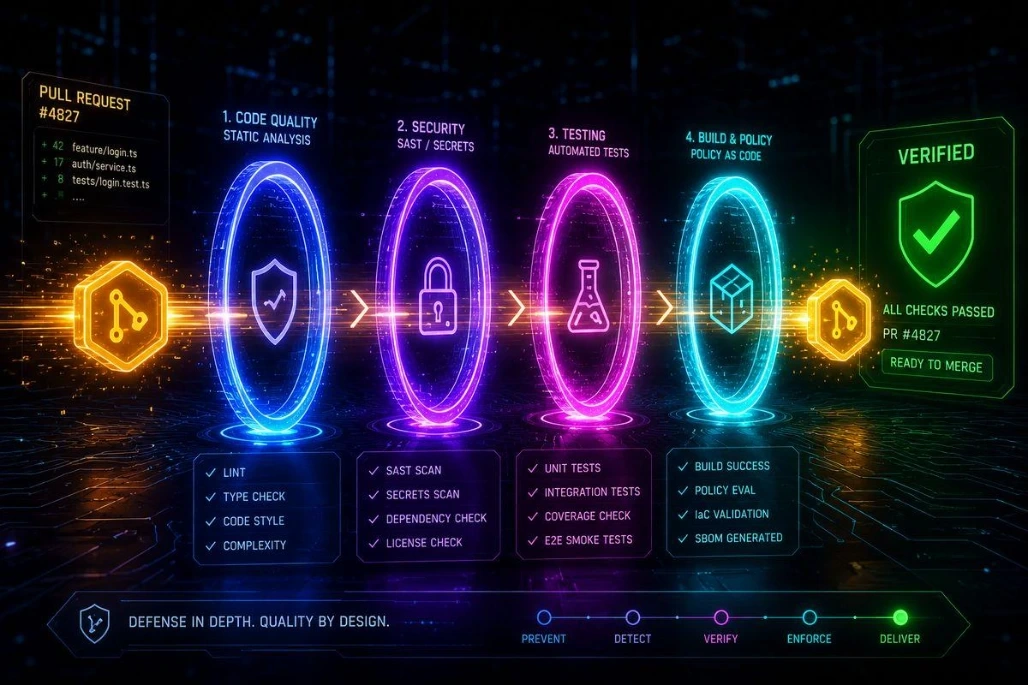
Automated tests provide immediate feedback about expected behavior. Integration tests identify problems between services, while security scanning examines dependencies and common vulnerabilities.
CI/CD systems also help enforce consistent release processes.
But a successful pipeline does not automatically prove that software is correct.
Tests may overlook unusual inputs, missing requirements, or architectural problems. An implementation could satisfy existing checks while introducing behavior those checks never anticipated.
Independent validation is particularly important when agents generate both application code and tests.
If the same incorrect assumption influences implementation and test generation, both may appear consistent while remaining wrong.
Red Hat's May 2026 discussion of trusted software factories highlights build provenance, dependency information, artifact signatures, security scans, and controlled release mechanisms.
For a .NET team using GitHub Actions or Azure DevOps, a practical workflow could require an agent-created pull request to pass unit tests, integration tests, dependency scanning, and reviewer approval before deployment.
Production observability then helps identify problems that pre-release testing missed.
Automation can accelerate delivery, but verification determines whether that speed produces dependable software.
Are Software Developers Becoming Supervisors of AI?
Coordinated AI development could change how engineers distribute their time.
Some routine implementation, test generation, and issue-resolution activities may become increasingly automated.
Meanwhile, requirements engineering, architecture, systems integration, and verification could demand greater attention.
Developers may spend more time deciding whether generated solutions satisfy business needs rather than manually producing every line of code.
That does not mean engineering becomes a passive supervisory role.
Understanding a distributed system, investigating a production failure, or evaluating architectural trade-offs still requires technical expertise.
Evidence also suggests that productivity improvements are uneven.
In an August 2026 analysis, McKinsey reported that some engineering organizations achieved substantial AI-related productivity gains while others experienced limited or negative effects.
The findings came from surveyed organizations and should not be treated as universal productivity estimates.
They highlight a practical reality: adding AI agents does not automatically improve the way software is delivered.
Engineering teams may need to redesign workflows, strengthen verification, and establish clearer responsibilities to benefit from increased automation.
The future developer may work with more autonomous systems, but accountability for software quality remains a human and organizational responsibility.
The Future of AI Software Factories: What Comes Next?
The near-term direction is toward deeper coordination between coding agents, repository tools, testing systems, and deployment platforms.
Automated issue resolution and agent-generated pull requests already demonstrate parts of this approach.
More comprehensive orchestration is plausible, especially for well-defined projects with reliable tests and established architecture.
Continuous evaluation may also become more important as software factories generate larger numbers of changes.
However, several capabilities remain uncertain.
Fully autonomous development of complex enterprise applications requires handling ambiguous requirements, incompatible dependencies, unexpected incidents, and long-term maintenance.
Those problems become harder when applications depend on external systems or operate under strict regulatory requirements.
A 2026 PwC report on agentic software delivery outlines increasing AI involvement across development stages while emphasizing the continuing importance of human responsibilities and delivery governance.
The most realistic near-term expectation is not software that builds itself under every condition.
It is software engineering in which more routine work is coordinated automatically, with human attention concentrated on design decisions, exceptions, and verification.
Conclusion: Software May Build Faster, but Engineering Still Matters
AI software factories represent an emerging approach to software delivery, combining autonomous coding agents, orchestration, testing, and operational feedback.
Their value comes from connecting development activities rather than simply generating additional code.
The technology is already moving beyond individual coding assistants, but reliable self-building applications remain an evolving ambition.
Architecture, integration, testing, security, and maintainability still determine whether generated software belongs in production.
For developers, the central challenge may shift toward designing workflows where automated implementation produces measurable, verifiable results.
If AI can coordinate much of software development, which engineering decisions should always remain under human control?
Frequently Asked Questions
What is an AI software factory?
An AI software factory coordinates AI agents and engineering services across activities such as requirement planning, code generation, testing, review, deployment, and monitoring. Its automation scope varies depending on the platform and organizational controls.
Can AI software factories build applications without developers?
They can automate selected development tasks and workflows. Complex architecture, unclear requirements, security-sensitive operations, production approval, and long-term maintenance may still require developers and other responsible professionals.
What is the difference between AI coding agents and AI software factories?
A coding agent typically performs development tasks within a repository or environment. An AI software factory coordinates multiple agents and engineering systems across a broader delivery workflow.
Are AI-generated applications ready for production?
Some can be, after appropriate validation. Production readiness depends on requirements, testing, security, integration, observability, and maintainability—not whether the implementation was written by an AI system or a human developer.


Join the conversation! Your thoughts help the community grow.