

This article is the second module of the Azure Az-900 course, and we will learn about the following.
- What are Azure and its services
- Using Azure Cloud Shell to launch configure your virtual machine to run a basic web server
- Scale up your server to give you more compute power
What is Azure
Azure is Microsoft's cloud computing platform. Azure is a continually expanding set of cloud services, that helps your organization meet your current and future business challenges. Azure gives you the freedom to build, manage, and deploy applications on a massive global network using your favorite tools and frameworks.
Azure services
Microsoft categorizes Azure cloud services into more than 18 main product types, let's take so a look at the most used categories -
Compute
Networking
Storage
Mobile
Databases
Web
Internet of Things
Artificial Intelligence
Machine Learning is a data science technique that allows computers to use existing data to forecast future behaviors, outcomes, and trends. Using machine learning, computers learn without being explicitly programmed.
DevOps
Create a virtual machine using Cloud Shell
The first step is to open your Azure account (it can be the free one); then click on the button as below.

A new Azure Cloud shell windows appear in the bottom of your Azure page, please switch from Powershell to Bash by selecting Bash as below,

Create a resource group
The first step is to create a resource group to hold all the things that we need to create. This allows us to administer all the VMs, disks, network interfaces, and other elements that make up our solution a unit.
And in this article, we will use the Azure CLI to create a resource group with the az group create command. It takes a --name to give it a unique name in our subscription, and a --location to tell Azure what area of the world we want the resources to be located by default.
So, let’s create a resource group by running the below command.
az group create --name myFirstResourceGroup --location
Do not forget to change local using one of the following lists.
'Centralus, eastasia, southeastasia, eastus, eastus2, westus, westus2, northcentralus, southcentralus, westcentralus, northeurope, westeurope, japaneast, japanwest, brazilsouth, australiasoutheast, australiaeast, westindia, southindia, centralindia, canadacentral, canadaeast,u ksouth, ukwest, koreacentral, koreasouth, francecentral, southafricawest’
Create a virtual machine
Let's get our Windows VM up and running.
- USERNAME=azureuser
- PASSWORD=$(openssl rand -base64 32)
Run the following az vm create command to create your VM. (use the same location as the group location in the previous step).
- az vm create \
- --name myVM \
- --resource-group myFirstResourceGroup\
- --image Win2016Datacenter \
- --size Standard_DS2_v2 \
- --location location\
- --admin-username $USERNAME \
- --admin-password $PASSWORD
When the VM is ready, you see information about it. Here's an example.
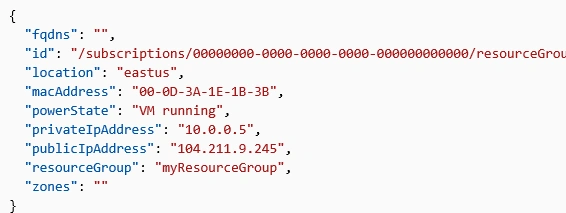
Add a web server
Step 1 Configure IIS
From Cloud Shell, run this az vm extension set command to download and execute a PowerShell script that installs IIS and configures a basic home page.
- az vm extension set \
- --resource-group myFirstResourceGroup \
- --vm-name myVM \
- --name CustomScriptExtension \
- --publisher Microsoft.Compute \
- --settings "{'fileUris':['https://raw.githubusercontent.com/MicrosoftDocs/mslearn-welcome-to-azure/master/configure-iis.ps1']}" \
- --protected-settings "{'commandToExecute': 'powershell -ExecutionPolicy Unrestricted -File configure-iis.ps1'}"
Step 2
az vm open-port --port 80 --resource-group myFirstResourceGroup --name myVM
Verify the configuration
Run this az vm show command to get your VM's public IP address.
az vm show -d -g myFirstResourceGroup -n myVM --query publicIps -o tsv
In a new browser tab, navigate to your VM's IP address (http:// followed by the IP address). You'll see your welcome message and your VM's name.

Scale up
What is scale?
Scale refers to adding network bandwidth, memory, storage, or compute power to achieve better performance.
In this example, we will increase our VM's size to Standard_DS3_v2.
- az vm resize \
- --resource-group myFirstResourceGroup \
- --name myVM \
- --size Standard_DS3_v2
Run az vm show to verify that your VM is running the new size.
- az vm show \
- --resource-group myFirstResourceGroup\
- --name myVM \
- --query "hardwareProfile" \
- --output tsv
You see your new VM size, 
Summary
In this module, we have learned about Microsoft Azure and how it relates to cloud computing, and we have used Azure Cloud Shell to configure a new virtual machine to run a basic web server.
Aakash MauryaPosted May 30, 2019, 1:00 PM
Great job.. Keep the good stuffs coming..