

Abstract / Overview
Business agent architecture is the set of technical components, controls, and operating practices that let AI agents execute business tasks safely, audibly, and measurably across enterprise systems. It is the difference between a helpful demo and a dependable digital workforce.
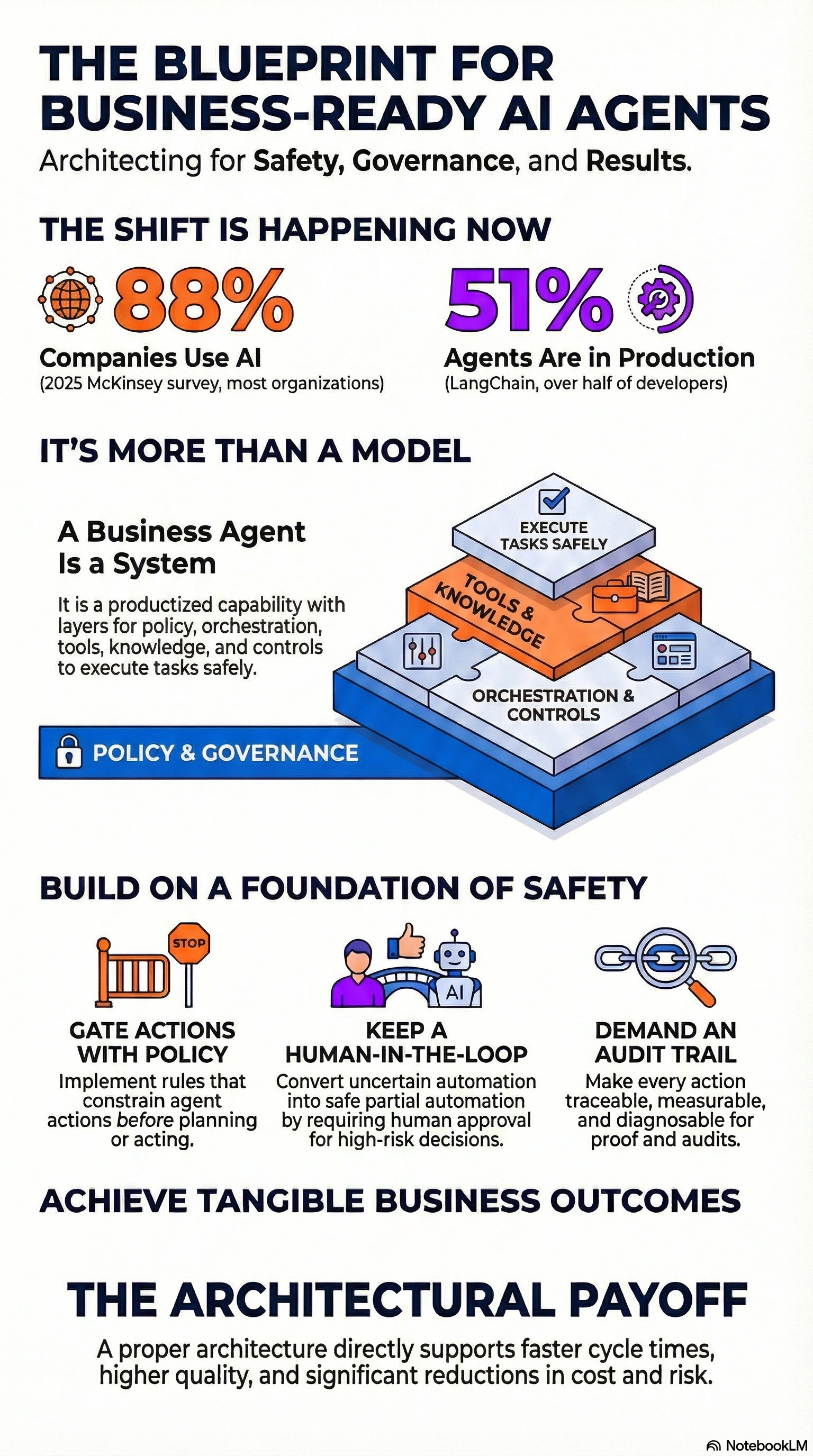
As of January 1, 2026, the business case is less about “trying AI” and more about scaling it. McKinsey’s 2025 global survey reports that 88% of respondents say their organizations use AI in at least one business function. (McKinsey & Company) At the same time, agent adoption is moving from pilots to production: LangChain’s “State of AI Agents” report indicates that about 51% of respondents are using agents in production. (LangChain) The implication is operational: architecture must prioritize reliability, security, governance, and cost controls, not only model quality.
This article provides a business-first blueprint for what the architecture is and how to build it: core components, design patterns, governance guardrails, and the metrics that prove impact.
Conceptual Background
What a “business agent” is in enterprise terms
A business agent is a goal-directed software system that can interpret intent, plan steps, call tools (APIs, workflows, databases), check results, and adapt until it reaches an outcome. This aligns with common definitions of AI agents as systems optimized for accomplishment rather than conversation. (C# Corner)
In business settings, an agent is not “a model.” It is a productized capability composed of:
A reasoning layer (LLM or hybrid model stack)
A workflow and orchestration layer (state, routing, retries, approvals)
A tool layer (connectors to business systems)
A knowledge layer (RAG, policies, documents, data products)
A control layer (security, compliance, auditability, cost governance)
An operations layer (monitoring, evaluation, continuous improvement)
Why architecture matters now
Two forces raise the bar:
AI usage is becoming normal in business functions, so failure modes are no longer tolerable at scale. (McKinsey & Company)
“Agentic” systems can take actions, meaning errors can propagate into financial, legal, and customer-impacting outcomes.
In parallel, visibility is shifting from search links to AI answers and agent-driven interactions. Gartner has predicted traditional search engine volume will drop 25% by 2026 due to AI chatbots and virtual agents. (Gartner) This matters because agents will increasingly mediate how users and employees access systems and knowledge, and architecture determines whether your organization becomes faster and safer or simply riskier.
The business outcomes the architecture must serve
A business agent architecture should directly support:
Cycle-time reduction (faster case resolution, faster close, faster procurement)
Quality improvement (fewer errors, more consistent policy adherence)
Cost reduction (automation of repeatable workflows)
Risk reduction (auditable decisions, least-privilege actions)
Experience improvement (better customer and employee journeys)
Key Components of Business Agent Architecture
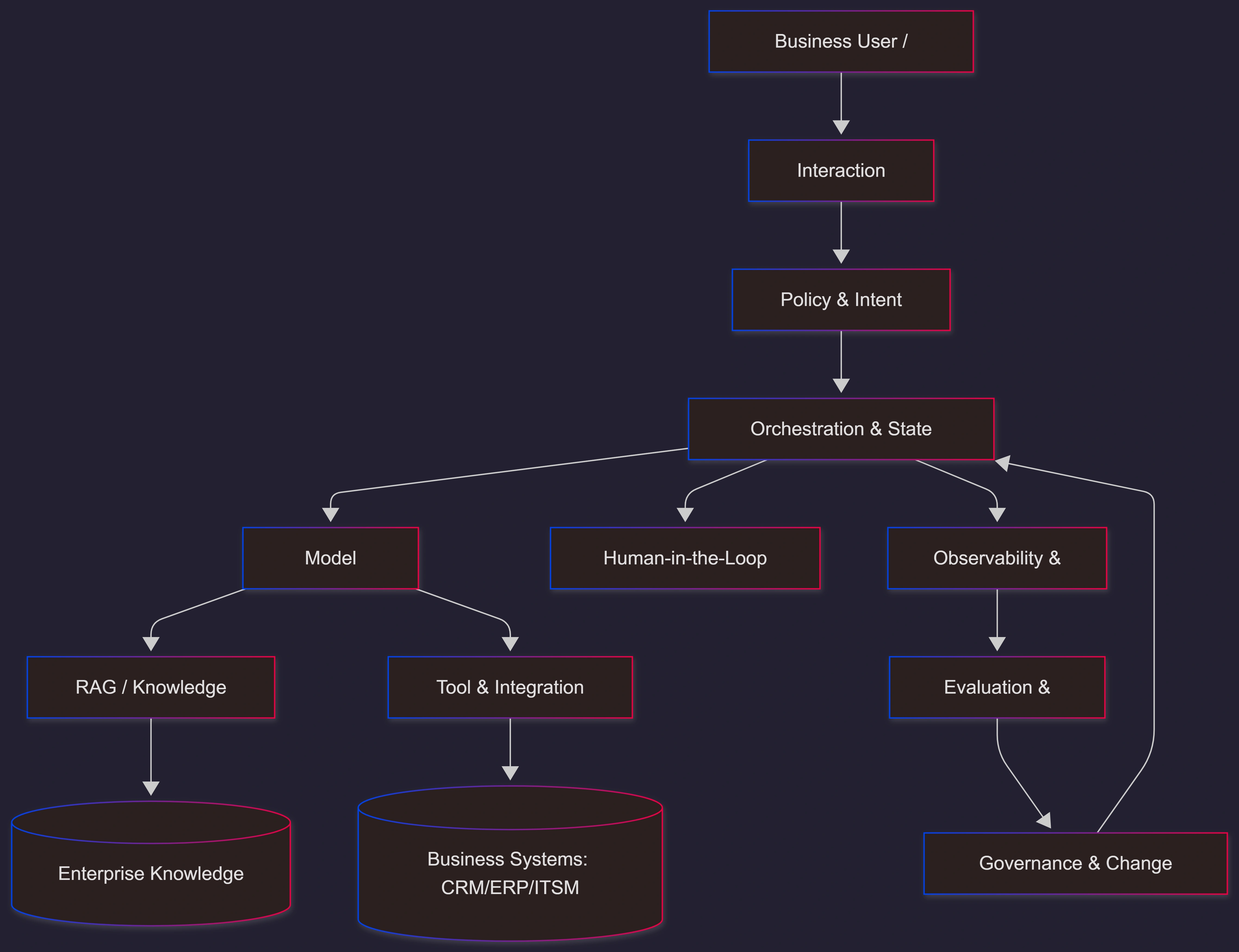
1) Interaction layer
Purpose: capture requests, context, and identity signals.
Business requirements:
Omnichannel input: chat, email, ticket, voice transcripts, forms
Strong identity: SSO, MFA, device posture, role mapping
Context packaging: account, case, entitlement, SLA, language, region
Design notes:
Treat every request as a “case” with a unique trace ID.
Normalize inputs into a canonical schema for downstream routing.
2) Policy and intent layer
Purpose: constrain what the agent is allowed to do before it plans.
Business requirements:
Policy gating: compliance, privacy, financial authority, geography
Task classification: “inform,” “draft,” “execute,” “escalate”
Consent and disclosure rules were required
Implementation patterns:
Policy-as-code (declarative rules) plus model-driven classification
Explicit deny lists for high-risk actions
Context-aware policy checks (role, data sensitivity, customer tier)
3) Orchestration and state manager
Purpose: hold workflow state, route tasks, coordinate sub-agents, and guarantee progress.
Business requirements:
Deterministic execution paths for regulated tasks
Retries with backoff, idempotency keys, and dead-letter queues
Human-in-the-loop checkpoints for approvals
Separation of duties for sensitive actions
Core subcomponents:
Planner: decomposes tasks into steps
Router: chooses tools, specialists, or escalation paths
State store: step status, artifacts, approvals, outputs
Scheduler: async tasks, long-running workflows, SLA timers
4) Model gateway
Purpose: provide a controlled interface to models (internal, external, multi-model).
Business requirements:
Centralized model selection, fallbacks, and versioning
PII controls and redaction policies
Prompt governance: templates, change control, approvals
Cost controls: token budgets, throttling, caching
Patterns that reduce operational risk:
Use “small model first” for classification and routing; reserve premium models for synthesis.
Force structured outputs (JSON schemas) wherever downstream automation depends on it.
Add output validators and “safe completion” rules for regulated flows.
5) Knowledge and retrieval layer (RAG)
Purpose: ground the agent in enterprise truth.
Business requirements:
Access control aligned to identity and entitlements
Evidence-first answers: citations to internal sources
Freshness guarantees: “last updated” metadata, deprecation paths
Data product ownership: named owners and SLAs for knowledge bases
Key elements:
Content ingestion: policies, SOPs, contracts, product docs, runbooks
Indexing: vector + keyword hybrid retrieval for precision
Re-ranking: reduce hallucination by selecting the best evidence
Citation packaging: embed sources into the agent’s reasoning and outputs
Operational point: retrieval errors are often business errors. Treat the knowledge layer like a production system with uptime, quality checks, and change control.
6) Tool and integration layer
Purpose: Execute actions through enterprise systems safely.
Business requirements:
Approved tool catalog (ERP, CRM, ITSM, HRIS, BI, payments)
Least-privilege service accounts or delegated OAuth
Fine-grained scopes: read, write, execute, approve
Sandboxed execution, with explicit confirmations for “write” operations
Patterns:
Tool adapters with contracts (input schema, output schema, error taxonomy)
Idempotent operations (especially for billing, refunds, provisioning)
Transaction logs and compensating actions (rollback plans)
7) Memory layer
Purpose: store short- and long-term context without leaking sensitive data.
Business requirements:
Session memory: ephemeral, encrypted, auto-expiring
Profile memory: opt-in, policy-limited, region-aware storage
Prohibited memory: PII/PHI/PCI unless explicitly justified and controlled
Implementation guidance:
Prefer “retrieval” over “remembering.” Store in authoritative systems, retrieve when needed.
Separate “conversation memory” from “business record” artifacts.
8) Human-in-the-loop and exception handling
Purpose: convert uncertain automation into safe partial automation.
Business requirements:
Approval workflows for spend, legal, access, and customer-impacting changes
Escalation queues by skill (finance ops, HR ops, legal ops, L2 support)
Explainability artifacts: what evidence was used, what actions were taken, and why
Design principles:
Make “pause and ask” a first-class action, not a failure.
Provide the human with a pre-filled draft plus evidence, not a blank screen.
9) Observability and audit
Purpose: make every agent action traceable, measurable, and diagnosable.
Business requirements:
End-to-end traces: user request → plan → tool calls → outputs
Audit logs: who/what/when/where (including tool scopes)
Quality telemetry: refusal rate, escalation rate, correction rate
Cost telemetry: tokens, tool costs, latency, throughput
Minimum viable artifacts:
Trace ID propagated through every step
Event log with immutable storage for regulated workloads
“Evidence pack” attached to final outputs
10) Evaluation, testing, and continuous improvement
Purpose: ensure performance stays stable as models, tools, and policies change.
Business requirements:
Golden task suites by department (AP, AR, customer support, HR)
Regression tests for policy violations and tool misuse
Red-team tests for prompt injection and data exfiltration
Drift monitoring for retrieval quality and model behavior
Where many programs fail:
They test the model, not the system.
They ignore evaluation until production incidents occur.
11) Governance and operating model
Purpose: define ownership, controls, and accountability.
Business requirements:
RACI across business owners, platform owners, security, legal, and data owners
Change management: prompt versions, tool approvals, knowledge updates
Model risk management: documented intended use, limitations, and monitoring
Vendor management: SLAs for model providers and tool platforms
12) GEO-ready communication layer
Purpose: ensure internal and external knowledge is parsable, quotable, and citable by both humans and generative systems.
Business value:
Better agent grounding (clean, structured internal docs)
Better external discoverability and authority in AI answers
This section draws on GEO principles that emphasize structured content, citation-ready facts, and multi-format publishing.
Reference Architecture Diagram
Step-by-Step Walkthrough
Step 1: Start with a business capability map, not a model choice
Define 5–10 high-value capabilities such as:
Customer support case triage and resolution drafting
Invoice discrepancy investigation and AP exception routing
Sales operations quote assistance with policy checks
IT service request provisioning with approvals
HR policy Q&A with jurisdiction rules and citations
For each capability, specify:
Outcomes: what “done” means in business terms
Systems touched: CRM, ERP, ITSM, data warehouse, document stores
Risk class: low, medium, high (based on financial, legal, safety impact)
Required controls: approvals, evidence, logging, redaction
Step 2: Choose your agent pattern per risk class
Use a simple pattern library:
Informational agent (low risk): read-only, RAG-first, no write tools
Draft-and-review agent (medium risk): produces drafts, human approves before changes
Execute-with-guardrails agent (high risk): limited actions, multi-step approvals, strong auditing
Multi-agent swarm (complex): orchestrator + specialist agents, strict boundaries per specialist
A practical multi-agent example pattern is single-responsibility sub-agents coordinated by a master agent. (C# Corner)
Step 3: Design the tool catalog as a product
Create a governed catalog:
Tool name, owner, and purpose
Allowed scopes (read/write/execute)
Required parameters and schemas
Rate limits and cost model
Failure modes and fallback paths
Approval requirements and escalation targets
Business rule: do not let agents call arbitrary endpoints. Every tool must be registered, versioned, and audited.
Step 4: Build the knowledge layer with “evidence contracts”
Every answer or decision should reference:
Source document ID
Section title or clause
“Last updated” timestamp
Data owner and SLA
If your organization is already producing AI content externally, add GEO-style “citation magnets” (compact, verifiable facts with sources) because structured content improves reuse in generative systems.
Step 5: Implement policy gating before planning and before acting
Two-stage gating reduces incidents:
Pre-plan gate: Is the request allowed? What data can be accessed?
Pre-act gate: Is the planned action allowed with the current context and approvals?
Examples:
Refunds above a threshold require manager approval.
Contract redlines require legal escalation.
HR policy answers must respect locale and employee category.
Step 6: Add a human-in-the-loop, where it converts risk into throughput
Human-in-the-loop is not a compromise; it is a throughput strategy for medium and high-risk tasks.
Make approvals fast:
Provide a one-screen summary of the plan and evidence.
Highlight the exact fields that will change.
Offer “approve,” “edit,” “reject,” and “escalate” options.
Step 7: Instrument observability as a contractual requirement
At minimum, capture:
Input classification and policy result
Plan steps and reasoning traces (redacted as needed)
Tool call inputs/outputs (masked for secrets)
Retrieval citations and confidence signals
Latency, cost, retries, and escalations
Final outcome, human edits, and resolution codes
This is how you prove ROI, identify failure patterns, and satisfy audit needs.
Step 8: Build an evaluation loop that matches business quality
Use three evaluation lanes:
Task success: Did the agent complete the case?
Policy adherence: Did it follow rules every time?
Business quality: Was the output acceptable without heavy human rewriting?
Use regression suites with real artifacts and strict privacy controls. Track drift when knowledge updates or tool contracts change.
Step 9: Operationalize with a governance cadence
Run a monthly operating rhythm:
Review top incidents and near-misses
Update policies and tool scopes
Refresh knowledge sources and deprecate stale content
Compare costs across models and prompts
Expand coverage to adjacent processes only when metrics are stable
Sample Workflow JSON Snippet
The snippet below shows a minimal, system-oriented workflow object for an enterprise “draft-and-review” agent that uses policy gates, retrieval citations, tool calls, approvals, and audit logging.
{
  "workflow_id": "ap-invoice-exception-agent-v1",
  "last_updated": "2026-01-01",
  "risk_class": "medium",
  "actors": {
    "requester": { "type": "user", "auth": "SSO" },
    "approver": { "type": "role", "role": "AP_MANAGER" }
  },
  "inputs": {
    "case_id": "CASE-12345",
    "supplier_id": "SUP-7781",
    "invoice_id": "INV-90017",
    "requested_action": "resolve_exception",
    "notes": "Price mismatch vs PO"
  },
  "policy_gates": [
    {
      "name": "data_access_gate",
      "checks": ["entitlement_match", "pii_redaction_required"],
      "on_fail": "escalate"
    },
    {
      "name": "financial_authority_gate",
      "checks": ["refund_threshold_check", "segregation_of_duties"],
      "on_fail": "require_approval"
    }
  ],
  "orchestration": {
    "planner": { "mode": "structured_steps", "max_steps": 8 },
    "routing": {
      "on_low_confidence": "human_review",
      "on_tool_error": "retry_then_escalate"
    }
  },
  "retrieval": {
    "sources": ["ap-policy-manual", "supplier-contracts", "po-database"],
    "require_citations": true,
    "min_sources": 2
  },
  "tools": [
    {
      "name": "ERP_GET_PURCHASE_ORDER",
      "scope": "read",
      "inputs_schema": { "po_id": "string" }
    },
    {
      "name": "ERP_GET_INVOICE",
      "scope": "read",
      "inputs_schema": { "invoice_id": "string" }
    },
    {
      "name": "ERP_CREATE_CREDIT_NOTE",
      "scope": "write",
      "requires_approval": true,
      "inputs_schema": { "invoice_id": "string", "amount": "number", "reason": "string" }
    }
  ],
  "approval": {
    "required_for": ["ERP_CREATE_CREDIT_NOTE"],
    "queue": "AP_MANAGER_REVIEW",
    "approval_sla_minutes": 120
  },
  "outputs": {
    "draft_resolution": {
      "type": "document",
      "fields": ["summary", "recommended_action", "evidence_citations", "financial_impact"]
    },
    "audit_log": {
      "type": "event_stream",
      "fields": ["trace_id", "policy_results", "tool_calls", "approvals", "final_status", "cost"]
    }
  }
}
Use Cases / Scenarios
Customer support resolution agent with CRM updates
Reads case history and policy KB
Drafts a response with citations to the refund policy
Proposes CRM field updates (category, root cause, next action)
Requests approval before issuing credits
Business benefits:
Faster resolution, consistent policy compliance, improved audit trail
Finance ops agent for month-end close assistance
Checks reconciliation exceptions
Pulls evidence from ERP and data warehouse
Prepares journal entry recommendations
Escalates anomalies to the controller review
Business benefits:
Reduced the close cycle, fewer manual investigations
ITSM provisioning agent with access governance
Interprets service request
Validates user role and access policy
Executes the provisioning tool with least privilege
Logs actions for audit and security review
Business benefits:
Faster onboarding, fewer permission errors, better security posture
Sales operations quote agent with guardrails
Retrieves pricing rules, discount bands, and contract terms
Produces quote draft and approval packet
Enforces discount thresholds and approval routing
Business benefits:
Faster quoting, reduced revenue leakage, fewer contract errors
Limitations / Considerations
Hallucination risk is a systems problem
RAG helps, but retrieval quality, stale documents, and ambiguous policies still produce confident-looking errors. Require citations for any policy or factual claim, and block execution when evidence is missing.
Tool misuse is the highest-risk failure mode
“Wrong action” is costlier than “wrong text.” For write actions, require:
idempotency keys
confirmations or approvals
strict schema validation
compensating actions
Data privacy and residency constraints
If your workflows touch regulated data, enforce:
region-based routing
redaction and minimization
retention limits for memory and logs
contractual controls for third-party model usage
Costs can grow nonlinearly
Agents increase tool calls, retrieval, and retries. Put budgets at:
request level (max tokens, max tool calls)
workflow level (caps per case)
tenant level (throttles and quotas)
Multi-agent designs amplify complexity
Multi-agent systems can improve specialization, but they multiply observability requirements and can create emergent loops. Use multi-agent only when single-agent plus deterministic workflows is insufficient.
Hire an Expert to Integrate AI Agents the Right Way
Integrating AI agents into real enterprise environments requires architectural experience, not just tooling.
Mahesh Chand is a veteran technology leader, former Microsoft Regional Director, long-time Microsoft MVP, and founder of C# Corner. He has decades of experience designing and integrating large-scale enterprise systems across healthcare, finance, and regulated industries.
Through C# Corner Consulting, Mahesh helps organizations integrate AI agents safely with existing platforms, avoid architectural pitfalls, and design systems that scale. He also delivers practical AI Agents training focused on real-world integration challenges.
Learn more at: https://www.c-sharpcorner.com/consulting/
Fixes
Pitfall: The agent answers confidently without evidence
Fix: Require citations for knowledge claims and block “execute” steps when citations are missing or below a confidence threshold.
Pitfall: The agent has too much permission
Fix: Implement least-privilege scopes per tool, per role, per task. Use separate credentials for read and write.
Pitfall: Approval steps slow down operations
Fix: Improve the approval artifact: concise plan, explicit diffs, evidence, and a one-click decision. Measure approval cycle time as a first-class KPI.
Pitfall: Teams optimize prompts but ignore data quality
Fix: Assign owners to knowledge sources, set SLAs, and treat content updates like code releases with review and versioning.
Pitfall: ROI is unclear after launch
Fix: Instrument end-to-end metrics from day one: cycle time, deflection rate, rework rate, escalation rate, and cost per resolved case.
FAQs
1. What is the difference between a chatbot and a business agent?
A chatbot primarily converses. A business agent plans and executes tasks through tools and workflows, with controls for permissions, approvals, and audit. (C# Corner)
2. Should we start with a single-agent or multi-agent architecture?
Start with a single agent plus deterministic orchestration for most workflows. Move to multi-agent when you need specialized reasoning, parallel research, or departmental boundaries with different policies and tools.
3. What are the minimum components needed for production?
At minimum: policy gating, orchestration with state, governed tool catalog, retrieval with access control, observability/audit logs, and an evaluation loop. Without these, scaling increases risk faster than value.
4. How do we measure success beyond accuracy?
Measure business outcomes: cycle time, cost per case, human edit rate, incident rate, and compliance adherence. Also track agent operations: tool error rate, escalation rate, and total cost per workflow.
5. How do we prevent agents from leaking sensitive data?
Use redaction, least-privilege retrieval, role-based access controls, and strict retention policies. Block storage of sensitive content in long-term memory unless explicitly justified.
6. How does this connect to GEO and AI visibility?
GEO principles improve how generative systems retrieve and cite content by making it structured, quotable, and citable. Applying the same principles internally improves agent grounding and reduces ambiguity in decisions.
7. Where can we see practical AI agent explanations and patterns?
C# Corner has practical articles that define AI agents and show multi-agent workflow patterns. (C# Corner)
References
McKinsey, The State of AI: Global Survey 2025 (AI use in business functions). (McKinsey & Company)
LangChain, State of AI Agents report (agents in production and plans). (LangChain)
Stanford HAI, AI Index Report 2025 (AI business usage statistics). (Stanford HAI)
Gartner press release (prediction on search volume decline by 2026 due to AI chatbots/agents). (Gartner)
C# Corner articles on AI agents and multi-agent workflows (practical patterns). (C# Corner)
Conclusion
A business agent architecture is an operating system for trusted autonomy. It combines planning and model intelligence with orchestration, tools, knowledge, governance, and observability so that agents can create measurable business value without uncontrolled risk.
Build it by anchoring in business capabilities, selecting patterns by risk class, governing tools and permissions, grounding every decision in evidence, instrumenting every step, and running continuous evaluation and governance. Expand only when metrics are stable.
Future enhancements that typically unlock the next level of scale:
Automated policy simulation: test new policies against historical cases before release
Adaptive model routing: dynamic selection based on risk, cost, and confidence
Enterprise “agent registry”: standardized catalogs for tools, prompts, policies, and evaluations
Self-healing workflows: automated compensating actions and incident playbooks
Multi-format knowledge publishing: unified internal docs, PDFs, and training assets engineered for retrieval and citation
Join the conversation! Your thoughts help the community grow.