I decided to write this article because I've been asked several times in technical interviews about the relationship between DDD Bounded Contexts and microservices.
When we build applications with complex business requirements, we often see that Domain-Driven Design (DDD) and microservices architecture work very well together. This approach is especially useful in systems where business logic is complex and requirements change quite often.
However, there is one important thing to understand. DDD and microservices can support each other, but they don't always need to be used together. We can apply DDD in a monolithic application, and we can also build microservices without using DDD.
Domain-Driven Design has two main groups of patterns: strategic and tactical patterns. Personally, I believe that strategic patterns, especially Bounded Context, are more important when we are designing large and complex systems.
The reason is quite simple. One of the biggest challenges in software architecture is not writing code or choosing technologies. It is understanding the business domain and defining the right boundaries. If we define these boundaries incorrectly, even using the best tactical patterns like Aggregate, Entity, or Value Object will not solve our architectural problems.
What Is a Bounded Context and Why Does It Matter?
A Bounded Context is a logical boundary where a particular domain model is valid. It helps us divide a complex business domain into smaller and more manageable parts.
But the main goal is not just to split a large system into smaller pieces. The goal is to make sure that each part has its own business rules, terminology, and domain model.
For example, the same business concept can have different meanings in different Bounded Contexts.
Let's take an e-commerce application as an example:
In the Ordering Context, a Customer is someone who places an order. In the Payment Context, a Customer may represent a person or an account involved in payment operations. In the Shipping Context, the important information about a customer might be the delivery address and contact details.
All these contexts use the Customer concept, but it doesn't mean they should use exactly the same Customer model. Each context has its own business requirements, and the model should represent those requirements.
We can compare Bounded Context with the Single Responsibility Principle (SRP) at a higher level. However, they are not exactly the same thing. SRP tells us that a module should have one main reason to change. Bounded Context defines where a particular domain model and its business rules are valid.
So, there are similarities between them, but they solve different problems.
Does One Bounded Context Always Mean One Microservice?
Üellç here is the question!
This is probably one of the most common questions when people start using DDD with microservices.
And the answer is no.
There is no strict rule saying that one Bounded Context must always be implemented as one microservice.
In many cases, starting with one Bounded Context mapped to one microservice can be a good decision. It gives us clear boundaries and helps us keep business logic separated.
But we should understand that Bounded Context and microservices solve different problems.
A Bounded Context defines the boundaries of a domain model, while a microservice is an architectural unit that can be developed, deployed, and scaled independently.
In simple words, Bounded Context helps us understand the business boundaries, while microservices help us decide how to organize and deploy the system.
Sometimes these boundaries match perfectly, and sometimes they don't.
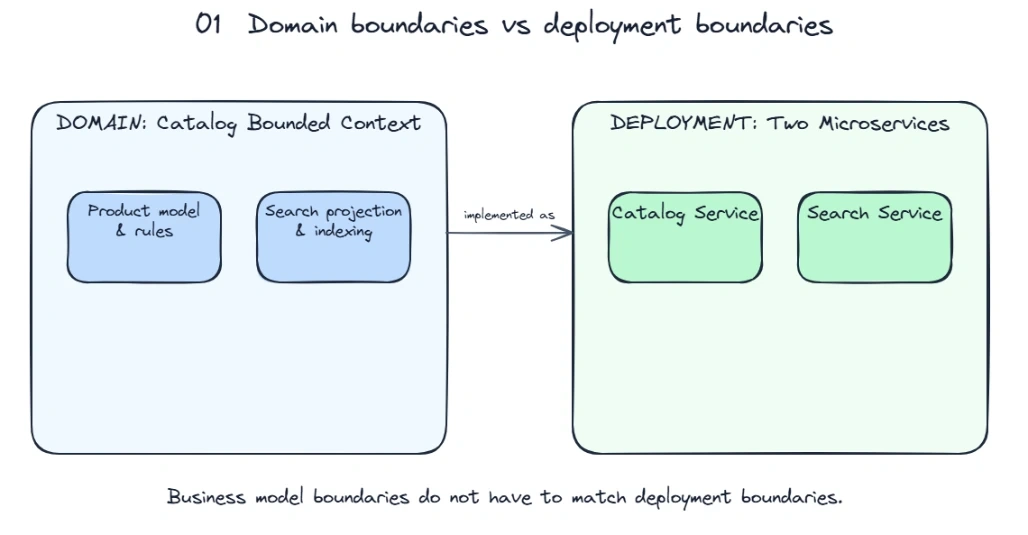
In real projects, we may also implement one Bounded Context using multiple microservices.
There can be different reasons for this decision, such as change rate, performance requirements, scalability, and team responsibilities.
For example, imagine that we have two features inside the same Bounded Context. One of them receives millions of requests every day, while another one is used only a few hundred times.
Technically, we can keep both features inside the same microservice. But sometimes separating them can help us scale and deploy them independently.
The same applies when one feature changes much more frequently than another.
However, I think it is important to mention that splitting a Bounded Context into multiple microservices does not automatically mean splitting its domain model into different Bounded Contexts.
These services may still belong to the same business context and use the same business language.
At the same time, we need to think about communication, data consistency, and dependencies between these services.
Because having more microservices doesn't always mean having a better architecture.
Actually, poorly defined boundaries can easily lead to what we call a distributed monolith.
In such systems, services are deployed separately, but they depend so much on each other that even a small change may require updating and deploying several services together.
A Practical Example: Bounded Contexts in an E-commerce System
Let's imagine that we are building a large e-commerce application.
The system allows customers to browse products, place orders, make payments, check product availability, and track deliveries.
At first, we may think that all these features belong to one e-commerce domain, and technically that is true.
But when we start analyzing the business requirements more carefully, we see that different parts of the system have different business rules, responsibilities, and reasons to change.
For exammple, we can identify several Bounded Contexts:
Catalog Context: Responsible for product information, descriptions, categories, images, and other product details.
Ordering Context: Responsible for creating orders, managing order statuses, and applying order-related business rules.
Payment Context: Responsible for processing payments, managing payment statuses, and handling refunds.
Inventory Context: Responsible for stock availability, product reservations, and warehouse operations.
Shipping Context: Responsible for delivery processes, shipment tracking, and logistics.
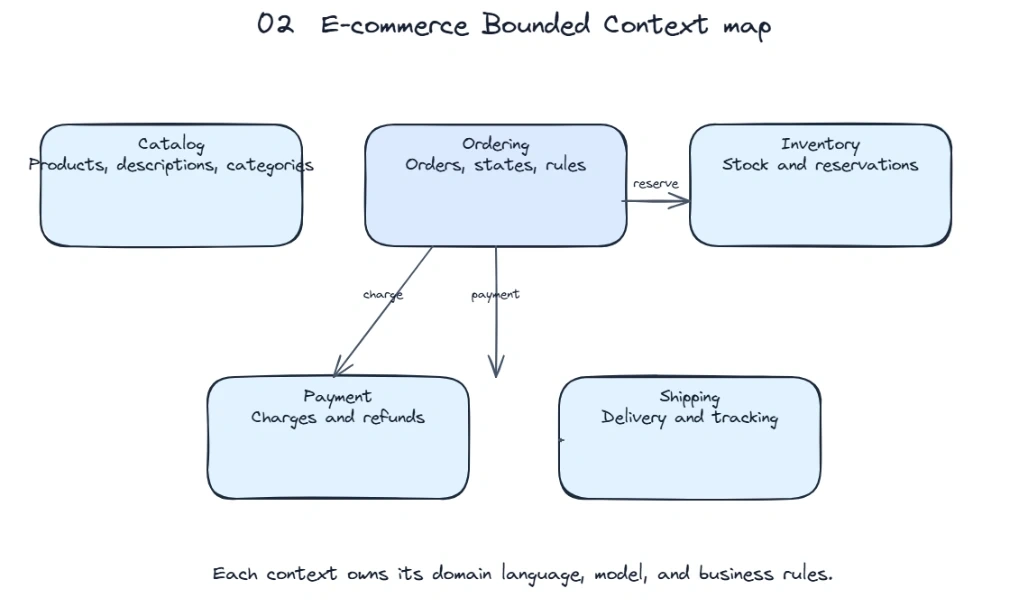
Now, the interesting part is that the same business concept can exist in several contexts but have different meanings.
The Product Model Is Not Always the Same
Let's take the Product concept.
Inside the Catalog Context, a Product may contain information like its name, description, images, category, and other details that customers see on the website.
But inside the Inventory Context, we don't really care about the product description or its images.
Here, we care about how many items are available, how many have been reserved, and which warehouse contains them.
In the Ordering Context, Product has another meaning.
When a customer places an order, we may only need the product ID, name, price at the time of purchase, and quantity.
We don't need to load the entire Catalog Product model just to create an order.
So, we have the same Product concept in three different contexts, but each context needs different information and has different business rules.
This is exactly why I believe defining Bounded Contexts correctly is so important.
If we try to create one shared Product Entity and use it everywhere, sooner or later this model will become too large and difficult to maintain.
Every new requirement from Catalog, Inventory, or Ordering may affect the same shared model.
As a result, a change in one business area can unexpectedly affect another one.
Instead, each Bounded Context should be able to define its own Product model based on its business needs.
The same idea applies to Customer, Order, and other business concepts.
How Should We Organize These Contexts as Microservices?
Now let's move from domain modeling to architecture.
One possible approach is to implement each Bounded Context as a separate microservice.
For example:
Catalog Service
Ordering Service
Payment Service
Inventory Service
Shipping Service
This approach gives us clear service boundaries and allows different business areas to evolve independently.
But again, this is just one possible approach, not a mandatory rule.
Let's imagine that our e-commerce application becomes very popular.
Millions of customers visit the website every day, search for products, apply filters, and browse different categories.
At the same time, product information is updated much less frequently.
Now we have an interesting situation.
Both product management and product searching are related to the Catalog domain, but their technical requirements are very different.
Product management mostly works with creating and updating product information.
Product searching, on the other hand, receives a very large number of read requests and may require a different database or search engine.
In this situation, we may decide to introduce two separate microservices.
The Catalog Service will manage product information, while the Search Service will handle searching and filtering.
For example, when a product is created or updated, the Catalog Service can publish an event. The Search Service can consume that event and update its own search index.
This allows us to scale the Search Service independently without increasing the number of Catalog Service instances.
But does it mean Search Service is automatically a new Bounded Context?
Not necessarily.
If Search Service only provides a search-optimized representation of Catalog data and doesn't have its own independent business model, it can still be considered a technical component within the same Bounded Context.
However, if searching becomes a separate business area with its own complex rules, terminology, and responsibilities, we may need to reconsider its boundaries.
So, in this example, one Bounded Context can be implemented using multiple microservices without necessarily creating new business boundaries.
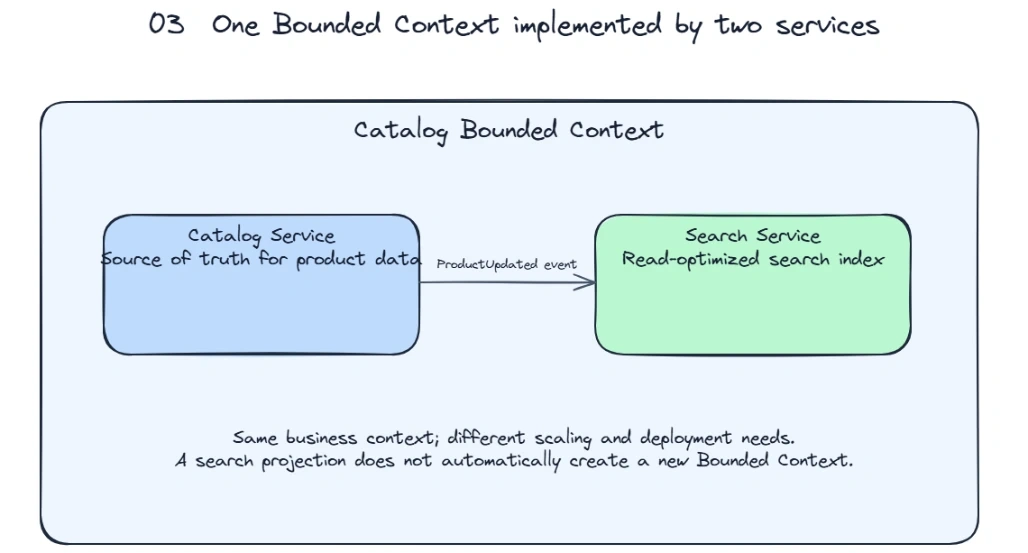
And this is one of the important differences between domain boundaries and deployment boundaries.
Communication Between Bounded Contexts
Let's continue with the same e-commerce application.
Imagine a customer wants to buy a laptop.
The customer adds the laptop to the shopping cart and places an order.
The Ordering Context is responsible for creating and managing the order. But it should not directly manage stock availability because that responsibility belongs to the Inventory Context.
For example, the Ordering Service should not connect directly to the Inventory database and update the available stock quantity.
If we allow this, we are breaking the boundaries between these contexts.
The Ordering Context would become dependent on the internal database structure and business rules of Inventory.
Instead, these contexts should communicate through clearly defined interfaces, such as APIs or events.
Let's say the customer places an order for two laptops.
The process might work like this:
The Ordering Service creates an order with a Pending status.
The Ordering Service requests a stock reservation from the Inventory Service.
The Inventory Service checks whether two laptops are available.
If the products are available, Inventory reserves them and confirms the reservation.
The payment process starts.
If the payment succeeds, the order can be confirmed.
If the payment fails, the system releases the reserved products and updates the order status.
Of course, this is a simplified example. In a real system, we also need to handle timeouts, duplicate messages, retries, and different failure scenarios.
But the main idea is that each Bounded Context is responsible for its own business rules.
Ordering doesn't need to know how Inventory calculates available stock.
Payment doesn't need to know how Ordering stores order information.
And Inventory doesn't need to know the internal structure of the Payment database.
Each context has its own responsibility, and they communicate through defined contracts.
What About Data Consistency?
Here we face another important challenge.
When we split our system into multiple microservices, each service may have its own database.
This means we cannot always use one database transaction to manage the entire business process.
For example, imagine that Inventory successfully reserves two laptops, but the Payment Service fails to process the payment.
What should happen to the reserved products?
We cannot simply leave them reserved forever.
One possible solution is to use the Saga pattern.
With Saga, we can divide a business process into multiple local transactions and use compensation actions when something goes wrong.
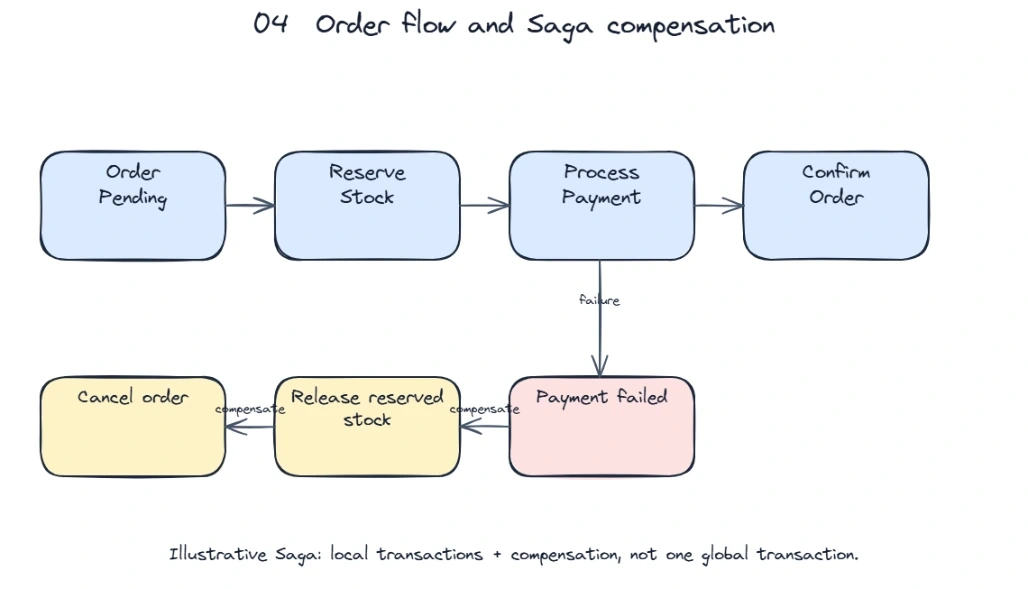
For example, if payment fails, we can execute a compensation action that releases the reserved stock.
However, I want to highlight something here.
The main purpose is not just to implement Saga or any other distributed system pattern.
The real goal is to keep business responsibilities separated and manage communication between contexts correctly.
Patterns are tools that help us solve problems. They should not be the reason why we create additional complexity.
Can One Microservice Contain Multiple Bounded Contexts?
Yes, technically it can.
For example, imagine that our e-commerce application is relatively small.
We have a limited number of customers, a small development team, and business requirements that are still changing.
In this case, creating separate microservices for Catalog, Ordering, Inventory, Payment, and Shipping may not be the best decision.
We would need to manage multiple deployments, service communication, monitoring, logging, and infrastructure.
And all this complexity may not bring much business value at this stage.
Instead, we can keep several Bounded Contexts inside the same application.
For example, we may have separate Catalog, Ordering, and Inventory modules, each with its own domain model and business rules.
The important thing is that these contexts should remain logically separated.
We should avoid situations where the Ordering module directly modifies Inventory's internal data or depends on its internal implementation.
So, the problem is not that several Bounded Contexts exist inside one application or deployment unit.
The problem starts when their models and responsibilities become mixed together.
As the system grows, keeping several contexts inside the same independently deployed service may become less practical, especially when they have different scaling requirements, change rates, or team ownership.
But it is still an architectural decision, not a strict DDD rule.
Why Modular Monolith Can Be a Better Starting Point
Another thing I often see is that developers start with microservices too early.
Sometimes the business domain is not fully understood yet, but the team already wants to create ten or fifteen microservices.
Personally, I don't think this is always a good idea.
When business boundaries are unclear, splitting the application into microservices can make future changes more difficult.
Because once we introduce network communication, separate databases, deployment pipelines, and distributed transactions, changing service boundaries becomes much more expensive.
In such cases, starting with a Modular Monolith can be a better decision.
A Modular Monolith allows us to organize the application into separate modules while keeping everything inside one deployable application.
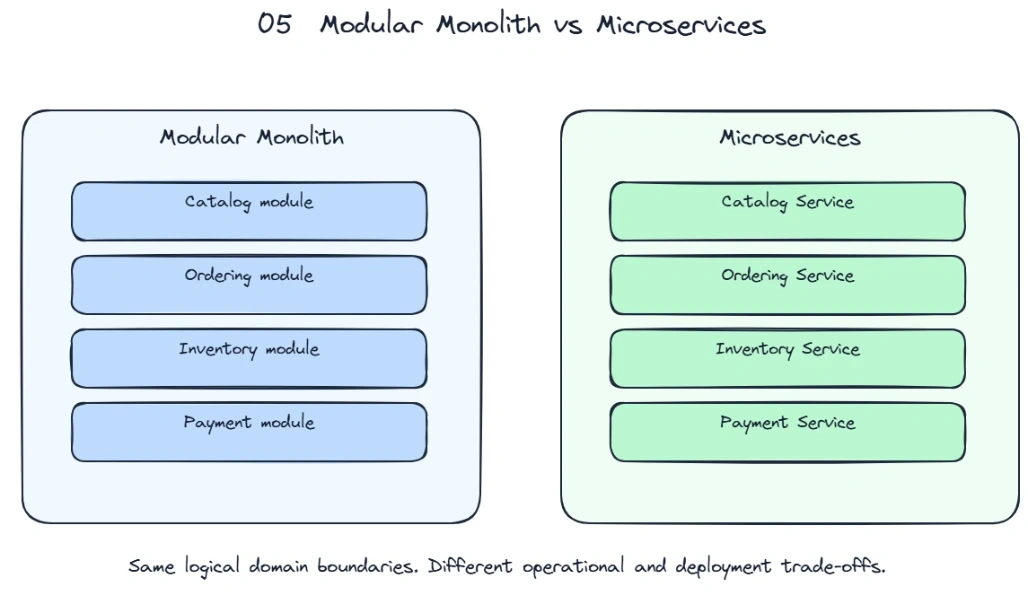
Each module can represent a Bounded Context with its own domain model, business rules, and interfaces.
For example, our e-commerce application can contain Catalog, Ordering, Inventory, Payment, and Shipping modules.
They are deployed together, but their internal responsibilities remain separated.
Later, if the Catalog module starts receiving millions of requests or the Payment module needs to be developed and deployed independently, we can consider extracting them into separate microservices.
Of course, this will be easier only if we designed the module boundaries correctly from the beginning.
If all modules directly access each other's tables and internal classes, extracting them later may still be difficult.
This is another reason why strategic DDD patterns are so important.
They help us make better decisions about boundaries before we start making technical decisions about deployment.
Scalability Is Not Always a Reason to Create More Microservices
One more thing I want to mention is scalability.
Sometimes we think that whenever a feature receives more traffic, we should immediately extract it into a separate microservice.
But this is not always necessary.
For example, imagine that our Catalog Service receives a large number of read requests.
Before splitting it into several microservices, we should understand the actual problem.
Maybe caching can solve it.
Maybe we need better database indexes.
Maybe we can use read replicas or increase the number of service instances.
Or maybe the problem is related to inefficient queries rather than service boundaries.
Creating another microservice introduces new responsibilities, such as network communication, failure handling, monitoring, and data synchronization.
So, before making this decision, we should understand whether the benefits are greater than the additional complexity.
In my opinion, microservices should be created because there is a real architectural or business need, not just because the system is becoming bigger.
Context Mapping Is Also Important
So far, we have mostly discussed how to identify Bounded Contexts and how they relate to microservices.
But strategic DDD is not only about identifying boundaries.
We also need to understand how different contexts interact with each other.
This is where Context Mapping becomes important.
Context Mapping helps us describe the relationships between Bounded Contexts, their dependencies, and how their models are integrated.
For example, in our e-commerce system, Ordering depends on information provided by Inventory and Payment.
But this doesn't mean Ordering should directly use their internal domain models.
Instead, we can define clear contracts between these contexts.
In some situations, an Anti-Corruption Layer can help us translate external models into the models used by our own context.
This is especially useful when integrating with third-party systems or legacy applications.
For example, imagine that our Payment Context integrates with an external payment provider.
The provider may use its own terminology, payment statuses, and data structures.
We don't want these external concepts to become part of our internal domain model.
An Anti-Corruption Layer can translate the provider's model into concepts that make sense inside our Payment Context.
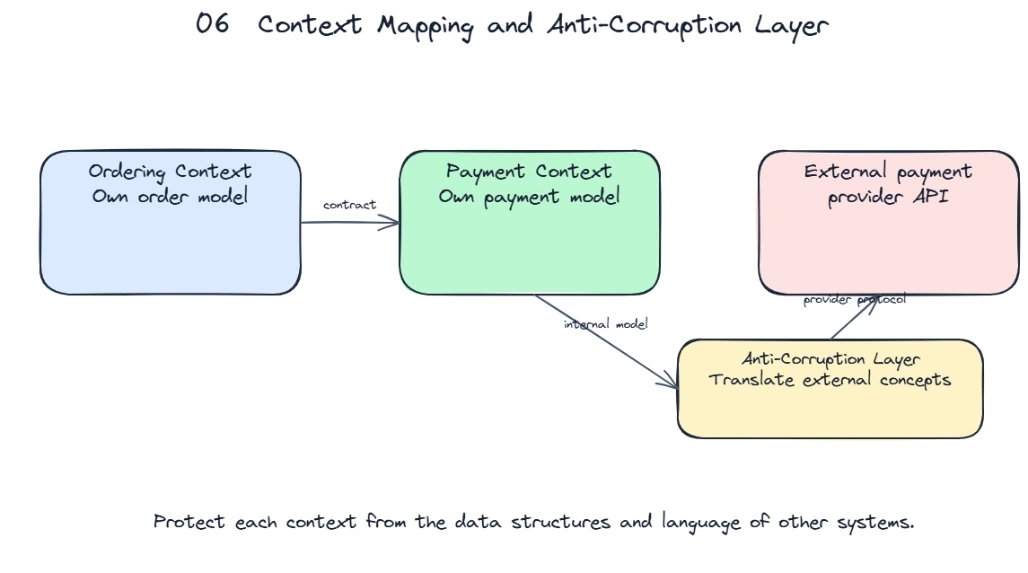
This allows us to keep our domain model independent from external systems.
And this is exactly one of the main goals of Bounded Context : protecting the meaning and rules of a domain model within its boundaries.
Final Thoughts
Based on my experience, when we use Domain-Driven Design together with microservices, the main goal should not be creating one microservice for every Bounded Context.
The goal should be understanding the business domain, defining the correct boundaries, and making architectural decisions based on those boundaries.
A Bounded Context defines where a domain model is valid. A microservice defines a technical and deployment boundary for implementing certain functionality.
Sometimes these boundaries will match, sometimes one Bounded Context will be implemented using several microservices, and sometimes multiple Bounded Contexts may exist inside one application or deployment unit.
There is no universal rule that works for every system.
We should consider business complexity, change rate,scalability, team responsibilities, and the future direction of the system.
I also believe that we should not choose microservices just because they are popular or because we want to follow modern architectural trends.
Sometimes a well-designed Modular Monolith is a much better solution than a system with many small services that are strongly dependent on each other.
For me, good software architecture is not about how many microservices we have.
It is about defining the right boundaries, keeping bussiness responsibilities clear, and making changes without affecting unrelated parts of the system.
And this is why I consider Bounded Context one of the most important concepts in Domain-Driven Design.


Join the conversation! Your thoughts help the community grow.