In large enterprises, responding to Request for Proposals (RFPs) is often a time-consuming and resource-intensive process. Teams spend days or even weeks reviewing documents, understanding requirements, coordinating with subject matter experts (SMEs), gathering pricing and compliance information, and preparing tailored responses.
What if much of this process could be automated through Agentic AI?
Recently, I explored an enterprise-grade AI solution built using Microsoft Copilot Studio, Azure AI services, Power Platform, and Python orchestration. The goal was to transform a traditionally manual RFP process into an intelligent, autonomous workflow capable of handling complex business operations with minimal human intervention.
The Challenge
A typical RFP response process involves:
Reviewing large volumes of unstructured documents
Identifying and extracting key requirements
Coordinating with multiple departments
Collecting pricing, legal, and compliance information
Drafting proposals and response documents
Communicating status updates to stakeholders
These activities often require significant manual effort, resulting in delays, inconsistencies, and increased operational costs.
The Agentic AI Approach
The proposed solution leverages a custom Copilot Agent that acts as an intelligent RFP coordinator.
When an RFP document is submitted, the AI agent analyzes the content, extracts key requirements, determines the appropriate stakeholders, gathers supporting information through connected systems, and generates an initial proposal draft.
Rather than simply answering questions, the agent takes actions, makes decisions, coordinates workflows, and orchestrates multiple systems to accomplish a business objective.
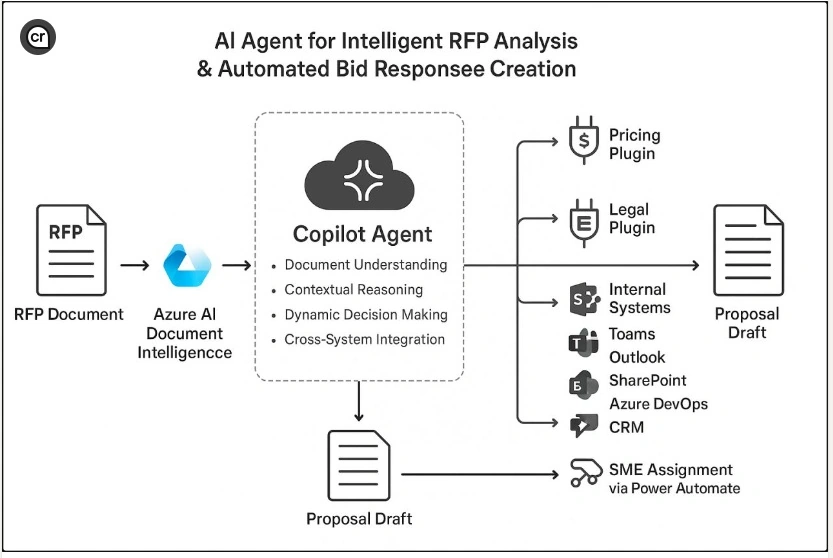
Solution Workflow
Step 1: RFP Analysis
The agent ingests RFP documents and uses AI-powered document intelligence to understand:
Business requirements
Technical requirements
Compliance obligations
Pricing expectations
Submission timelines
Step 2: Requirement Extraction
Using Generative AI and orchestration logic, the agent identifies actionable items and categorizes them for different business functions.
Examples include:
Technical review requests
Security and compliance assessments
Commercial pricing requirements
Legal review tasks
Step 3: Department Coordination
The agent automatically routes tasks to relevant SMEs and stakeholders using Microsoft Teams, SharePoint, and Power Automate workflows.
This eliminates the need for manual follow-ups and email coordination.
Step 4: External System Integration
The solution utilizes plugins and APIs to access:
The agent retrieves the required information on demand and incorporates it into the proposal generation process.
Step 5: Proposal Generation
Once sufficient information is collected, the AI agent generates a draft response tailored to the specific RFP requirements.
The generated proposal can then be reviewed, refined, and approved by business users before submission.
Step 6: Stakeholder Notifications
Throughout the process, the agent proactively updates stakeholders regarding:
Pending tasks
Review status
Escalations
Completion milestones
This ensures complete visibility and accountability across departments.
Technology Stack
The solution combines multiple Microsoft and AI technologies:
Microsoft Copilot Studio (Custom Copilot Agent)
Azure AI Document Intelligence
Microsoft Power Platform
Power Automate
SharePoint
Microsoft Teams
Microsoft Graph API
Python-based orchestration services
Generative AI models
Together, these technologies create a connected ecosystem where AI is not merely generating content but actively driving business processes.
Key Agentic Capabilities
The solution demonstrates several important characteristics of Agentic AI:
Understanding Unstructured Documents
The agent can process large and complex RFP documents, extracting meaningful insights without requiring predefined templates.
Cross-Department Collaboration
The agent coordinates activities across multiple teams, ensuring the right stakeholders are engaged at the right time.
Tool and Plugin Utilization
By leveraging plugins and APIs, the agent can retrieve pricing, compliance, and operational data from enterprise systems.
Autonomous Content Creation
The agent generates proposal drafts while maintaining context, business requirements, and supporting information from connected data sources.
Intelligent Workflow Orchestration
The agent continuously evaluates progress, triggers actions, and manages dependencies throughout the RFP lifecycle.
Business Benefits
Organizations can achieve several advantages through this approach:
Faster RFP turnaround times
Reduced manual effort
Improved response quality and consistency
Better stakeholder collaboration
Enhanced compliance and governance
Increased proposal win-rate potential
Scalable enterprise operations
Why This Matters
Many organizations view Generative AI primarily as a content-generation tool. However, its real business value emerges when combined with orchestration, automation, and enterprise integrations.
This RFP use case demonstrates how Microsoft Copilot Studio, Generative AI, Python, and Power Platform can work together to create intelligent agents capable of executing complex business processes from end to end.
The future of enterprise AI is not just about generating answers. It is about creating autonomous agents that can understand, reason, coordinate, and act across organizational systems.
Agentic AI represents that next step, helping organizations move from simple AI assistance to truly intelligent business execution.


Join the conversation! Your thoughts help the community grow.