

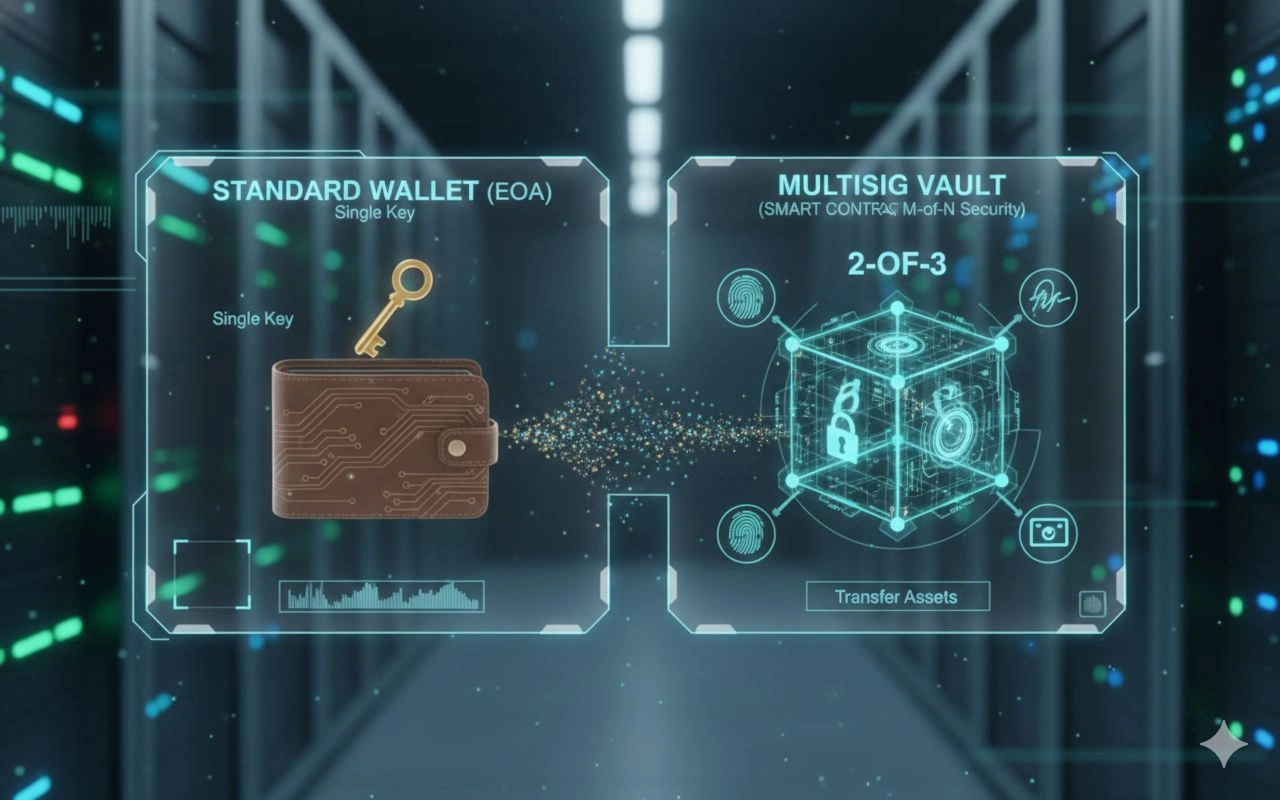
This is one of the most common and most misunderstood questions in crypto, especially among founders, developers, and teams that start with a single wallet and later realize they need better security.
The short answer is no.
You cannot convert an existing normal wallet into a multisig wallet.
The longer answer matters far more, because misunderstanding this leads to real losses, broken governance, and false confidence.
This article explains why it is not possible, what people actually mean when they ask this question, and the correct and safe way to move from a single wallet to multisig control.
What People Mean by an Existing Wallet
When most people say existing wallet, they mean a standard wallet address such as MetaMask, Trust Wallet, Coinbase Wallet, or a hardware wallet address. Technically, these are called externally owned accounts, or EOAs.
An EOA has three defining properties.
It is controlled by exactly one private key
It has no code deployed at the address
It signs transactions directly with that key
Once an EOA is created, these properties never change.
What a Multisig Wallet Actually Is
A multisig wallet is not a setting, feature, or toggle. A multisig wallet is a smart contract deployed on the blockchain.
That smart contract contains logic such as
Who the owners are
How many signatures are required
How transactions are validated and executed
Because multisig behavior lives in contract code, it can only exist at addresses that were created as smart contracts from the beginning.
This is why tools like Safe deploy a new address when you create a multisig wallet. That address is fundamentally different from a normal wallet address.
Why You Cannot Convert an Existing Wallet
An existing EOA has no smart contract code. There is nothing on chain that can be modified to suddenly require multiple signatures.
You cannot attach logic to an address that does not have code.
You cannot rewrite how signatures are validated for an EOA.
You cannot change the cryptographic ownership model after creation.
This is not a limitation of tooling. It is a core property of how blockchains work. If conversion were possible, it would mean ownership rules could be changed retroactively, which would break immutability and security guarantees.
The Common Misconception
Many people assume multisig is a wallet feature similar to two factor authentication. It is not.
Multisig is enforced by smart contract code, not by wallet software. Wallet software like MetaMask is just a key manager and transaction signer. It does not control how the blockchain validates ownership.
What You Can Do Instead
While you cannot make an existing wallet multisig, you can absolutely migrate to a multisig safely and correctly. This is what every serious project eventually does.
Option 1 Create a New Multisig and Move Funds
This is the most common and simplest approach.
You create a new multisig wallet using Safe.
You add multiple owners.
You set a threshold such as 2 of 3.
You transfer assets from the old wallet to the multisig address.
From that moment forward, all spending requires multiple approvals. Your old wallet becomes just another tool, not the vault.
Option 2 Transfer Contract Ownership to a Multisig
Many projects do not just hold tokens. They control smart contracts. For example, ERC20 token ownership, minting permissions, admin roles, and treasury controllers.
In these cases, you update the contract so that the multisig becomes the owner or admin. Once that is done, no single wallet can perform sensitive actions. This step is far more important than just moving funds.
Option 3 If Your Wallet Is Already a Smart Contract
Some wallets are smart contract wallets from day one. In those cases, you may be able to change owners or thresholds because the wallet was designed to be configurable.
But even here, you are not converting a normal wallet into a multisig. You are modifying a smart contract wallet that already exists.
Why This Design Is a Good Thing
It may feel inconvenient, but this separation is what keeps crypto secure. If wallets could be upgraded or converted after creation, attackers could hijack ownership rules. The fact that you must create a new multisig and move assets is a safety feature, not a flaw.
Best Practices When Migrating to Multisig
Use a testnet first to practice the process.
Use hardware wallets for at least two owners.
Move contract ownership before moving large balances.
Leave a small balance in the old wallet for gas and recovery actions.
Document who controls each signer and under what circumstances they sign.
Multisig is not just a technical change. It is an operational discipline.
EOA vs Multisig
| Feature | Standard Wallet (EOA) | Multisig Wallet (Smart Contract) |
|---|---|---|
| Control | One private key/seed phrase | Multiple independent keys |
| Security | Single point of failure | Redundant security (M-of-N) |
| Setup | Immediate | Requires a blockchain transaction |
| Flexibility | Static | Can often add/remove owners |
One Sentence Summary
You cannot make an existing wallet a multisig wallet because multisig wallets are smart contracts, not single key accounts, so the correct approach is to create a new multisig wallet and migrate assets and permissions to it.
Final Thoughts
If you are managing meaningful value, using a single wallet is not brave or fast. It is fragile. Multisig is the standard for teams, DAOs, and serious projects because it removes single points of failure. The right question is not whether you can convert an existing wallet. The right question is why you have not migrated yet.
Join the conversation! Your thoughts help the community grow.