

Managing computers and mobile devices is an important job for every IT department. Microsoft provides three main ways to manage devices: Configuration Manager, Microsoft Intune, and Co-management. Each solution has different features and is useful in different situations. Understanding these tools helps organizations choose the best way to manage their devices.
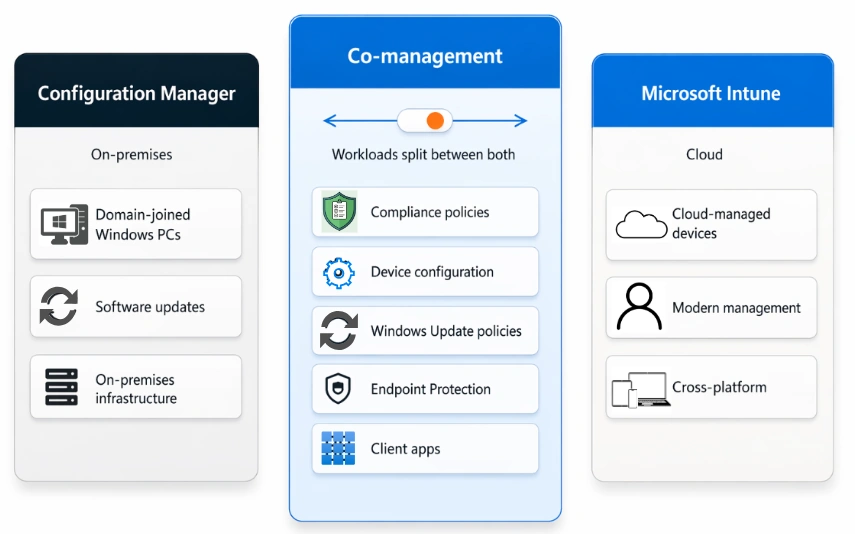
Configuration Manager
Configuration Manager is a device management tool that works mainly in an on-premises environment. It uses a client installed on Windows devices to communicate with a local server.
Configuration Manager helps IT administrators install software, deploy operating systems, manage updates, collect hardware and software information, and create detailed reports. It is a good choice for organizations that need full control over their Windows devices.
Advantages
Provides detailed hardware and software information
Supports software deployment and automation
Works even when devices have limited internet access
Offers powerful reporting features
Disadvantages
Requires on-premises servers
Costs more to set up and maintain
Mainly supports Windows devices
Not the best choice for remote workers
Microsoft Intune
Microsoft Intune is a cloud-based device management service. It manages devices through the internet using secure HTTPS connections.
Intune supports Windows, macOS, Android, and iOS/iPadOS devices. It allows administrators to deploy applications, apply security policies, manage updates, and protect company data from anywhere.
It is a good solution for companies with remote employees and cloud-based environments.
Advantages
No on-premises servers are needed
Supports multiple operating systems
Easy to manage remote devices
Simple to deploy and maintain
Disadvantages
Provides less detailed inventory than Configuration Manager
Some advanced features are still improving
Requires a reliable internet connection
Co-management
Co-management allows Configuration Manager and Intune to manage the same Windows 10 and Windows 11 devices together.
With co-management, organizations do not have to move everything to the cloud at once. They can move one workload at a time from Configuration Manager to Intune. This makes the migration process easier and safer.
For example, compliance policies and Windows updates can be managed by Intune, while software deployment remains in Configuration Manager.
Advantages
Makes cloud migration easier
Uses the strengths of both tools
Protects existing Configuration Manager investments
Allows gradual movement to Intune
Disadvantages
More difficult to configure
Two management systems must be maintained
Some workloads cannot be moved immediately
Comparison
| Feature | Configuration Manager | Microsoft Intune | Co-management |
|---|---|---|---|
| Device Management | On-premises | Cloud-based | Uses both tools |
| Supported Devices | Mainly Windows | Windows, macOS, Android, iOS/iPadOS | Windows devices |
| Policy Management | Group Policy and packages | Configuration profiles and compliance policies | Managed by either tool |
| Software Deployment | MSI, scripts, and packages | Win32, MSIX, and Store apps | Both methods can be used |
| Inventory | Detailed inventory | Basic cloud inventory | Depends on the active workload |
When to Use Each Solution
Use Configuration Manager when
Your company has an on-premises environment.
You mainly manage Windows computers.
You need detailed reporting and inventory.
Devices may not always have internet access.
Use Microsoft Intune when
Your company uses cloud services.
Employees work remotely.
You manage different operating systems.
You want a simple cloud-based solution.
Use Co-management when
You already use Configuration Manager.
You want to move to Intune slowly.
You want to reduce migration risks.
You want to use both tools during the transition.
How Co-management Works
First, a Windows device is enrolled in Microsoft Intune while it is still managed by Configuration Manager. Then, the administrator selects which workloads should be managed by Intune.
For example:
Compliance policies → Intune
Device configuration → Intune
Windows updates → Intune
Software deployment → Configuration Manager
Later, more workloads can be moved to Intune until all device management is done in the cloud.
Example
Contoso has 10,000 Windows laptops managed by Configuration Manager. The company wants to start using Intune for compliance policies and Windows updates.
The IT team enables co-management. They move compliance policies and updates to Intune but continue using Configuration Manager for software deployment. After several months, they move more workloads to Intune until all devices are fully managed in the cloud.
Conclusion
Configuration Manager, Microsoft Intune, and Co-management are all useful device management solutions.
Configuration Manager is best for organizations that need strong on-premises management. Microsoft Intune is best for cloud-based and remote work environments. Co-management is the best choice for organizations that want to move from Configuration Manager to Intune step by step.
Choosing the right solution depends on your organization's needs, existing infrastructure, and future plans.
Join the conversation! Your thoughts help the community grow.