
With adequate planning and preparation the PMP examination can be cleared. This article provides a detailed approach to crack the exam based on the author's practical experience and common pitfalls one should avoid.
Introduction
Clearing the PMP is like crossing the finish line in a marathon - it is a grueling test of endurance. Having a clear goal, being consistent and persistent in your preparation will go a long way in helping you crack the same. Read on, as the author shares how he did it.
Preliminary preparation
As you might be already aware, a candidate is required to attend a mandatory 35 hour training course to be eligible for attempting the exam. This training is usually provided by the local PMI chapter in your city or affiliated training partners. Before you actually attend the training, you can take up a series of proactive steps which will give you a head start.
Action steps taken up by me
I made it a point to read the entire PMBOK (Project Management Body of Knowledge - a PMI publication) once from cover to cover before actually attending the training. The following were the benefits:
- Like most other candidates, I was not in "discovery mode" during the training. I already had a good grasp of the subject matter being discussed.
- It also gave me a good idea of the entire span of topics I needed to get a good grip on to be able to crack the exam.
- I also had my list of questions ready to ask the instructors about topics / points which I could not understand in the 1st reading of the PMBOK.
During the 2 week training
I attended the training conducted by the local PMI chapter. More than the subject matter being discussed - the striking aspect of this training was the cross-section of practicing professionals who come together under one roof. The group had practicing project managers from diverse industries such as manufacturing, construction, nuclear energy, armed forces and of course, information technology. The sheer variety of experiences shared provides good food for thought and is one of the gains of participating in such trainings. Keep the following points in mind during the training:
- Be alert and vigilant during all the discussions - this will help you in practical application of the skills learnt.
- Ask questions - do not keep even a single doubt to be clarified later.
- Network with other participants
- Make sure a study group of the participants is created on Yahoo / Google before the course is over. This has great benefits which will be highlighted in the subsequent sections.
- Always keep a flash drive handy - a lot of study material will be shared during the 2 weeks of training. Ensuring that you have access to all of it will save you hours of effort - this is synergy at its best.
- During the mock tests keep a track of where you stand in comparison with other participants. This will give you real time feedback on your state of preparation for the exam.
- Switch off your cell phone and absorb the experience. Taking a break from your busy professional duties and just doing something different for a good length of time will cause you to think in new directions and release your creativity. Just enjoy the experience.
On the day following the last day of the training, do yourself a favor and take a break from work for 1 day if it is a working day. If it's a holiday, lock yourself up in a room, cut out all the distractions, interruptions and start creating your roadmap - a blueprint which will lead you to sure success.
Action steps taken up by me
The day following the last day of training was a Monday. I took leave from office and started preparing a plan:
Step 1: Identify and finalize all the study material to be read.
List of stuff I used:
- The PMBOK
- Practice standard on EVM - a PMI publication
- Practice standard on WBS - a PMI publication
- Rita Mulcahy's publication on clearing the PMP and mock test software.
- Study material provided by the local PMI chapter
Pitfall: There are a large number of websites, blogs, and postings made by many people sharing information. Whilst it might be useful to refer to the same, I have observed many people getting lost in this veritable sea of information and not knowing when to stop. The study material listed above was all that I read for clearing the exam.
Moral of the story:
Identify clearly what study material you will be using, keep an upper limit on the same. Do not get distracted or side tracked. Remember you have limited time.
| "Dost thou love life? Then do not squander time, for that's the stuff life is made of." - Benjamin Franklin American statesman, inventor, author |
Step 2: Take stock of the amount of time you can devote towards the exam preparation.
This will have 2 components,
- Free time available on working days i.e. Monday to Friday
- Free time available on weekends i.e. Saturday and Sunday
Monday to Friday: 1.5 hrs (reading during traveling) + 1 hr (at day-end) = 2.5 hrs per day
Saturday & Sunday: 8hrs per day
Total available time in a week for study = (2.5 X 5) + (8 X 2) = 28.5 hrs per week
In addition, I factored in 8hrs for every available public holiday. And of course, clearing the exam will require a minimum amount of sacrifice and commitment which you may be sensing already.
Step 3: Devise a strategy to study the subject matter.
The PMP examination comprises of 200 multiple choice questions wherein you need to choose the correct option from 4 possible answers within a time limit of 4 hrs. The PMBOK comprises of 44 processes grouped under 9 knowledge areas. Most of the questions asked are scenario based and test your overall process understanding i.e. the answer choices are very close and unless you have understood the 44 processes thoroughly, you will not be able to make the right choice. Questions do not repeat in the PMP exam.
How do you eat an elephant - one chunk at a time. How do you crack the PMP exam - 1 process at a time.
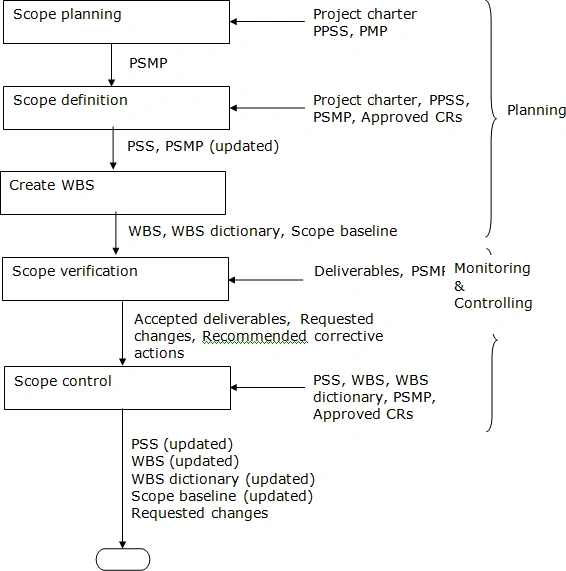
For example - let us consider the "Scope" knowledge area. It consists of 5 processes:
- Scope Planning
- Scope Definition
- Create WBS
- Scope Verification
- Scope Control
| Sr.No | Task details |
| 1 | Read Scope Planning(PMBOK) |
| 2 | Practice process diagram * |
| 3 | Read Scope definition(PMBOK) |
| 4 | Practice process diagram |
| 5 | Chapter 1: Introduction to the practice standard for WBS |
| 6 | Chapter 2:Defining the WBS |
| 7 | Chapter 3:Importance of the WBS |
| 8 | Chapter 4:Defining WBS quality |
| 9 | Chapter 5:Considerations while creating a WBS |
| 10 | Create WBS(PMBOK) |
| 11 | Practice process diagram |
| 12 | Scope verification(PMBOK) |
| 13 | Practice process diagram |
| 14 | Scope control(PMBOK) |
| 15 | Practice process diagram |
| 16 | Scope Management - Rita Mulcahy's book |
| 17 | Attempt all scope management questions in Rita Mulcahy's book |
* A process diagram is similar to a flowchart - it tries to represent all the inputs, outputs, tools and techniques corresponding to a particular process and links all the processes in a particular knowledge area using arrows. It's like a mind map - it captures the knowledge area understanding on paper. An example is provided for understanding at the end of this section.
If you closely observe the above table, the task listing sequence is initially aimed at understanding all the scope management processes in detail. Task 17 is a check point to see if you are exam-ready. In this manner, you can follow the same process for all the 9 knowledge areas and identify all the tasks at a detailed level.
| "The winning is really in the details, I told Floyd. It's in the details that you get ahead." - Lance Armstrong, 7 time Tour De France winner in his book "Every second counts" |
Mike GoldPosted Aug 12, 2009, 12:32 AM
Very informative. Not sure I'd want to eat an elephant though...