

Abstract / Overview
AI agents are moving from experimental prototypes to revenue-generating systems. Enterprises now deploy agents to qualify leads, automate operations, and support customers at scale. This guide explains what AI agents are and how to build production-grade agents using LangChain, n8n, and AutoGen. The focus is on business value: speed, reliability, governance, and lead generation.
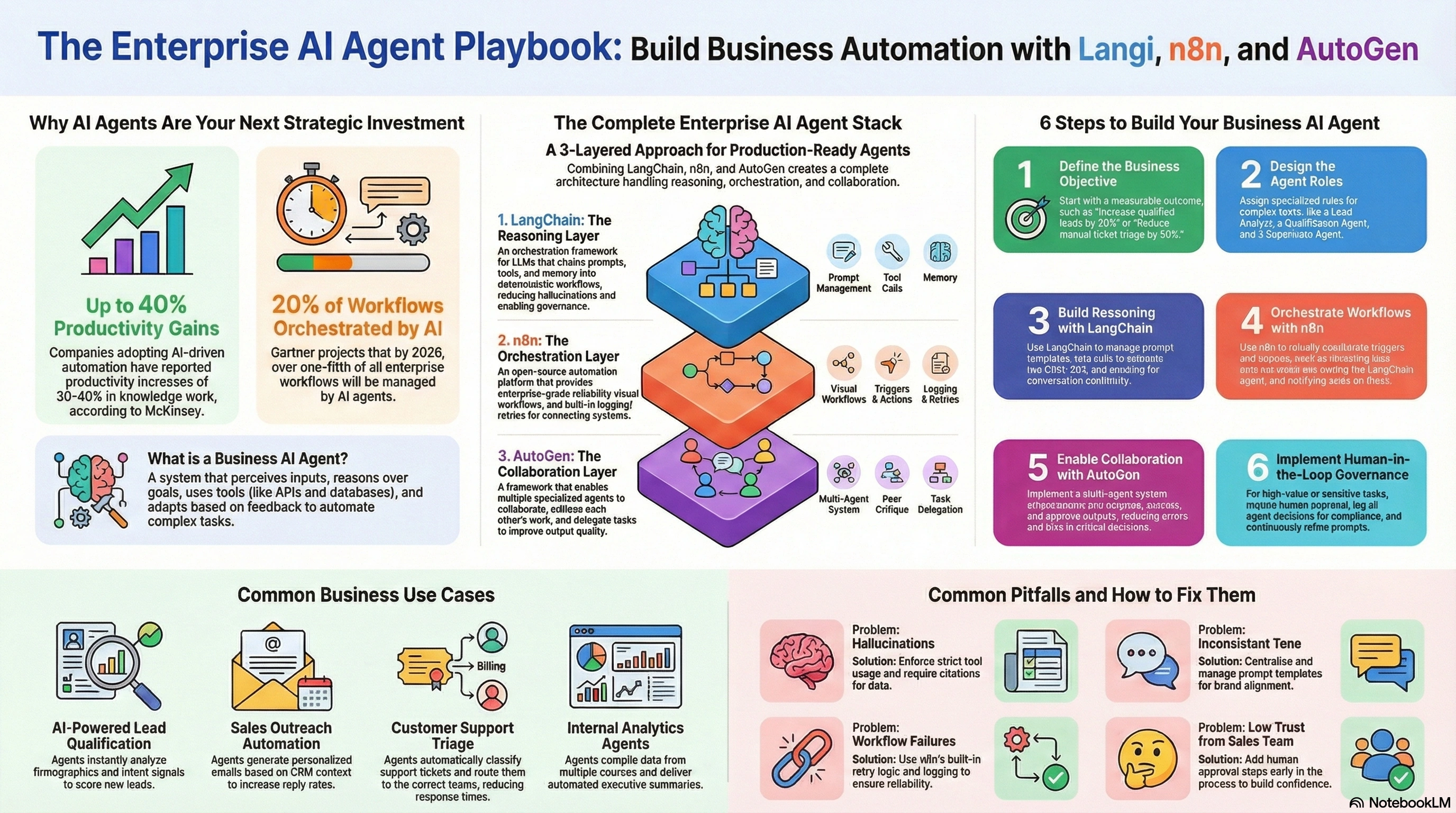
According to McKinsey, companies adopting AI-driven automation report up to 30–40% productivity gains in knowledge work. Gartner projects that by 2026, over 20% of enterprise workflows will be orchestrated by AI agents. These trends make agent frameworks a strategic investment, not a technical experiment.
Conceptual Background: What Are AI Agents in a Business Context
An AI agent is a system that can perceive inputs, reason over goals, take actions using tools, and adapt based on feedback. In business environments, agents replace rigid automation with decision-aware systems.
Key characteristics:
Goal-driven execution
Tool usage (APIs, databases, SaaS apps)
Context retention across steps
Ability to collaborate with other agents
In practice, agents act as autonomous employees for defined tasks: sales qualification, reporting, ticket routing, or compliance checks.
Why LangChain, n8n, and AutoGen Together
Each framework solves a different layer of the agent stack:
LangChain handles reasoning, memory, and tool orchestration.
n8n provides reliable, auditable workflow automation across systems.
AutoGen enables multi-agent collaboration and delegation.
Used together, they form a complete enterprise-ready agent architecture.
Tool Overview and Business Value
LangChain
LangChain is an orchestration framework for large language models. It allows developers to chain prompts, tools, and memory into deterministic workflows.
Business value:
Faster development of AI-powered features
Reduced hallucinations through tool grounding
Easier governance via structured prompts
n8n
n8n is an open-source automation platform that connects APIs, databases, and SaaS tools.
Business value:
Enterprise-grade reliability
Visual workflows for non-developers
Built-in logging and retries
AutoGen
AutoGen enables multiple agents to collaborate, critique, and delegate tasks.
Business value:
Separation of concerns (planner, executor, reviewer)
Higher output quality through agent debate
Scalable decision-making for complex tasks
Step-by-Step Walkthrough: Building a Business AI Agent Stack
Step 1: Define the Business Objective
Every agent must map to a measurable outcome. Examples:
Increase qualified leads by 20%
Reduce manual ticket triage time by 50%
Automate weekly analytics reporting
Assumption: the primary motive is lead generation.
Step 2: Design the Agent Roles
A common pattern uses multiple agents:
Lead Analyst Agent: interprets inbound data
Qualification Agent: scores leads using rules and LLM reasoning
Outreach Agent: drafts personalized responses
Supervisor Agent: validates outputs
Step 3: Reasoning and Tools with LangChain
LangChain manages:
Prompt templates aligned to business tone
Tool calls (CRM lookup, enrichment APIs)
Memory for conversation continuity
Minimal example:
from langchain.agents import initialize_agent
from langchain.tools import Tool

agent = initialize_agent(
    tools=[crm_lookup, email_writer],
    llm=llm,
    agent="zero-shot-react-description"
)
This agent can reason about when to fetch CRM data and when to generate outreach copy.
Step 4: Workflow Orchestration with n8n
n8n coordinates triggers and systems:
Webhook receives lead data
Calls LangChain agent via API
Writes results to CRM
Notifies sales in Slack
Sample workflow JSON:
{
  "trigger": "webhook",
  "steps": [
    "validate_input",
    "call_langchain_agent",
    "update_crm",
    "notify_sales"
  ]
}
This ensures reliability, retries, and auditability.
Step 5: Multi-Agent Collaboration with AutoGen
AutoGen introduces structured collaboration:
One agent proposes a lead score
Another critic's assumptions
A supervisor agent approves fthe inal output
This reduces errors and bias, critical in revenue-impacting workflows.
from autogen import AssistantAgent, UserProxyAgentStep 6: Human-in-the-Loop Governance
For high-value leads:
Require supervisor approval
Log decisions for compliance
Continuously refine prompts
This balances automation with accountability.
End-to-End Architecture Overview

Use Cases / Scenarios
AI-Powered Lead Qualification
Agents analyze firmographics, intent signals, and past interactions to score leads instantly.
Sales Outreach Automation
Agents generate personalized emails based on CRM context, increasing reply rates.
Customer Support Triage
Agents classify tickets and route them to the right teams, reducing response times.
Internal Analytics Agents
Agents compile data from multiple sources and deliver executive summaries.
Limitations / Considerations
LLM costs scale with usage
Poor prompt design leads to inconsistent outputs
Over-automation without review risks brand damage
Security and data privacy must be enforced
Fixes: Common Pitfalls and Solutions
Hallucinations → enforce tool usage and citations
Inconsistent tone → centralize prompt templates
Workflow failures → use n8n retries and logging
Low trust from sales → add human approvals early
Lead Generation Strategy Layer
This architecture supports lead generation by:
Reducing response time to seconds
Personalizing outreach at scale
Creating consistent qualification standards
Best practice: gate advanced agent features behind demos, audits, or strategy calls.
Hire an Expert to Integrate AI Agents the Right Way
Integrating AI agents into real enterprise environments requires architectural experience, not just tooling.
Mahesh Chand is a veteran technology leader, former Microsoft Regional Director, long-time Microsoft MVP, and founder of C# Corner. He has decades of experience designing and integrating large-scale enterprise systems across healthcare, finance, and regulated industries.
Through C# Corner Consulting, Mahesh helps organizations integrate AI agents safely with existing platforms, avoid architectural pitfalls, and design systems that scale. He also delivers practical AI Agents training focused on real-world integration challenges.
Learn more at: https://www.c-sharpcorner.com/consulting/
FAQs
Are AI agents production-ready today?
Yes, when combined with orchestration and governance layers.Do I need multiple agents?
Single agents work for simple tasks. Multi-agent systems outperform for complex decisions.Is this stack enterprise-safe?
Yes, with proper logging, access control, and human-in-the-loop design.How long to build an MVP?
Teams typically deliver a working MVP in 2–4 weeks.
References
McKinsey AI Productivity Reports
Gartner AI Automation Forecasts
LangChain Documentation
n8n Enterprise Automation Guides
AutoGen Research Papers
Conclusion
Building AI agents is no longer experimental. With LangChain for reasoning, n8n for orchestration, and AutoGen for collaboration, businesses can deploy reliable, revenue-driving agents today. This stack aligns technical capability with business outcomes, making it ideal for lead generation, sales automation, and operational efficiency.
Organizations that invest now will own automation advantages as AI-first workflows become the standard.
Join the conversation! Your thoughts help the community grow.