

Introduction
Databases sit at the heart of nearly every modern software system. Whether you are building an enterprise ERP system, a fintech platform, an AI powered application, or a high traffic social network, choosing the right database architecture determines how well your system scales, performs, and evolves over time.
For decades, relational databases dominated the data world. Systems such as MySQL, PostgreSQL, SQL Server, and Oracle powered most enterprise applications. These systems follow a structured schema, rely on SQL queries, and ensure strong transactional consistency.
However, the explosion of big data, distributed systems, and internet scale applications introduced a new class of databases known as NoSQL databases. These databases provide flexible schemas, horizontal scalability, and optimized performance for massive datasets.
Today, developers and architects must understand the fundamental differences between relational and NoSQL databases in order to design scalable systems.
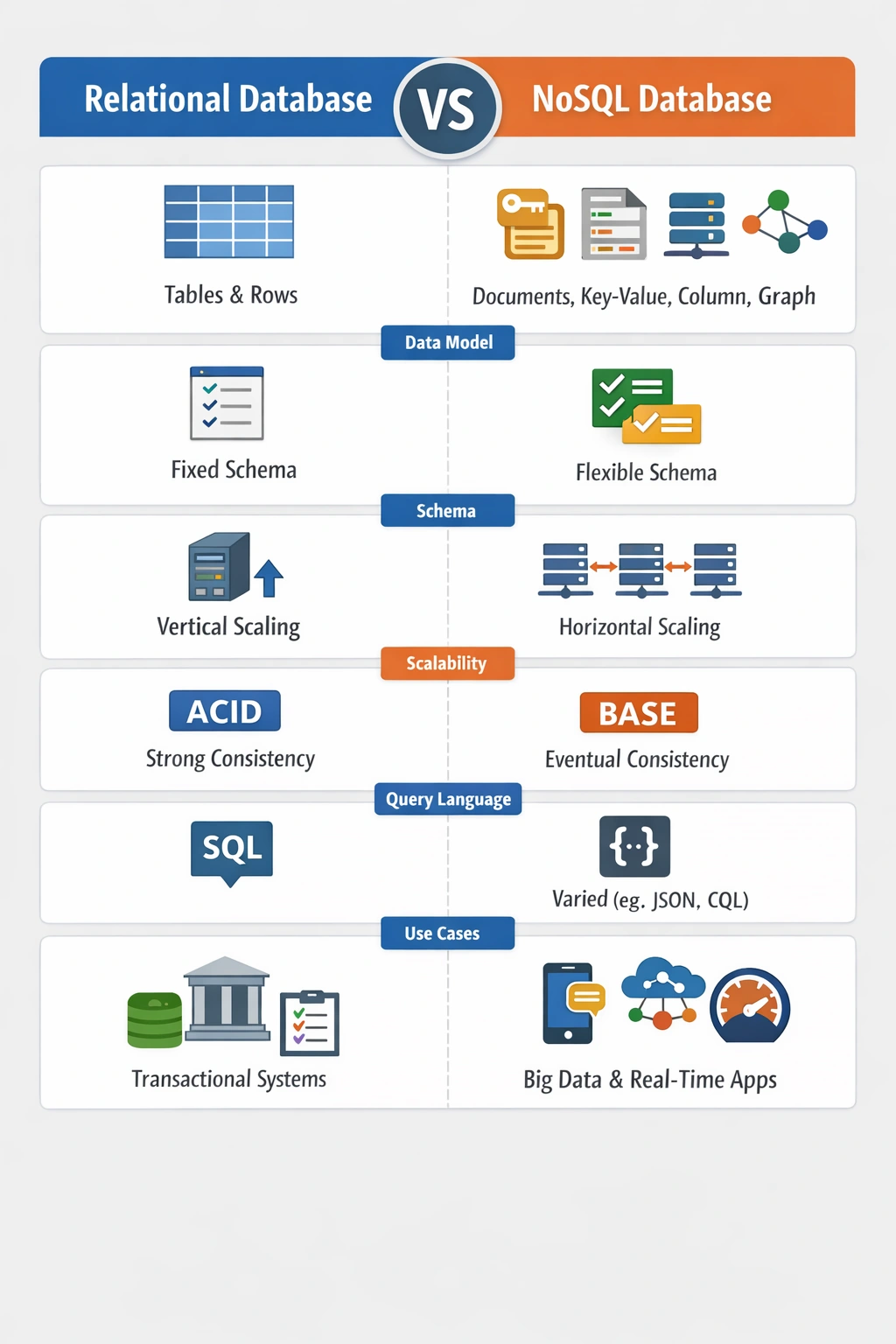
This article explores the architectural differences, performance tradeoffs, use cases, and real world scenarios where each database type excels.
What is a Relational Database
A relational database stores data in structured tables consisting of rows and columns. Each table represents an entity and relationships between tables are defined through keys. The relational model was first introduced by Edgar F. Codd in the 1970s and became the foundation for modern enterprise data systems.
In relational databases:
Data is stored in tables
Tables have rows (records) and columns (attributes)
Relationships are enforced using primary keys and foreign keys
Data integrity is ensured through ACID transactions
Example table structure:
Users Table
| UserID | Name | Country | |
|---|---|---|---|
| 1 | John | [email protected] | USA |
| 2 | Sarah | [email protected] | UK |
Orders Table
| OrderID | UserID | Amount |
|---|---|---|
| 101 | 1 | 250 |
| 102 | 2 | 90 |
The UserID column connects these two tables through a relational link.
This approach ensures structured and consistent data storage.
What is a NoSQL Database
NoSQL databases were designed to handle large scale distributed data systems that traditional relational databases struggled to support efficiently. Unlike relational systems, NoSQL databases do not require rigid schemas and can store data in multiple formats such as documents, key value pairs, graphs, or column families.
NoSQL databases prioritize:
Horizontal scalability
Flexible data models
High performance for massive workloads
Example document database record:
{
  "userID": 1,
  "name": "John",
  "email": "[email protected]",
  "orders": [
      {"orderID":101, "amount":250},
      {"orderID":103, "amount":70}
  ]
}
In this model, related information is stored together in a single document rather than separate tables.
This eliminates the need for complex joins.
Types of NoSQL Databases
NoSQL is not a single technology. It represents several database models designed for different workloads.
| Type | Description | Examples |
|---|---|---|
| Key Value | Data stored as key value pairs | Redis, DynamoDB |
| Document | JSON like documents | MongoDB, CouchDB |
| Column Family | Column oriented storage | Cassandra, HBase |
| Graph | Relationship based data | Neo4j, Amazon Neptune |
Each model optimizes different types of queries and workloads.
Core Differences Between Relational and NoSQL Databases
The most important differences lie in schema design, scalability, consistency models, and data storage methods.
| Feature | Relational Databases | NoSQL Databases |
|---|---|---|
| Data Model | Table based | Multiple models |
| Schema | Fixed schema | Flexible schema |
| Query Language | SQL | Varies by database |
| Scalability | Vertical scaling | Horizontal scaling |
| Transactions | Strong ACID | Often eventual consistency |
| Joins | Supported | Usually avoided |
| Performance | Complex queries | High scale distributed systems |
Database Architecture Comparison
Relational Database Architecture
Relational databases are typically designed for single node or vertically scaled systems.
Architecture characteristics include:
• structured schemas
• normalized data models
• strong transactional consistency
• centralized control
This architecture works extremely well for financial systems, enterprise software, and transactional workloads.
However, scaling becomes difficult when datasets grow to billions of records.
NoSQL Architecture
NoSQL databases are designed for distributed architectures.
They support:
• automatic sharding
• distributed data replication
• high availability clusters
• fault tolerant data storage
Typical distributed architecture:
Client Application
       |
Load Balancer
       |
---------------------------
|     |     |     |       |
Node1 Node2 Node3 Node4
Each node stores part of the dataset and requests are distributed across nodes.
This enables massive scalability.
Schema Design Differences
Relational Schema
Relational databases use normalized schemas.
Example:
Users table
Orders table
Products table
Relationships require JOIN queries.
Advantages
• data integrity
• reduced duplication
• structured data
Disadvantages
• complex joins
• slower performance at massive scale
NoSQL Schema
NoSQL often uses denormalized schemas.
Example document:
{
  "user": "John",
  "orders":[
     {"product":"Laptop", "price":1200},
     {"product":"Phone", "price":800}
  ]
}
Advantages
• faster queries
• reduced joins
• flexible schema evolution
Disadvantages
• potential data duplication
Scalability
Scalability is one of the most significant differences.
| Scaling Method | Relational Database | NoSQL Database |
|---|---|---|
| Vertical Scaling | Add more CPU and RAM | Supported but limited |
| Horizontal Scaling | Difficult | Native capability |
| Distributed Systems | Complex setup | Built in |
For example, platforms such as Netflix, Amazon, and Uber rely heavily on distributed NoSQL architectures to handle billions of requests daily.
Consistency Models
Relational databases follow the ACID model.
ACID stands for:
| Property | Meaning |
|---|---|
| Atomicity | Transactions succeed fully or fail completely |
| Consistency | Database remains valid |
| Isolation | Transactions do not interfere |
| Durability | Data persists after commit |
NoSQL databases often follow the BASE model.
| Property | Meaning |
|---|---|
| Basically Available | System remains operational |
| Soft State | Data may temporarily change |
| Eventual Consistency | Data becomes consistent over time |
This model allows higher scalability at the cost of immediate consistency.
Query Languages
Relational databases use SQL.
Example SQL query:
SELECT name, email
FROM Users
WHERE country = 'USA';
NoSQL databases use various query languages depending on the implementation.
Example MongoDB query:
db.users.find({country:"USA"})Because of this diversity, NoSQL systems lack a universal standard like SQL.
Performance Considerations
Performance depends heavily on the workload.
| Scenario | Best Choice |
|---|---|
| Financial transactions | Relational database |
| Large scale web apps | NoSQL |
| Complex joins | Relational |
| Real time analytics | NoSQL |
| Massive distributed data | NoSQL |
Relational databases excel at complex queries and transactions, while NoSQL systems excel at massive scale workloads.
When to Use a Relational Database
Relational databases remain the best choice for applications requiring strict consistency and complex relational queries.
Typical use cases include
• banking systems
• accounting software
• ERP systems
• inventory systems
• CRM platforms
Examples of popular relational databases:
| Database | Organization |
|---|---|
| MySQL | Oracle |
| PostgreSQL | Open source |
| SQL Server | Microsoft |
| Oracle Database | Oracle |
When to Use NoSQL Databases
NoSQL databases are ideal for applications requiring scalability and flexible schemas.
Common use cases include
• social networks
• IoT platforms
• AI data pipelines
• big data systems
• recommendation engines
• real time analytics
Popular NoSQL databases include
| Database | Type |
|---|---|
| MongoDB | Document |
| Cassandra | Column family |
| Redis | Key value |
| DynamoDB | Key value |
| Neo4j | Graph |
Hybrid Approaches
Many modern systems combine both relational and NoSQL databases.
Example architecture:
| Component | Database |
|---|---|
| Transaction processing | SQL database |
| User session caching | Redis |
| Analytics | Cassandra |
| Logs and events | Elasticsearch |
This approach is often called polyglot persistence, meaning multiple databases are used depending on workload requirements.
Advantages and Disadvantages
Relational Databases
Advantages
• strong consistency
• standardized SQL language
• mature ecosystem
• excellent for structured data
Disadvantages
• limited horizontal scaling
• rigid schema
• complex joins at scale
NoSQL Databases
Advantages
• horizontal scalability
• flexible schemas
• high performance for big data
• distributed architecture
Disadvantages
• weaker consistency models
• lack of universal query standard
• potential data duplication
Real World Technology Stacks
Many major technology companies combine both database types.
| Company | Relational DB | NoSQL DB |
|---|---|---|
| Amazon | Aurora | DynamoDB |
| MySQL | Cassandra | |
| Netflix | MySQL | Cassandra |
| Oracle | Espresso |
This demonstrates that both database types play important roles in modern systems.
Frequently Asked Questions
What is the main difference between SQL and NoSQL databases
SQL databases use structured tables with predefined schemas and relational links. NoSQL databases store data in flexible formats such as documents, key value pairs, or graphs and scale horizontally.
Are NoSQL databases replacing relational databases
No. Relational databases remain essential for transactional systems. NoSQL databases complement them for large scale distributed workloads.
Is MongoDB better than SQL
MongoDB is not universally better. It performs better for flexible schema and large scale distributed applications, while SQL databases excel in transactional consistency and relational queries.
Which database is better for AI applications
AI systems often use NoSQL databases for handling massive datasets, logs, and model outputs. However relational databases are still used for metadata and transactions.
Can relational databases scale horizontally
Yes, but scaling relational databases horizontally is complex and usually requires sharding or specialized distributed systems.
What is the future of databases
The future of databases is increasingly distributed, cloud native, and hybrid, combining relational consistency with NoSQL scalability.
Technologies such as NewSQL databases attempt to combine the best of both worlds by providing SQL compatibility with distributed scalability.
Summary
Relational databases and NoSQL databases serve different purposes in modern software architecture. Relational databases provide structured schemas, strong consistency, and powerful SQL queries. They remain the backbone of enterprise transactional systems.
NoSQL databases offer flexible schemas, distributed architecture, and horizontal scalability. They are ideal for handling massive datasets and high traffic applications. The key takeaway for developers and architects is that there is no universal solution. The best systems often combine both relational and NoSQL databases depending on workload requirements. Understanding these differences allows teams to design systems that are scalable, reliable, and ready for the demands of modern applications.
Join the conversation! Your thoughts help the community grow.