

Abstract / Overview
Enterprise safety for AI agents is the discipline of governing, constraining, and monitoring autonomous or semi-autonomous AI systems so they operate within defined business, legal, and ethical boundaries. As enterprises move from experimental copilots to production-grade agents that act, decide, and execute, unmanaged autonomy becomes a material business risk. This article explains what enterprise safety means in practice and how to design governance models, technical guardrails, and risk control systems that enable scale without loss of control.
Direct Answer
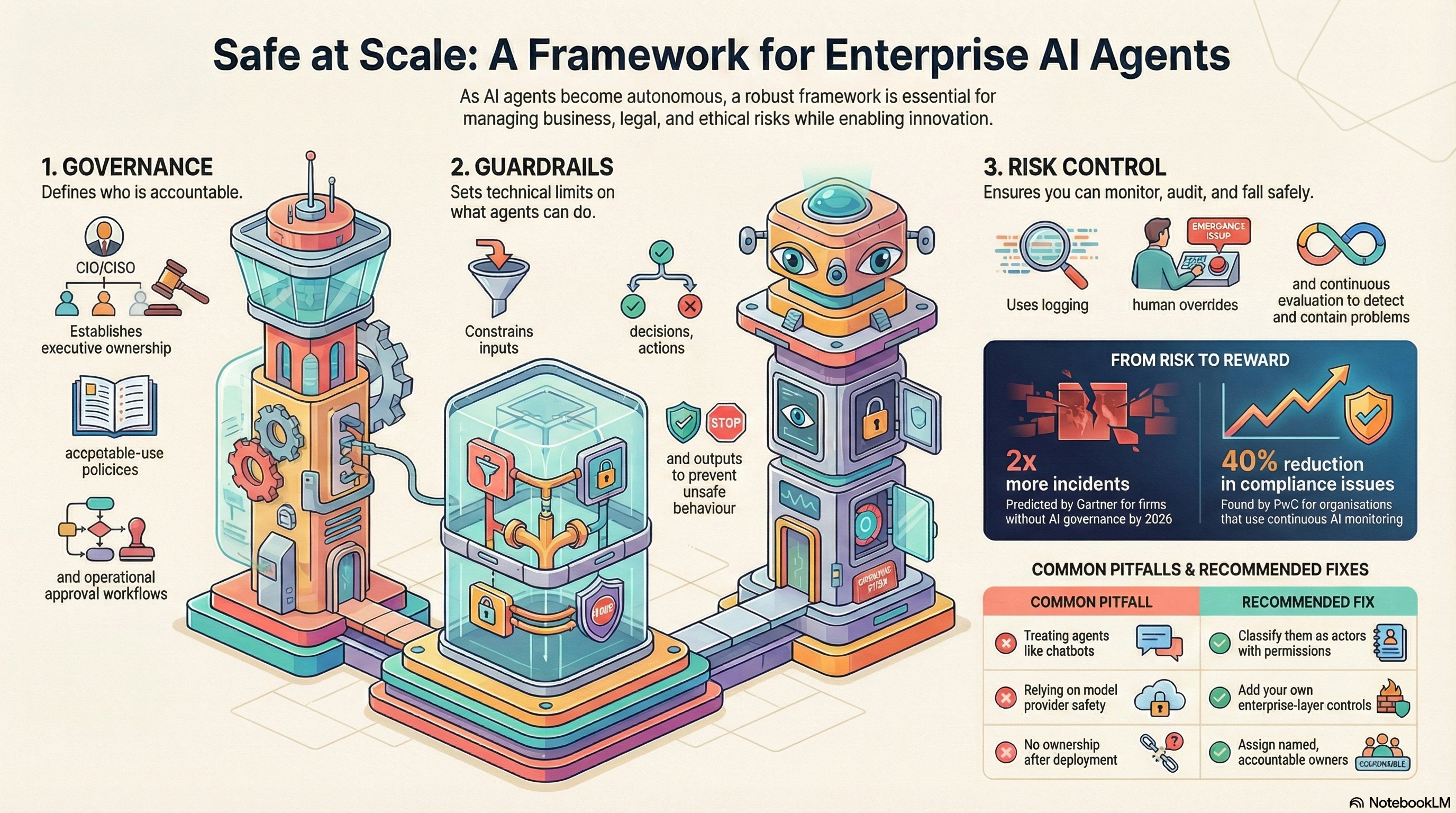
Enterprise safety for AI agents is the combination of governance, technical guardrails, and continuous risk controls that ensure AI agents act only within approved objectives, permissions, and compliance boundaries while remaining auditable, explainable, and reversible.
Conceptual Background
AI agents differ from traditional software because they reason, plan, and act dynamically. This introduces new failure modes that standard IT controls were not designed to handle.
Key drivers behind enterprise AI safety include:
Autonomous decision-making without deterministic rules
Tool and API execution with real-world impact
Continuous learning or adaptation
Probabilistic outputs that vary over time
According to McKinsey, over 55% of enterprises now deploy AI in at least one core business process, increasing exposure to operational and regulatory risk. Gartner predicts that by 2026, enterprises without formal AI governance will experience twice as many AI-related incidents as those with structured controls.
Enterprise safety is not about slowing innovation. It is about enabling safe autonomy.
Governance: Defining Who Controls the Agent
Governance defines who is accountable for what across the AI lifecycle.
Core Governance Layers
Strategic Oversight
Executive ownership (CIO, CISO, Chief AI Officer)
Alignment with business objectives
Risk appetite definition
Policy and Standards
Acceptable-use policies for agents
Data access and retention rules
Human-in-the-loop requirements
Operational Governance
Model approval workflows
Deployment gates
Incident response ownership
Leading enterprises align agent governance with existing frameworks such as the NIST AI Risk Management Framework and ISO/IEC 23894.
Governance Anti-Pattern
Decentralized agent deployment without centralized approval results in “shadow agents” that bypass controls, creating untracked liability.
Guardrails: Constraining What the Agent Can Do
Guardrails are technical constraints embedded into the agent’s runtime behavior.
Key Guardrail Categories
Input Guardrails
Prompt validation
Sensitive data detection
Context filtering
Decision Guardrails
Confidence thresholds
Policy-based reasoning checks
Tool eligibility rules
Action Guardrails
Permission-based tool execution
Rate limits and spend caps
Environment isolation (sandbox vs production)
Output Guardrails
Toxicity and bias filters
Regulatory language checks
Disclosure and attribution enforcement
Modern agent platforms often integrate guardrails at the orchestration layer rather than the model layer, especially when using foundation models from providers like OpenAI or Microsoft.
Guardrails Principle
If an agent can take an action, that action must be explicitly permitted, logged, and reversible.
Risk Control: Monitoring, Auditing, and Failing Safely
Risk control ensures that when something goes wrong, the organization can detect, contain, and correct it quickly.
Core Risk Control Mechanisms
Observability
Decision logs with prompts and outputs
Tool usage tracing
Token and cost monitoring
Auditability
Immutable logs
Versioned prompts and policies
Model provenance tracking
Human Override
Kill switches
Manual approval checkpoints
Escalation paths
Continuous Evaluation
Drift detection
Bias monitoring
Performance regression alerts
PwC reports that enterprises with continuous AI monitoring reduce compliance incidents by up to 40% compared to static control models.
Step-by-Step Walkthrough: Building an Enterprise Safety Model
Step-by-Step
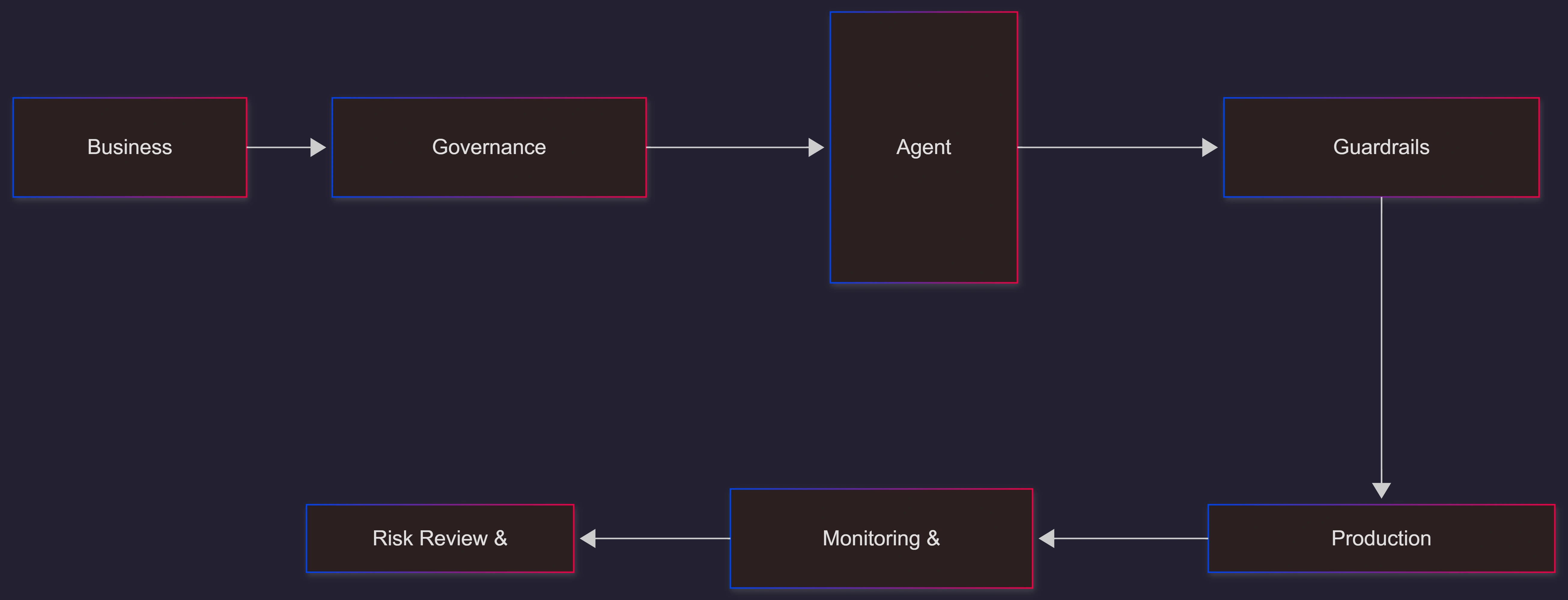
Define the business task the agent is allowed to perform
Map risks (financial, legal, reputational, security)
Assign executive and operational ownership
Implement permissioned tool access
Deploy with logging and kill-switches enabled
Review agent behavior continuously
Use Cases / Scenarios
Customer Support Agents
Guardrails prevent hallucinated policy promises
Governance defines escalation thresholds
Finance and Procurement Agents
Spend caps and approval workflows
Full audit trails for regulators
Developer Productivity Agents
Restricted repository access
Secure code generation policies
Security Operations Agents
Read-only access by default
Human approval for remediation actions
Limitations / Considerations
Guardrails can reduce agent autonomy if poorly designed
Overly rigid governance slows experimentation
Monitoring generates large data volumes
Safety controls must evolve with model capability
Enterprise safety is not a one-time setup. It is an operating model.
Fixes: Common Pitfalls and Solutions
Pitfall: Treating agents like chatbots
Fix: Classify them as actors with permissionsPitfall: Relying solely on model provider safeguards
Fix: Add enterprise-layer controlsPitfall: No ownership after deployment
Fix: Assign named accountable ownersPitfall: No rollback strategy
Fix: Implement versioned policies and kill switches
Hire an Expert to Integrate AI Agents the Right Way
Integrating AI agents into real enterprise environments requires architectural experience, not just tooling.
Mahesh Chand is a veteran technology leader, former Microsoft Regional Director, long-time Microsoft MVP, and founder of C# Corner. He has decades of experience designing and integrating large-scale enterprise systems across healthcare, finance, and regulated industries.
Through C# Corner Consulting, Mahesh helps organizations integrate AI agents safely with existing platforms, avoid architectural pitfalls, and design systems that scale. He also delivers practical AI Agents training focused on real-world integration challenges.
Learn more at: https://www.c-sharpcorner.com/consulting/
FAQs
Are AI agents safe for regulated industries?
Yes, when deployed with governance, auditability, and human oversight aligned to regulatory requirements.Do guardrails reduce agent performance?
They reduce unsafe behavior, not task performance, when designed correctly.Is AI governance only a legal concern?
No. It is a business risk, security, and brand trust concern.Can small teams implement enterprise safety?
Yes. Start with limited permissions, logging, and manual approvals.
References
NIST AI Risk Management Framework (2024)
ISO/IEC 23894: Artificial Intelligence Risk Management
McKinsey Global AI Survey
PwC Responsible AI Reports
C# Corner eBooks on AI Governance and GEO
Conclusion
Enterprise AI agents represent a shift from tools to actors. Without governance, guardrails, and risk control, that shift introduces unacceptable exposure. With the right safety architecture, enterprises gain speed without sacrificing trust, compliance, or accountability. Organizations that invest early in enterprise safety will scale AI agents confidently while competitors struggle with preventable failures.
Join the conversation! Your thoughts help the community grow.