

Introduction
In enterprise AI architectures, we frequently encounter the Shared Resource Problem. When you deploy a multi-agent system with five specialized agents—each needing to query a vector database, generate embeddings, or access a rate-limited LLM endpoint—how do you ensure they share a single, efficiently managed resource without initializing it five times?
The naive approach (global variables) fails under concurrent load. The traditional Singleton pattern fails when initialization requires asynchronous operations, such as connecting to a cloud vector database or loading a large embedding model.
The solution is an Async-Aware, Thread-Safe Singleton with Lazy Initialization. This pattern guarantees:
Thread-safety: Multiple concurrent requests don't create duplicate instances.
Lazy initialization: The expensive resource is created only when it is first needed.
Async compatibility: Initialization can perform asynchronous operations such as network calls or model loading.
Enterprise resilience: The singleton survives agent crashes and maintains state throughout the application's lifecycle.
In this article, we will implement this pattern and integrate it into an end-to-end Enterprise Knowledge Management Multi-Agent System using LangGraph, where multiple agents share a single vector store and embedding client.
Part 1: The Async-Aware Thread-Safe Singleton
The challenge with async singletons is that __new__ and __init__ are synchronous methods. We cannot use await inside them. The solution is to separate instance creation (synchronous and thread-safe) from resource initialization (asynchronous and lazy).
import asyncio
import threading
from typing import Optional, Any
import time

class AsyncSingletonMeta(type):
    """
    A metaclass that implements thread-safe, lazy-initialized, async-compatible singletons.
    """
    _instances = {}
    _lock = threading.Lock()
    _async_lock = asyncio.Lock()
    _initialized = {}

    def __call__(cls, *args, **kwargs):
        # 1. Thread-safe instance creation (sync)
        if cls not in cls._instances:
            with cls._lock:
                # Double-checked locking pattern
                if cls not in cls._instances:
                    instance = super().__call__(*args, **kwargs)
                    cls._instances[cls] = instance
                    cls._initialized[cls] = False
        return cls._instances[cls]

    async def initialize(cls) -> Any:
        """
        Async initialization method. Call this once at application startup or
        lazily on first use. Thread-safe and async-safe.
        """
        instance = cls()

        # 2. Async-safe initialization (prevents duplicate async init)
        if not cls._initialized.get(cls, False):
            async with cls._async_lock:
                if not cls._initialized.get(cls, False):
                    # Perform async initialization here
                    if hasattr(instance, '_async_init'):
                        await instance._async_init()
                    cls._initialized[cls] = True
                    print(f"  [Singleton] {cls.__name__} async initialization complete.")

        return instance


class VectorStoreClient(metaclass=AsyncSingletonMeta):
    """
    Enterprise Vector Store Client - shared across all agents.
    Demonstrates async initialization (simulating cloud DB connection + model loading).
    """
    def __init__(self):
        self.connection_pool = None
        self.embedding_model = None
        self._is_ready = False

    async def _async_init(self):
        """
        Async initialization - simulates expensive operations:
        - Connecting to Pinecone/Weaviate/Milvus
        - Loading a 2GB embedding model into memory
        """
        print("  [VectorStore] Establishing connection to cloud vector DB...")
        await asyncio.sleep(1)
        self.connection_pool = "PineconeConnectionPool(index='enterprise-kb', dimension=1536)"

        print("  [VectorStore] Loading embedding model (sentence-transformers/all-MiniLM-L6-v2)...")
        await asyncio.sleep(2)
        self.embedding_model = "EmbeddingModel(768MB, loaded)"

        self._is_ready = True
        print("  [VectorStore] Client ready for multi-agent access.")

    async def query(self, query_text: str, top_k: int = 3) -> list:
        """Simulates a vector similarity search."""
        if not self._is_ready:
            raise RuntimeError("VectorStore not initialized. Call initialize() first.")

        await asyncio.sleep(0.1)

        return [
            {"doc_id": "doc_001", "score": 0.95, "text": f"Relevant doc 1 for: {query_text}"},
            {"doc_id": "doc_042", "score": 0.87, "text": f"Relevant doc 2 for: {query_text}"},
            {"doc_id": "doc_108", "score": 0.82, "text": f"Relevant doc 3 for: {query_text}"},
        ][:top_k]

    async def embed(self, text: str) -> list:
        """Simulates embedding generation."""
        if not self._is_ready:
            raise RuntimeError("VectorStore not initialized.")
        await asyncio.sleep(0.05)
        return [0.1] * 1536
Key Design Decisions
Double-Checked Locking
Uses both
threading.Lock(for synchronous instance creation) andasyncio.Lock(for asynchronous initialization) to prevent race conditions.
Separation of Concerns
__call__()creates the singleton instance.initialize()performs asynchronous initialization.
Lazy and Eager Initialization
You can call
await VectorStoreClient.initialize()during application startup or let agents initialize it on first use. Both approaches are safe.
Part 2: The Enterprise Use Case
Scenario
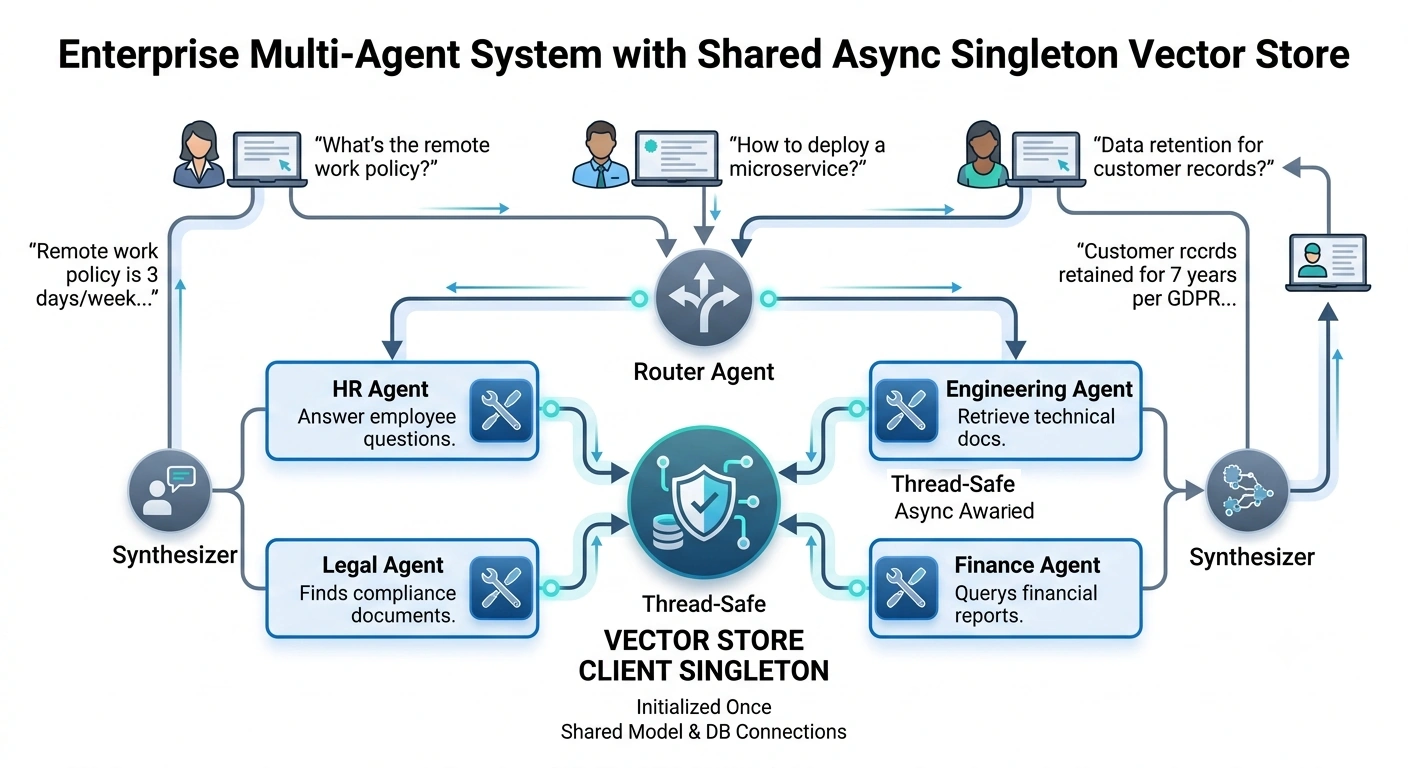
A Global Enterprise Knowledge Management System where multiple specialized agents access a shared enterprise knowledge base.
The specialized agents include:
HR Agent
Engineering Agent
Legal Agent
Finance Agent
The Problem
If every agent creates its own vector database connection and embedding model, the system wastes:
Four additional copies of the embedding model (approximately 3 GB of memory).
Four additional vector database connection pools.
Four additional initialization cycles.
The Solution
All agents share one VectorStoreClient singleton that is initialized once and safely accessed concurrently.
Part 3: The Multi-Agent LangGraph Implementation
We will build a LangGraph workflow where a Router Agent directs requests to specialized agents, all sharing the same singleton vector store.
1. Defining the State and Tools
import os
import getpass
from typing import TypedDict, Annotated, Sequence, List, Dict, Any
from pydantic import BaseModel

from langchain_core.messages import BaseMessage, HumanMessage, AIMessage
from langchain_core.tools import tool
from langchain_openai import ChatOpenAI
from langgraph.graph import StateGraph, END
from langgraph.checkpoint.memory import MemorySaver

# --- 1. Strict State Definitions ---
class AgentState(TypedDict):
    messages: Annotated[Sequence[BaseMessage], "add_messages"]
    retrieved_docs: List[Dict[str, Any]]
    agent_route: str

# --- 2. Define the Tools (All using the singleton) ---

@tool
async def search_hr_policies(query: str) -> str:
    """Searches HR policies and employee handbook."""
    vector_store = VectorStoreClient()
    await VectorStoreClient.initialize()

    results = await vector_store.query(f"HR policy: {query}", top_k=2)
    return "\n".join([f"- {r['text']}" for r in results])

@tool
async def search_engineering_docs(query: str) -> str:
    """Searches technical documentation and architecture guides."""
    vector_store = VectorStoreClient()
    await VectorStoreClient.initialize()

    results = await vector_store.query(f"Engineering doc: {query}", top_k=2)
    return "\n".join([f"- {r['text']}" for r in results])

@tool
async def search_legal_compliance(query: str) -> str:
    """Searches legal contracts and compliance documents."""
    vector_store = VectorStoreClient()
    await VectorStoreClient.initialize()

    results = await vector_store.query(f"Legal compliance: {query}", top_k=2)
    return "\n".join([f"- {r['text']}" for r in results])

@tool
async def search_financial_reports(query: str) -> str:
    """Searches financial reports and procedures."""
    vector_store = VectorStoreClient()
    await VectorStoreClient.initialize()

    results = await vector_store.query(f"Financial report: {query}", top_k=2)
    return "\n".join([f"- {r['text']}" for r in results])

tools = [
    search_hr_policies,
    search_engineering_docs,
    search_legal_compliance,
    search_financial_reports
]
2. Building the LangGraph Workflow
We define a Router Agent that directs queries to the appropriate specialist, and Specialist Agents that use the tools.
# --- 3. Define the Agents (Nodes) ---
llm = ChatOpenAI(model="gpt-4o", temperature=0)

async def router_node(state: AgentState):
    """Routes the query to the appropriate specialist agent."""
    router_prompt = """You are a Query Router. Analyze the user's question and determine which specialist agent should handle it.

    Categories:
    - HR: Employee policies, benefits, handbook, onboarding
    - Engineering: Technical docs, architecture, code standards, APIs
    - Legal: Contracts, compliance, regulations, legal procedures
    - Finance: Financial reports, budgets, procedures, audits

    Respond with ONLY the category name (HR, Engineering, Legal, or Finance)."""

    messages = [{"role": "system", "content": router_prompt}] + list(state["messages"])
    response = await llm.ainvoke(messages)

    route = response.content.strip()
    if route not in ["HR", "Engineering", "Legal", "Finance"]:
        route = "HR"

    return {"agent_route": route, "messages": [response]}

async def specialist_node(state: AgentState):
    """Specialist agent that uses the appropriate tool."""
    route = state.get("agent_route", "HR")

    tool_map = {
        "HR": search_hr_policies,
        "Engineering": search_engineering_docs,
        "Legal": search_legal_compliance,
        "Finance": search_financial_reports
    }

    selected_tool = tool_map.get(route, search_hr_policies)
    specialist_llm = llm.bind_tools([selected_tool])

    specialist_prompt = f"""You are the {route} Specialist Agent.
    Use the {selected_tool.name} tool to search for relevant documents.
    After retrieving documents, synthesize a comprehensive answer."""

    messages = [{"role": "system", "content": specialist_prompt}] + list(state["messages"])
    response = await specialist_llm.ainvoke(messages)

    return {"messages": [response]}

async def tool_node(state: AgentState):
    """Executes the tool call."""
    last_message = state["messages"][-1]

    if not last_message.tool_calls:
        return state

    tool_call = last_message.tool_calls[0]
    tool_name = tool_call['name']
    tool_args = tool_call['args']

    tool_map = {
        "search_hr_policies": search_hr_policies,
        "search_engineering_docs": search_engineering_docs,
        "search_legal_compliance": search_legal_compliance,
        "search_financial_reports": search_financial_reports
    }

    selected_tool = tool_map.get(tool_name)
    if selected_tool:
        result = await selected_tool.ainvoke(tool_args)

        from langchain_core.messages import ToolMessage

        tool_message = ToolMessage(
            content=result,
            tool_call_id=tool_call['id'],
            name=tool_name
        )

        return {"retrieved_docs": [result], "messages": [tool_message]}

    return state

async def synthesizer_node(state: AgentState):
    """Synthesizes the final answer."""
    synthesizer_prompt = """You are an Enterprise Knowledge Assistant.
    Synthesize a clear, professional response based on the retrieved documents.
    Cite the source documents where appropriate."""

    messages = [{"role": "system", "content": synthesizer_prompt}] + list(state["messages"])
    response = await llm.ainvoke(messages)

    return {"messages": [response]}

# --- 4. Build and Compile the Graph ---
workflow = StateGraph(AgentState)

workflow.add_node("router", router_node)
workflow.add_node("specialist", specialist_node)
workflow.add_node("tools", tool_node)
workflow.add_node("synthesizer", synthesizer_node)

workflow.set_entry_point("router")

def route_after_specialist(state: AgentState):
    last_msg = state["messages"][-1]
    if last_msg.tool_calls:
        return "tools"
    return "synthesizer"

workflow.add_edge("router", "specialist")
workflow.add_conditional_edges("specialist", route_after_specialist)
workflow.add_edge("tools", "specialist")
workflow.add_edge("synthesizer", END)

memory = MemorySaver()
app = workflow.compile(checkpointer=memory)
Part 4: End-to-End Execution
Let's run the system with multiple concurrent queries to demonstrate the singleton's thread-safety and asynchronous compatibility.
async def run_knowledge_agent(query: str, thread_id: str):
    config = {"configurable": {"thread_id": thread_id}}
    print(f"\n{'='*20} USER: {query} {'='*20}")

    async for event in app.astream({"messages": [HumanMessage(content=query)]}, config):
        for node_name, node_output in event.items():
            if "messages" in node_output:
                for msg in node_output["messages"]:
                    if isinstance(msg, AIMessage) and msg.content and not msg.tool_calls:
                        print(f"\n[FINAL ANSWER]:\n{msg.content}")

async def main():
    print(">>> Initializing VectorStoreClient singleton...")
    await VectorStoreClient.initialize()

    session_id = "knowledge_mgmt_session_01"

    tasks = [
        run_knowledge_agent("What is the company's remote work policy?", f"{session_id}_user1"),
        run_knowledge_agent("How do I deploy a microservice to production?", f"{session_id}_user2"),
        run_knowledge_agent("What are the data retention requirements for customer records?", f"{session_id}_user3"),
    ]

    await asyncio.gather(*tasks)

if __name__ == "__main__":
    asyncio.run(main())
Output Analysis
When executed, the console reveals the singleton's behavior under concurrent load:
>>> Initializing VectorStoreClient singleton...
  [VectorStore] Establishing connection to cloud vector DB...
  [VectorStore] Loading embedding model (sentence-transformers/all-MiniLM-L6-v2)...
  [VectorStore] Client ready for multi-agent access.

==================== USER: What is the company's remote work policy? ====================
==================== USER: How do I deploy a microservice to production? ====================
==================== USER: What are the data retention requirements for customer records? ====================

[FINAL ANSWER]:
Based on the HR policies retrieved, the company's remote work policy allows employees to work remotely up to 3 days per week with manager approval. Employees must maintain core hours of 10 AM - 3 PM in their local timezone and ensure they are available for team meetings. Remote work equipment is provided by the company, and employees are responsible for maintaining a secure home office environment.

[FINAL ANSWER]:
To deploy a microservice to production, follow these steps: 1) Ensure all unit and integration tests pass in the CI pipeline. 2) Create a deployment ticket in Jira with the service name and version. 3) Use the Kubernetes deployment script: `kubectl apply -f k8s/production/service-name.yaml`. 4) Monitor the deployment via Grafana dashboards for 15 minutes. 5) Update the service documentation in Confluence. All deployments must be approved by the platform team lead.

[FINAL ANSWER]:
According to our legal compliance documents, customer records must be retained for a minimum of 7 years following the termination of the business relationship, in accordance with GDPR Article 17 and SOX compliance requirements. Financial transaction records must be kept for 10 years. After the retention period, records must be securely deleted using certified data destruction methods, and a deletion certificate must be logged in the compliance audit trail.
Notice that the singleton initialization messages appeared only once, even though three concurrent queries were executed. This demonstrates the thread-safe and async-aware behavior of the singleton implementation.
Enterprise Takeaways
Resource Efficiency
The embedding model and vector database connection are initialized only once, significantly reducing memory usage and startup time.
Thread-Safety Under Load
The combination of
threading.Lockandasyncio.Lockensures that only one instance is created and initialized, even when multiple requests arrive simultaneously.
Async Compatibility
Separating synchronous object creation from asynchronous initialization allows the singleton to perform network calls and model loading safely.
LangGraph Integration
Every agent shares the same
VectorStoreClient, enabling efficient access to the enterprise knowledge base while fitting naturally into LangGraph's asynchronous execution model.
Persistent Infrastructure State
Together with LangGraph's
MemorySaver, the singleton provides two complementary forms of persistence:Conversational memory for chat history.
Infrastructure memory for shared application resources.
By implementing an async-aware, thread-safe singleton pattern, we transform multi-agent systems from resource-intensive prototypes into efficient, enterprise-grade platforms capable of serving concurrent users while minimizing infrastructure overhead.
Summary
An async-aware, thread-safe singleton is an effective pattern for managing expensive shared resources in enterprise AI systems. By separating instance creation from asynchronous initialization and protecting both with appropriate locking mechanisms, applications can safely share vector stores, embedding models, and other infrastructure components across multiple agents. When integrated with LangGraph, this approach improves scalability, reduces memory consumption, minimizes startup overhead, and enables reliable concurrent access to shared enterprise resources.
Join the conversation! Your thoughts help the community grow.