

Introduction
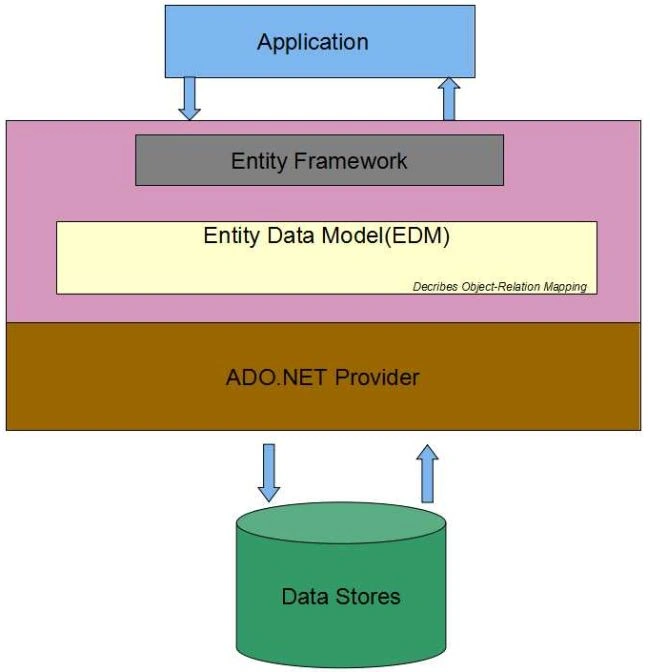
Figure: This figure illustrates how the Entity Framework works and it shows how the data stores interact.
Entity Framework Improvements
This article is for those that want to understand what the new features provided in the new Visual Studios 2015 are. Here are some of the features related to the Entity Framework. In the scenario of the programming world, everybody wants reliable tools to make Software. After the Entity Framework Enhancement, the Visual Studio has evolved to provide reliability and decorum for optimized and functional coding.
The two versions of the Entity Framework that have been introduced are given below:
- Entity Framework 6.1.2- beta 1
- Entity Framework 7
Entity Framework 6.1.2- beta 1
- The Entity Framework 6.1.2 beta 1 runtime is the most important update included in a number of places in this release.
- The runtime will be installed when creating a new model using the Entity Framework Tools in a project that does not already have the Entity Framework Runtime installed. The runtime is pre-installed in new ASP.NET projects, depending on the project template being selected.
Entity Framework 7
The most optimized enhancement with Entity Framework is a popular data access choice for client-server applications that target the full .NET Framework. Framework Entity 7 includes a wide range of applications built with some wonderful technologies, such as WPF, WinForms, and ASP.NET. Although there were many features, as we look into the future of the programming world, we believe that there is value in providing the same programming model for data access on the remaining platforms where .NET development is common in the programming world. This includes Windows Store, Windows Phone and the Cloud Optimized .NET will work on all of these platforms as well as Mono, on both Mac and Linux, and for Windows Phone and Windows Store, the first and initial goal is to provide local data access using the Entity Framework.
SQLite is the most common database of choice on devices and thus it can be said that it supports mobile devices data while parts of the Entity Framework are clearly tied to relational data stores, much of the functionality that the Entity Framework provides is applicable to many non-relational data stores too. Examples of such functionality include change tracking, LINQ, and units of work. In Entity Framework 7 the advancement targets non-relational data stores, such as Azure Table Storage.
There is no abstraction layer that hides the type of data store being targeted. The common patterns/components that apply to most data stores will be handled by the core framework. Things that are specific to specific types of data stores will be available as extensions that are included as part of the provider. For example, the concept of a model builder that allows you to configure your model will be a part of the Core framework. However, the ability to configure things such as cascade delete on a foreign key constraint will be included as extensions in the relational database provider. These are the most exciting features that have been released that provide a convenient way to analyze, interact and process the data.
Manish Kumar ChoudharyPosted Nov 21, 2014, 7:14 AM
nice one..