

Here I am explaining GridView CRUD Operations using N-Tier Architecture.
First here I am explaining databases, table parameters, and Stored Procedures to Create, Read, Update and Delete Operations.
- Use [GridData]
- CREATE TABLE [dbo].[OperatingSystem](
- [OSId] [int] IDENTITY(1,1) NOT NULL,
- [OSName] [varchar](100) NULL,
- [CreateDate] [datetime] NULL,
- [Status] [smallint] NULL,
- CONSTRAINT [PK_OperatingSystem] PRIMARY KEY CLUSTERED
- (
- [OSId] ASC
- )WITH (PAD_INDEX = OFF, STATISTICS_NORECOMPUTE = OFF, IGNORE_DUP_KEY = OFF, ALLOW_ROW_LOCKS = ON, ALLOW_PAGE_LOCKS = ON) ON [PRIMARY]
- ) ON [PRIMARY]
- GO
- SET ANSI_PADDING OFF
- GO
- ALTER TABLE [dbo].[OperatingSystem] ADD DEFAULT (getdate()) FOR [CreateDate]
- GO
- ALTER TABLE [dbo].[OperatingSystem] ADD DEFAULT ('1') FOR [Status]
- GO
- Stored Procedures are,
- //Create Procedure
- Create Procedure [dbo].[InsertSystemName]
- (
- @OSName varchar(50)
- )
- AS
- BEGIN
- insert into OperatingSystem(OSName) values(@OSName)
- END
- //Get Data Procedure
- ALTER Procedure [dbo].[GetSystemsData]
- As
- Begin
- select * from OperatingSystem where Status='1'
- End
- //Update Procedure
- ALTER Procedure [dbo].[UpdateSystems]
- (
- @Id int,
- @Name varchar(100),
- @Status int
- )
- As
- BEGIN
- update OperatingSystem set OSName=@Name,Status=@Status where OSId=@Id
- END
- //Delete Procedure
- ALTER Procedure [dbo].[DeleteSystemsData]
- (
- @Id int
- )
- As
- Begin
- update OperatingSystem set Status='0' where OSId=@Id
- End
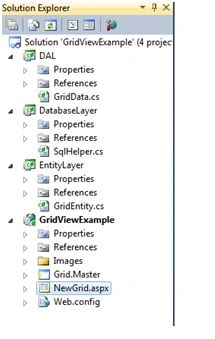
- Next create the solution from Visual Studio. First create a solution add three class libraries named "DAL", "Databaselayer", "EntityLayer" and one web application named "GridViewExample" as ini the following image.
- Next add refernces for the solution. First DAL for the DatabaseLayer and EntityLayer.
- For the GridViewExample add "DAL", "Databaselayer" and "Entitylayer".
- In the DatabaseLayer, add one refernce System.Configuration.
Getting to the Databaselayer, create a classs named "SqlHelper.CS" and write the following code.
Note: Here dbconnection is a connection string for SQL Server.
- public static string CONNECTION_STRING = ConfigurationManager.ConnectionStrings["dbconnection"].ConnectionString;
- public static DataSet ExecuteParamerizedSelectCommand(string CommandName, CommandType cmdType, SqlParameter[] param) {
- DataSet ds = new DataSet();
- using(SqlConnection con = new SqlConnection(CONNECTION_STRING)) {
- using(SqlCommand cmd = con.CreateCommand()) {
- cmd.CommandType = cmdType;
- cmd.CommandText = CommandName;
- cmd.Parameters.AddRange(param);
- try {
- if (con.State != ConnectionState.Open) {
- con.Open();
- }
- using(SqlDataAdapter da = new SqlDataAdapter(cmd)) {
- da.Fill(ds);
- }
- } catch {
- throw;
- }
- }
- }
- return ds;
- }
- // This function will be used to execute CUD(CRUD) operation of parameterized commands
- public static bool ExecuteNonQuery(string CommandName, CommandType cmdType, SqlParameter[] pars) {
- int result = 0;
- using(SqlConnection con = new SqlConnection(CONNECTION_STRING)) {
- using(SqlCommand cmd = con.CreateCommand()) {
- cmd.CommandType = cmdType;
- cmd.CommandText = CommandName;
- cmd.Parameters.AddRange(pars);
- try {
- if (con.State != ConnectionState.Open) {
- con.Open();
- }
- result = cmd.ExecuteNonQuery();
- } catch {
- throw;
- }
- }
- }
- return (result > 0);
- }
- //Getting To EntityLayer, add a class and named as GridData.CS and write following code:
- public class OperatingSystemEntity {
- public int OSId {
- get;
- set;
- }
- public string OSName {
- get;
- set;
- }
- public DateTime CreateDate {
- get;
- set;
- }
- public int Status {
- get;
- set;
- }
- }
- //Getting to DAL, Add a class and named as GridData.cs and write the following code:
- public class GridData {
- public bool CreateSystem(OperatingSystemEntity SEntity) {
- SqlParameter[] parameters = new SqlParameter[] {
- new SqlParameter("@OSName", SEntity.OSName),
- };
- return SqlHelper.ExecuteNonQuery("InsertSystemName", CommandType.StoredProcedure, parameters);
- }
- public List < OperatingSystemEntity > GetSystemsData(OperatingSystemEntity SEntity) {
- List < OperatingSystemEntity > ListEntry = null;
- SqlParameter[] parameters = new SqlParameter[] {
- };
- using(DataSet ds = SqlHelper.ExecuteParamerizedSelectCommand("GetSystemsData", CommandType.StoredProcedure, parameters)) {
- if (ds.Tables.Count > 0) {
- ListEntry = new List < OperatingSystemEntity > ();
- foreach(DataRow row2 in ds.Tables[0].Rows) {
- OperatingSystemEntity entry = new OperatingSystemEntity();
- entry.OSId = Convert.ToInt32(row2["OSId"].ToString());
- entry.OSName = row2["OSName"].ToString();
- entry.CreateDate = Convert.ToDateTime(row2["CreateDate"].ToString());
- entry.Status = Convert.ToInt32(row2["Status"].ToString());
- ListEntry.Add(entry);
- }
- }
- }
- return ListEntry;
- }
- public bool UpdateSystems(OperatingSystemEntity SEntity) {
- SqlParameter[] parameters = new SqlParameter[] {
- new SqlParameter("@Id", SEntity.OSId),
- new SqlParameter("@Name", SEntity.OSName),
- new SqlParameter("@Status", SEntity.Status),
- };
- return SqlHelper.ExecuteNonQuery("UpdateSystems", CommandType.StoredProcedure, parameters);
- }
- public bool DeleteSystem(OperatingSystemEntity SEntity) {
- SqlParameter[] parameters = new SqlParameter[] {
- new SqlParameter("@Id", SEntity.OSId),
- };
- return SqlHelper.ExecuteNonQuery("DeleteSystemsData", CommandType.StoredProcedure, parameters);
- }
- }
- }
Then the Solution Explorer will be such as follows:
Getting to GridViewExample Web Application, add a new form named NewGrid.aspx and add the following code:
- <asp:Content ID="Content1" ContentPlaceHolderID="head" runat="server">
- <script language="javascript" type="text/javascript">
- function validate() {
- if (document.getElementById("<%=txtname.ClientID %>").value == "") {
- alert("Please Enter Name");
- document.getElementById("<%=txtname.ClientID %>").focus();
- return false;
- }
- }
- </script>
- </asp:Content>
- <asp:Content ID="Content2" ContentPlaceHolderID="Body" runat="server">
- <div>
- <h2 style="width: 80%">
- <u>Create System</u></h2>
- <table>
- <tr>
- <td colspan="2">
- <asp:Label runat="server" ID="lblmsgerror" Font-Bold="true"></asp:Label>
- </td>
- </tr>
- <tr>
- <td>
- <asp:Label ID="lblname" runat="server" Text="SystemName"></asp:Label>
- </td>
- <td>
- <asp:TextBox ID="txtname" runat="server"></asp:TextBox>
- </td>
- </tr>
- <tr>
- <td>
- </td>
- <td>
- <asp:Button ID="btnsave" runat="server" Text="Save" OnClick="btnsave_Click" />
- </td>
- </tr>
- </table>
- </div>
- <h2 style="width: 80%">
- <u>Total Availble Systems</u></h2>
- <p>
- <asp:Label runat="server" ID="lblmsg" ForeColor="Red" Font-Bold="true"></asp:Label>
- </p>
- <div>
- <asp:GridView ID="gvSystem" runat="server" AutoGenerateColumns="false" OnRowUpdating="gvSystem_RowUpdating" OnRowEditing="gvSystem_RowEditing" OnRowDeleting="gvSystem_RowDeleting" DataKeyNames="OSId" OnRowCancelingEdit="gvSystem_RowCancelingEdit">
- <Columns>
- <asp:TemplateField>
- <EditItemTemplate>
- <asp:ImageButton ID="imgbtnUpdate" CommandName="Update" runat="server" ImageUrl="~/Images/Update.jpg" ToolTip="Update" Height="20px" Width="20px" />
- <asp:ImageButton ID="imgbtnCancel" runat="server" CommandName="Cancel" ImageUrl="~/Images/Cancel.jpg" ToolTip="Cancel" Height="20px" Width="20px" />
- </EditItemTemplate>
- <ItemTemplate>
- <asp:ImageButton ID="imgbtnEdit" CommandName="Edit" runat="server" ImageUrl="~/Images/Edit.jpg" ToolTip="Edit" Height="20px" Width="20px" />
- <asp:ImageButton ID="imgbtnDelete" CommandName="Delete" OnClientClick="return confirm('Are you sure you want to delete selected record?')" Text="Edit" runat="server" ImageUrl="~/images/Delete.jpg" ToolTip="Delete" Height="20px" Width="20px" />
- </ItemTemplate>
- </asp:TemplateField>
- <asp:TemplateField HeaderText="System Name">
- <EditItemTemplate>
- <asp:TextBox ID="txtname" runat="server" Text='<%# Eval("OSName")%>'></asp:TextBox>
- </EditItemTemplate>
- <ItemTemplate>
- <asp:Label ID="lblname" runat="server" Text='<%# Eval("OSName")%>'></asp:Label>
- </ItemTemplate>
- </asp:TemplateField>
- <asp:TemplateField HeaderText="Date Of Created">
- <ItemTemplate>
- <asp:Label ID="lbldate" runat="server" Text='<%# Eval("CreateDate")%>'></asp:Label>
- </ItemTemplate>
- </asp:TemplateField>
- <asp:TemplateField HeaderText="Status">
- <EditItemTemplate>
- <asp:TextBox ID="txtstatus" runat="server" Text='<%# Eval("Status")%>'></asp:TextBox>
- </EditItemTemplate>
- <ItemTemplate>
- <asp:Label ID="lblstatus" runat="server" Text='<%# Eval("Status")%>'></asp:Label>
- </ItemTemplate>
- </asp:TemplateField>
- </Columns>
- </asp:GridView>
- </div>
- </asp:Content>
In NewGrid.aspx.cs file, write the following code:
- OperatingSystemEntity SEntity = new OperatingSystemEntity();
- GridData GData = new GridData();
- protected void Page_Load(object sender, EventArgs e) {
- btnsave.Attributes.Add("onclick", "return validate()");
- if (!IsPostBack) {
- BindData();
- }
- }
- protected void btnsave_Click(object sender, EventArgs e) {
- SEntity.OSName = txtname.Text;
- if (GData.CreateSystem(SEntity) == true) {
- lblmsgerror.ForeColor = Color.Green;
- lblmsgerror.Text = "System Name Saved Successfully";
- BindData();
- txtname.Text = "";
- } else {
- lblmsgerror.ForeColor = Color.Red;
- lblmsgerror.Text = "System Name Already Exists ";
- }
- }
- private void BindData() {
- List < OperatingSystemEntity > SList = GData.GetSystemsData(SEntity);
- if (SList.Count != 0) {
- gvSystem.DataSource = SList;
- gvSystem.DataBind();
- } else {
- lblmsg.Text = "No Data found..";
- }
- }
- private static String GetTextFromRowBox(GridViewRow row, String field) {
- return ((TextBox) row.FindControl(field)).Text;
- }
- protected void gvSystem_RowUpdating(object sender, GridViewUpdateEventArgs e) {
- int id = Convert.ToInt32(gvSystem.DataKeys[e.RowIndex].Values["OSId"].ToString());
- GridViewRow row = gvSystem.Rows[e.RowIndex];
- SEntity.OSName = GetTextFromRowBox(row, "txtname");
- SEntity.Status = Convert.ToInt32(GetTextFromRowBox(row, "txtstatus").ToString());
- SEntity.OSId = id;
- if (GData.UpdateSystems(SEntity) == true) {
- gvSystem.EditIndex = -1;
- BindData();
- lblmsg.Text = "Records Updated sucessfully";
- } else {
- lblmsg.Text = "Updation Failed";
- }
- }
- protected void gvSystem_RowEditing(object sender, GridViewEditEventArgs e) {
- gvSystem.EditIndex = e.NewEditIndex;
- BindData();
- }
- protected void gvSystem_RowCancelingEdit(object sender, GridViewCancelEditEventArgs e) {
- gvSystem.EditIndex = -1;
- BindData();
- }
- protected void gvSystem_RowDeleting(object sender, GridViewDeleteEventArgs e) {
- int ID = Convert.ToInt32(gvSystem.DataKeys[e.RowIndex].Values["OSId"].ToString());
- deleterecords(ID);
- }
- private void deleterecords(int ID) {
- SEntity.OSId = ID;
- if (GData.DeleteSystem(SEntity) == true) {
- lblmsg.Text = "Records deleted sucessfully...";
- BindData();
- lblmsg.Text = "";
- } else {
- lblmsg.ForeColor = Color.Red;
- lblmsg.Text = "Records deleted failed...";
- BindData();
- lblmsg.Text = "";
- }
- }
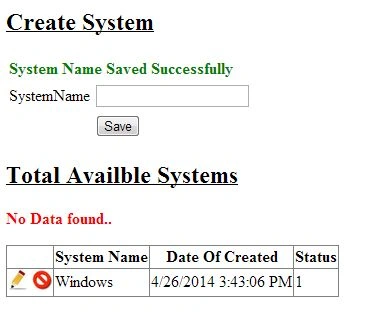
Like that we have completed the CRUD Operations for the Gridview in the N-Tier architecture. If you have any doubts then please leave a comment. I will explain ASAP. The output will appear as in the following:
Thanks and happy coding.
Bala Bhaskara CharyPosted Jul 10, 2015, 3:38 AM
nice