

It uses strongly-typed delegates to log messages, which means no more messing around with string manipulating at runtime. It’s like having a pre-baked log template that’s ready to go whenever you need it.
A Simple Comparison with Benchmark
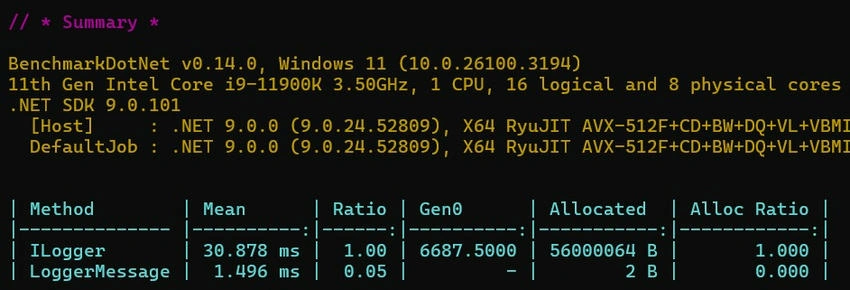
I tested two ways to log 1M user IDs.
- ILogger extension methods: Most of us are used to this. It formats the log message at runtime, which can be slow and memory-heavy.
- LoggerMessage: This pre-compiles the log template, so it’s lightning-fast and super lightweight.
Why Is It So Fast?
- ILogger extension methods: Every time you log, it has to parse the template, format the string, and allocate memory for the result. This happens every single time you log something.
- LoggerMessage: The log template is pre-compiled, so there’s no runtime string formatting.
It uses a reusable Action, so it just plugs in the values and logs the message. While there's still a small amount of work to insert the values, it's drastically faster than full string formatting. No extra work, no extra memory.
Some Pitfalls and Considerations
- Not Always Necessary: For simple, infrequent logging, the performance gains of LoggerMessage might not be noticeable.
- Context: LoggerMessage primarily focuses on the formatting aspect. It doesn't inherently provide richer contextual information..We'll still need to handle things like log levels, event IDs, and structured logging separately.
public static class LoggerMessageTemplates
{
    // A reusable logging delegate for informational logs
    private static readonly Action<ILogger, int, Exception> _logInfo =
        LoggerMessage.Define<int>(
            LogLevel.Information,
            new EventId(1, "LoggerMessageTemplates"),
            "Processing user from template: {UserId}");

    // Helper method for informational logs
    public static void LogInfo(this ILogger logger, int userId)
    {
        _logInfo(logger, userId, null!); // For info, pass null for the exception parameter
    }
}
Benchmark Code & Result
[Benchmark(Baseline = true)]

public Task ILogger()
{
	for (int userId = 1; userId <= 1000000; userId++)
	{
		_logger.LogInformation("Processing user {userId}", userId);
	}
	return Task.CompletedTask;
}
[Benchmark]
public Task LoggerMessage()
{
	for (int userId = 1; userId <= 1000000; userId++)
	{
		_logger.LogInfo(userId);
	}
	return Task.CompletedTask;
}
Join the conversation! Your thoughts help the community grow.