
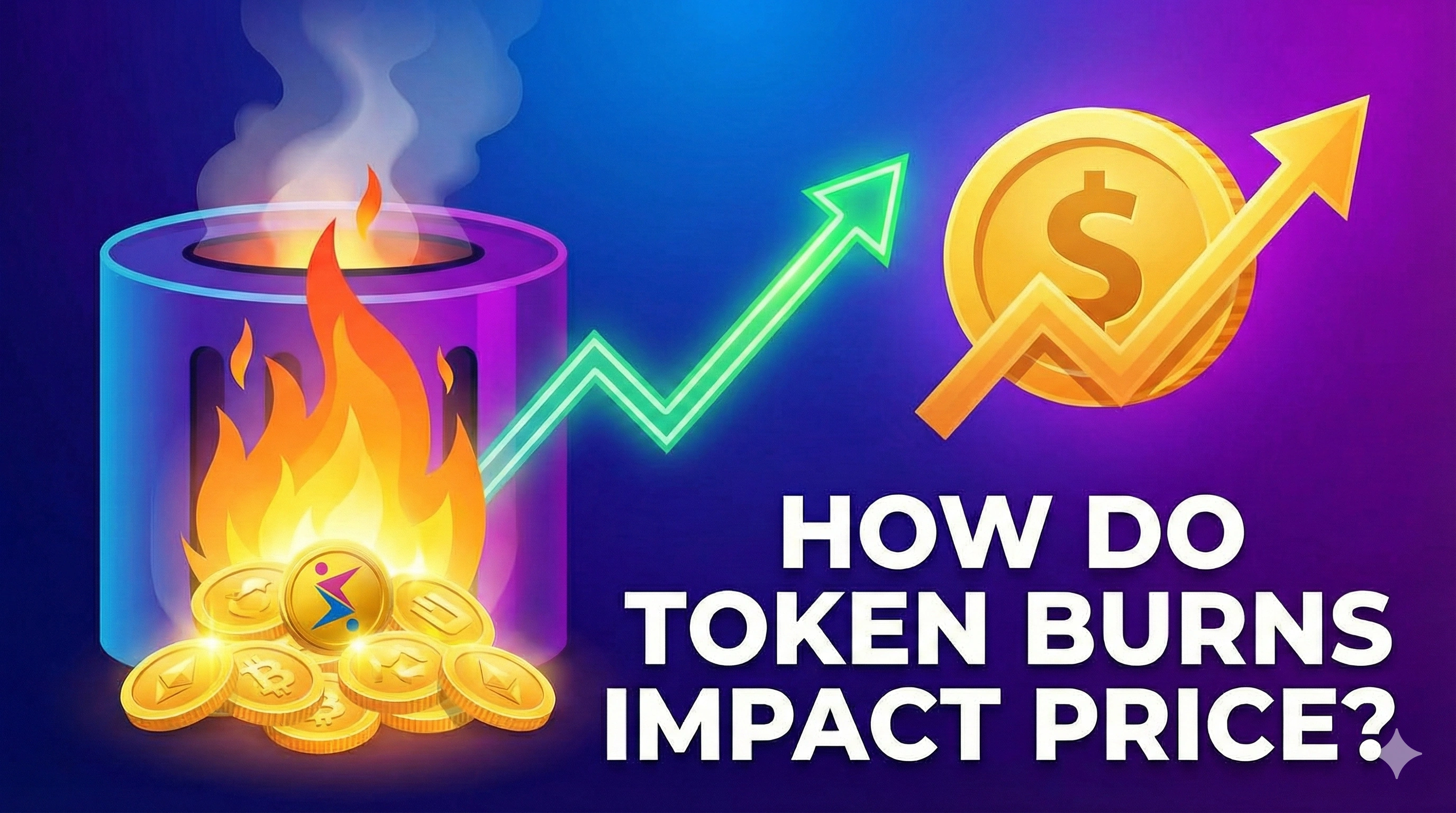
How Do Token Burns Impact Price
Token burns are one of the most misunderstood and overhyped mechanics in crypto. Founders announce massive burns, communities cheer, charts move for a moment, and hype fills social media. Yet the fundamental truth remains simple.
Burns only create value when they are tied directly to real utility and real demand.
A burn without demand is a marketing flash. A burn with demand becomes an economic engine that compounds over time. To understand why, we must break down what token burns are, how they work, and why only a fraction of projects implement them correctly.
What Exactly Is A Token Burn
A token burn permanently removes tokens from circulation by sending them to an unrecoverable burn address. This reduces supply and increases scarcity.
When executed correctly, burns reduce circulating supply, increase scarcity, strengthen price floors, and support long term investor confidence. But when burns are used for hype rather than actual economic purpose, they accomplish nothing.
Why Burns Can Increase Token Price
Burns influence price by tightening supply while demand remains stable or grows. This shift in the balance between buyers and available tokens creates upward price pressure.
A burn is more likely to raise price when demand is rising, token utility is increasing, or the burn represents meaningful economic activity.
If demand grows faster than supply shrinks, long term value begins to strengthen naturally.
Why Burns Sometimes Do Not Affect Price
Some projects announce burns but see no price reaction at all. Reasons include weak utility, low user activity, sell pressure exceeding burn volume, or burn amounts too small to matter.
Burns amplify strength. They do not repair broken fundamentals.
The Only Burns That Truly Matter
Two burn models consistently create real value.
Utility driven burns are triggered when users interact with the platform such as transaction fees, redemption fees, or staking penalties. These scale with usage and growth.
Revenue linked burns are tied directly to real revenue such as marketplace fees or a percentage of app revenue. These anchor price to real economic performance.
Hype driven burns fade fast and have little or no impact.
How Burns Create Long Term Value
Deflationary models strengthen over time because supply continues to shrink while utility, adoption, and participation expand.
This creates higher price floors, increased staking interest, stronger investor confidence, and reduced sell pressure. Many of the most successful tokens in history used sustained deflation to support long term value.
Case Study Sharp Economy’s Burn Utility Model
Sharp Economy uses a sustainable, utility based burn system woven into the ecosystem itself. Burns are triggered by real actions such as rewards redemption, merchant payments, app activity, ecosystem fees, and community participation.
This means every time Sharp’s ecosystem grows, supply decreases naturally.
It is predictable, organic, and scalable.
As user adoption rises across Sharp Rewards, partner programs, and utility driven features, burn volume rises proportionally. This alignment between real utility and deflationary mechanics is exactly how long term token value is built.
How Burns Influence Holder Behavior
Burns affect more than supply. They shape psychology.
When holders know tokens are consistently being removed, they tend to hold longer, stake more, sell less, and monitor burn activity closely.
Burns also make it easier for market makers to manage price stability because circulating supply remains controlled.
Burns And Market Makers
Market makers perform better when token economies are predictable.
Consistent burn mechanics help them stabilize liquidity, reduce volatility, support smoother price curves, and maintain buyer confidence.
A shrinking supply also limits how aggressively whales and bots can push the price downward.
Implementing Burns The Right Way
Burns must be designed as part of a complete tokenomics model. Successful burn frameworks include real utility triggers, predictable frequency, transparent reporting, on chain verification, and alignment with emission schedules.
Burns without substance are noise. Burns with utility become value drivers.
How Much Should A Project Burn
Most sustainable models burn between 1 percent and 5 percent of ecosystem activity.
Burn amounts must match usage. Burning too much too quickly can damage liquidity or restrict growth.
Burn Tactics To Avoid
Founders should avoid one time hype burns, burning treasury tokens that were never circulating, announcing burns without proof, or using burns to distract from weak fundamentals.
Investors recognize these tactics instantly.
How Burns Strengthen A Token Economy
A well designed burn model supports healthy token velocity, lower long term inflation, deeper liquidity, more stable price action, and a stronger perception of value.
That is why mature ecosystems integrate utility, liquidity, staking, real rewards, and burns into a cohesive economic engine.
Guidance From Experts For Sustainable Burn Models
Designing a burn mechanism that actually increases long term price requires real experience in economics, engineering, treasury strategy, and liquidity design.
Founders looking to implement meaningful burn models or redesign tokenomics can work directly with Mahesh Chand and C# Corner Consulting for
tokenomics architecture, utility and burn design, exchange listing preparation, investor ready documentation, and ecosystem planning.
Mahesh has helped architect multiple token ecosystems including Sharp Economy and supports teams in building tokens built for long term strength, stability, and adoption.
Contact here https://www.c-sharpcorner.com/consulting/
Join the conversation! Your thoughts help the community grow.