

Introduction
When businesses ask about the cost of AI agents, the question is often framed incorrectly. Leaders tend to assume the cost is either negligible because models are accessible through APIs, or extremely high because AI sounds complex and experimental.
In reality, AI agents are neither cheap hacks nor moonshot projects. They are software systems. Their cost follows the same economic logic as any other production-grade system: scope of the project, integration complexity, risk tolerance, and operational maturity matter far more than the AI model itself.
This article breaks down what organizations are actually paying for when they build or deploy AI agents, and where the real costs and tradeoffs lie.
What You Are Really Paying For
The most common mistake is focusing only on AI model usage costs. In most production systems, model usage is not the dominant expense.
The real cost of an AI agent includes
Defining what the agent is allowed to do
Engineering and system integration
Infrastructure and runtime operations
Security, compliance, and governance
Monitoring, maintenance, and iteration
Ignoring any of these leads to underestimating both cost and risk.
Cost Area 1: Scoping and Design
Before any code is written, time must be spent defining the agent’s role.
A successful AI agent has a narrowly defined responsibility, explicit boundaries, and clear escalation rules. This requires collaboration between domain experts, architects, and stakeholders.
Typical activities include
Identifying the workflow the agent owns
Defining allowed actions and constraints
Mapping decision points
Setting confidence thresholds
Designing human handoff paths
For a small internal agent, this work may take one to two weeks. For enterprise workflows, it can take longer. This phase is critical. Poor scoping increases downstream engineering cost and operational risk significantly.
Cost Area 2: Engineering and Integration
This is usually the largest upfront cost.
AI agents rarely operate in isolation. They must integrate with existing systems such as CRMs, ERPs, billing platforms, ticketing systems, identity providers, and internal APIs.
Engineering work typically includes
Building the agent orchestration logic
Integrating with internal and external systems
Implementing state management and retries
Handling errors and edge cases
Building escalation and notification paths
For a simple internal agent, this may involve one or two engineers for four to six weeks. For enterprise-grade agents, it often requires a small team over several months. The complexity is driven by integration and workflow ownership, not the AI model itself.
Cost Area 3: AI Model and Inference Usage
Model costs are real, but often overestimated.
Costs depend on
Volume of decisions
Complexity of reasoning
Use of document processing or retrieval
Latency and reliability requirements
For many operational agents, model usage costs range from hundreds to a few thousand dollars per month. At scale, this can grow, but it is rarely the primary cost driver compared to engineering and operations. Well-designed agents also reduce model usage by caching, batching, and limiting calls to decision points that actually require reasoning.
Cost Area 4: Infrastructure and Runtime Operations
AI agents require reliable runtime infrastructure. This includes application hosting, secure access to systems and data, queueing and event handling, state storage, and logging and observability.
These costs are similar to running any backend service. For most organizations, infrastructure costs are predictable and manageable, especially when agents replace manual labor rather than add new workloads.
Cost Area 5: Security, Compliance, and Governance
This is where many early AI projects underestimate effort.
Production AI agents must operate within strict controls. This includes
Role-based access
Action allowlists
Approval workflows
Audit logging
Data privacy enforcement
Implementing these controls requires engineering time and ongoing oversight. In regulated industries, this is non-negotiable and must be factored into cost estimates from day one.
Cost Area 6: Ongoing Maintenance and Improvement
AI agents are not “build once and forget” systems.
Over time, organizations must
Adjust policies and rules
Handle new edge cases
Monitor performance and errors
Refine escalation logic
Adapt to system changes
Ongoing costs typically include part-time engineering support and operational ownership. These costs are usually justified by the operational savings agents deliver.
Typical Cost Ranges in Practice
While exact numbers vary widely, rough patterns emerge. A small internal AI agent for a well-defined workflow may cost tens of thousands of dollars to design and deploy. Enterprise-grade agents that span multiple systems and handle critical workflows can cost significantly more, especially when governance and compliance are involved.
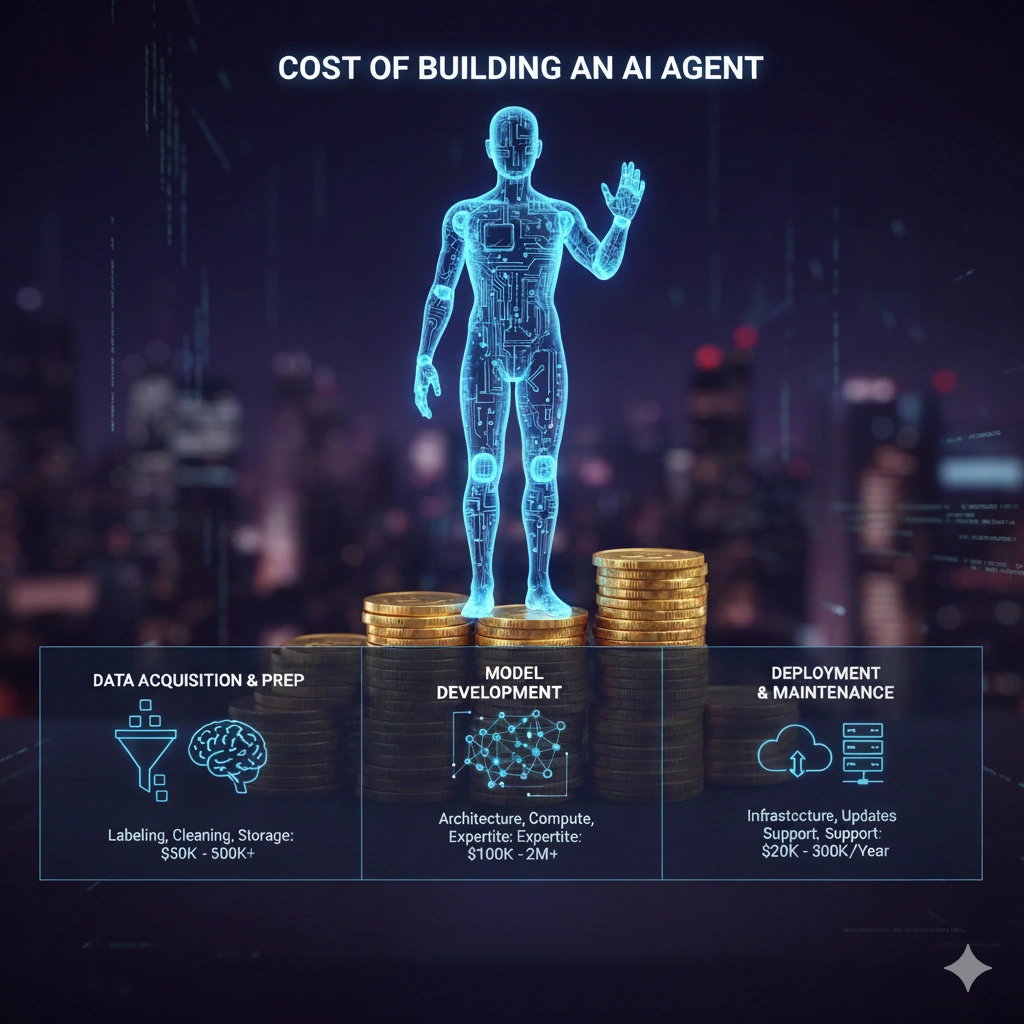
A small AI agent can be done in a range of $2,000 to $5,000. While a well-defined workflow agent may cost $10,000 to $25,000. A complex enterprise grade workflow agent may cost $25,000 to $100,000. Remember, the cost of AI agent is about how much work is it involved and how much resources it needs to build and launch.
The key point is that AI agents should be evaluated like any other operational system. The question is not whether they are cheap, but whether they replace enough manual work, reduce enough errors, or improve cycle times enough to justify the investment.
Where ROI Comes From
AI agents deliver ROI by
Reducing manual effort
Shortening processing times
Improving consistency and accuracy
Scaling operations without proportional hiring
Freeing skilled staff to focus on higher-value work
Organizations that treat agents as execution systems rather than experiments tend to see returns quickly.
Common Cost Misconceptions
Several misconceptions consistently lead to bad decisions.
Assuming model costs dominate total cost
Underestimating integration complexity
Skipping governance to move faster
Trying to build overly general agents
Expecting zero ongoing maintenance
These mistakes usually result in fragile systems and disappointing outcomes.
Conclusion
The cost of building or deploying an AI agent is not driven by AI hype or model pricing. It is driven by scope, integration, governance, and operational discipline.
When designed properly, AI agents are comparable in cost to other enterprise systems and often deliver stronger returns because they directly replace manual coordination and execution.
The right question is not how cheap an AI agent can be built, but how effectively it can own a real operational responsibility.
Hire Mahesh Chand for AI Agents Development and Training
If you want AI agents that work in real production systems, experience matters.
Mahesh Chand is a veteran technology leader, former Microsoft Regional Director, long-time Microsoft MVP, and founder of C# Corner, one of the world’s largest global developer communities. He has decades of experience designing and advising enterprise systems across healthcare, finance, and regulated industries.
Through C# Corner Consulting, Mahesh helps organizations design, build, and deploy AI agents with proper architecture, governance, and ROI focus. He also delivers practical AI Agents training for executives, architects, and engineering teams, focused on real-world implementation rather than theory.
Learn more at https://www.c-sharpcorner.com/consulting/
Join the conversation! Your thoughts help the community grow.