
The problem of finding the maximum volume inscribed ellipsoid is a fascinating topic in mathematics and optimization. Given a set of the data points or a convex hull, the objective is to find the ellipsoid with the maximum volume that is the completely contained within the given shape. In this article, we will explore the mathematical formulation of this problem and discuss various optimization techniques to find the maximum volume inscribed ellipsoid.
Understanding Inscribed Ellipsoids
An inscribed ellipsoid is an ellipsoid that fits snugly within a given shape, such as a set of the data points or a convex hull. The goal is to find the ellipsoid with the maximum volume that is the completely contained within the given shape. This problem arises in various fields, including geometry, computer graphics and data analysis.
Mathematical Formulation
The mathematical formulation of problem involves finding the center and the shape matrix of the inscribed ellipsoid. The center represents the position of ellipsoid within the given shape, and the shape matrix defines the shape and orientation of the ellipsoid. The objective is to the maximize the volume of the ellipsoid subject to constraints imposed by the given shape.
Here's a mathematical formulation of the problem:
Let:
A be the matrix representing the linear transformation applied to unit sphere to obtain the ellipsoid.
x be the vector representing the center of ellipsoid.
λ be a positive scalar representing the scaling factor for ellipsoid.
The problem is to the maximize the volume V of the inscribed ellipsoid subject to certain constraints. The mathematical formulation can be written as follows:
Objective Function:
Maximize V = (4/3) π λ₁ λ₂ λ₃
Constraints:
The matrix A must be positive definite and symmetric.
The scaling factors λ₁, λ₂, and λ₃ must be positive.
The ellipsoid defined by (x, A, λ) must be inscribed within a given bounding shape, such as a polyhedron or a convex hull. This can be represented by additional inequality constraints.
Package
The "ellipsoid" package in R is specifically designed for the computations related to ellipsoids. It provides functions for the fitting ellipsoids to the data points, computing the volume and surface area of the ellipsoids and finding the maximum volume inscribed ellipsoid. The package utilizes optimization techniques to the solve the mathematical problem of the finding the maximum volume inscribed ellipsoid.
steps to find the maximum volume inscribed ellipsoid
1: Define the Problem
Start by defining the problem and the objective. The objective is to find the ellipsoid with maximum volume that fits inside a given shape or set of points.
2: Gather Data or Define the Shape
Gather the data points or define the shape within which you want to find the maximum volume inscribed ellipsoid. This could be a set of the 3D points or a defined geometric shape.
3: Set Initial Parameters
Set initial parameters for the ellipsoid, such as the center coordinates, semi-axis lengths and rotation matrix. These initial parameters will serve as the starting point for optimization algorithm.
4: Define the Volume Function
Define a function that calculates the volume of the ellipsoid given its parameters. This function takes the ellipsoid parameters as input and returns the volume.
5: Optimization Algorithm
Apply an optimization algorithm to the iteratively update the ellipsoid parameters in order to maximize the volume. One commonly used optimization algorithm is the iterative scaling algorithm.
6: Convergence Criteria
Define convergence criteria to the stop the optimization algorithm when it reaches a satisfactory result. This could be based on the change in volume between iterations or the number of iterations.
7: Implement the Algorithm
Implement the optimization algorithm in R using appropriate packages such as optim or nloptr. Set up the objective function to the maximize the volume and provide the necessary constraints.
8: Run the Algorithm
Run the implemented algorithm using the gathered data points or defined shape as input. The algorithm will iteratively update the ellipsoid parameters until the convergence criteria are met.
9: Retrieve the Maximum Volume Inscribed Ellipsoid
Once the algorithm converges, retrieve the ellipsoid parameters that correspond to maximum volume. These parameters will define the maximum volume inscribed ellipsoid.
10: Visualize the Result
Finally, visualize the maximum volume inscribed ellipsoid within the given shape or data points using the appropriate plotting functions or 3D visualization tools in R.
Examples of Maximum Volume Inscribed Ellipsoid
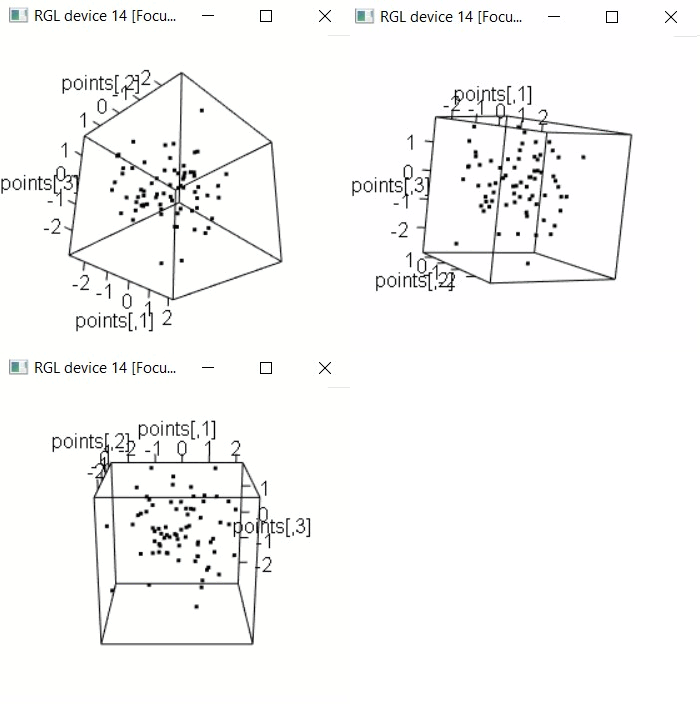
Example 01 : Using the rgl Package
R
library(rgl)
points <- matrix(rnorm(300), ncol = 4)
plot3d(points, xlim = range(points[, 2]), ylim = range(points[, 3]), zlim = range(points[, 3]))
output
Example 02 : Using the "Rvcg" Package
R
library(Rvcg)
data <- matrix(rnorm(350), ncol = 4)
plot3d(data, xlim = c(-5, 5), ylim = c(-5, 5), zlim = c(-5, 5), col = "red", box = FALSE, aspect = TRUE)
output :
Join the conversation! Your thoughts help the community grow.