Introduction
In recent years, digital learning platforms have become extremely popular. However, one of the biggest challenges these platforms face is maintaining learner engagement. Many learners begin with enthusiasm but gradually lose interest due to repetitive content, lack of interaction, and slow progress visibility.
Gamification provides an effective solution to this problem. By integrating game mechanics such as experience points, levels, rewards, and challenges, learning platforms can motivate users and make learning enjoyable. Gamification does not replace learning; instead, it enhances it by making the process more interactive and goal-oriented.
This article explains how to gamify a learning platform using my project Code Quest, a gamified coding learning platform, as a real-world example.
Understanding Gamification in Education
Gamification refers to the use of game design elements in non-game environments, particularly in education and training systems. The main objective is to improve engagement, consistency, and learning outcomes.
Common gamification components include:
• Experience points (XP)
• Levels and progress bars
• Badges and achievements
• Streaks and daily goals
• Leaderboards and rankings
• Reward systems
These components create a sense of progress and achievement, which encourages learners to stay active and motivated.
Code Quest: Overview of the Gamified Platform
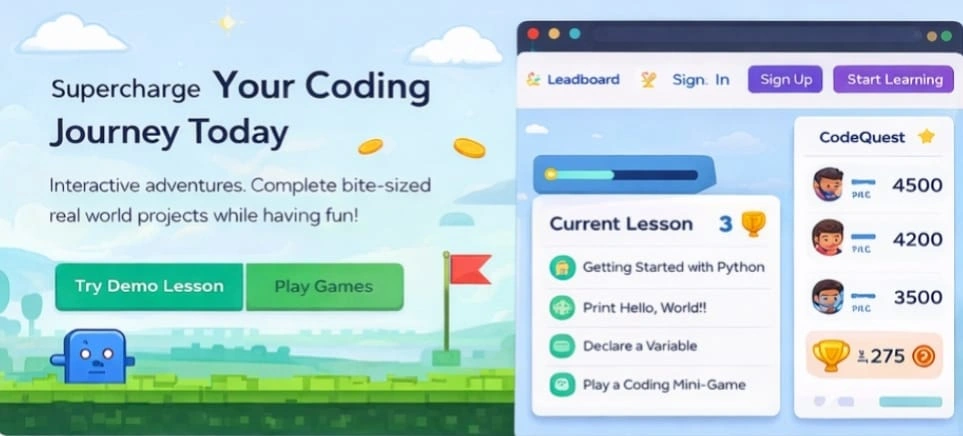
Code Quest is an interactive coding learning platform designed around the principle of learning by doing. Instead of passively reading tutorials, users actively solve coding challenges, play mini-games, and receive instant feedback on their performance.
The platform presents learning as a journey, where users progress step by step, unlocking new content as they improve their skills. This approach makes learning structured, engaging, and goal-oriented.
Implementing XP and Level-Based Progression
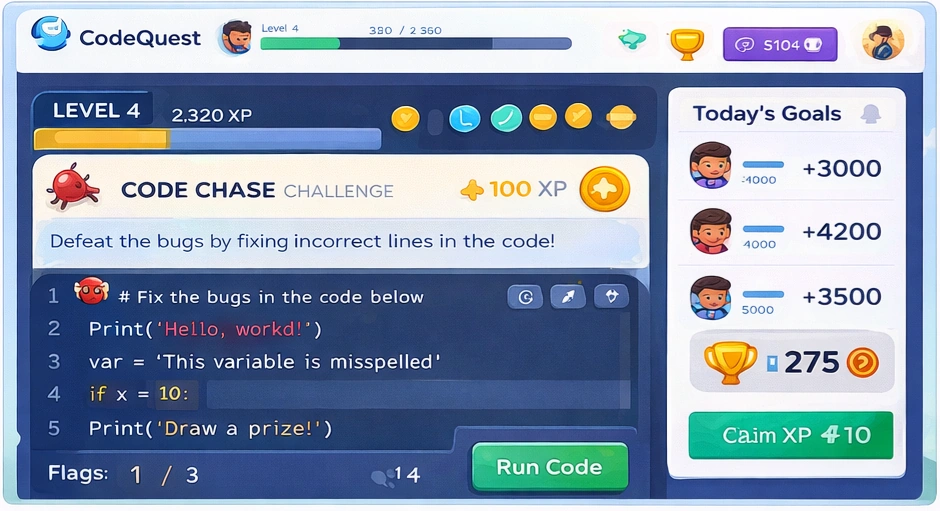
One of the core elements of gamification in Code Quest is the XP and level system. Users earn experience points by completing lessons, solving challenges, and participating in games. As XP increases, the user progresses to higher levels.
This system provides:
• Clear visibility of progress
• Motivation to complete tasks
• A structured learning path
Experience Points (XP) are a core element of gamified learning platforms. XP represents the learner’s progress and effort over time. In a platform like Code Quest, XP can be awarded for completing coding lessons, solving challenges, participating in games, and maintaining daily learning streaks.
As learners accumulate XP, they gradually move to higher levels, which creates a sense of growth and achievement. XP systems motivate learners to stay consistent, as progress is visible and measurable.
A well-designed XP structure ensures that rewards are aligned with learning objectives, encouraging both effort and skill development rather than just speed.
Badges, Streaks, and Leaderboards
Badges are awarded for specific achievements such as completing modules or maintaining learning streaks. These badges act as visual indicators of success and motivate learners to achieve more.
In Code Quest, badges help learners track their accomplishments and feel proud of their progress. Badges also promote goal-oriented learning, as learners often aim to unlock specific achievements. When displayed on user profiles or leaderboards, badges encourage healthy competition and increase engagement across the platform.
Streaks encourage daily practice, while leaderboards introduce healthy competition among users.
Game-Based Learning in Code Quest
Games play a major role in Code Quest. The platform includes mini-games such as tic-tac-toe and puzzle solving based tasks. These games help learners apply concepts in a fun and interactive manner.
It play a central role in Code Quest. Learners unlock new levels and badges as they progress, creating a sense of achievement.
Streaks and leaderboards add a competitive element, motivating learners to remain consistent. Token-based rewards give learners tangible recognition for their efforts and can be reused within the platform ecosystem, reinforcing long-term engagement.
Token-Based Reward System
Code Quest also includes a token-based reward system using Sharp Tokens. Learners earn tokens by completing lessons, games, and maintaining streaks. These tokens are stored in a wallet and serve as digital rewards.
In Code Quest, earned tokens are credited to the learner’s wallet and can be reused within the platform ecosystem. Tokens encourage long-term engagement by giving learners tangible rewards for their effort. When integrated carefully, token systems increase motivation while maintaining focus on learning outcomes rather than purely external rewards.
Psychology Behind Gamification
Gamification works because it aligns with basic human psychology. People naturally enjoy achieving goals, receiving rewards, and seeing visible progress.
In Code Quest:
• XP and levels satisfy achievement motivation
• Badges provide recognition
• Streaks support habit formation
• Leaderboards introduce social motivation.
Progress Analytics and Feedback
Tracking progress is essential in a gamified learning platform. Code Quest provides analytics that show learners their completed lessons, earned XP, streaks, and overall performance.
This feedback-driven system helps learners identify their strengths and areas for improvement, supporting continuous growth.
Conclusion
Gamification can make learning more engaging, interactive, and goal-oriented when applied thoughtfully. By combining elements such as XP, levels, badges, and challenges with practical coding tasks, learners are encouraged to practice consistently.
The Code Quest project demonstrates how gamification techniques can be applied in an educational setting through structured progression, interactive tasks, and reward mechanisms that reinforce learning.
When implemented carefully, gamification supports understanding, problem-solving skills, and long-term knowledge retention.
Future Scope
Potential enhancements to gamified learning platforms include:
AI-assisted mentoring for personalized guidance
Multiplayer and collaborative challenges
Expanded game mechanics such as adaptive difficulty
Mobile and cross-platform accessibility
Community-driven learning features such as peer discussions and shared challenges
These additions can further improve scalability and learner engagement.
Acknowledgement
This project was developed with the assistance of AI tools used for ideation and technical guidance during development.


Join the conversation! Your thoughts help the community grow.